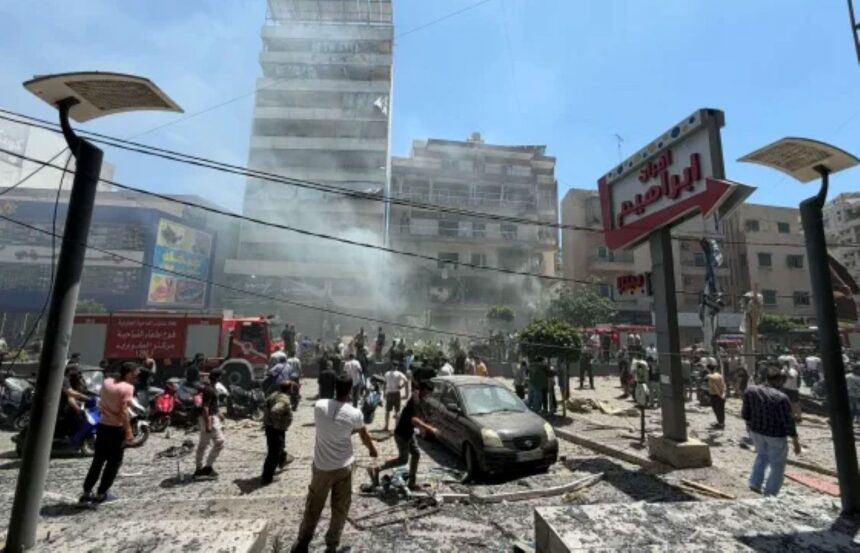
Just hours after US President Donald Trump used the global stage at the G7 Summit to reprimand Israeli military operations, Israeli fighter jets launched a fresh wave of kinetic airstrikes across southern Lebanon.
According to Lebanon’s state-run National News Agency (NNA), Israeli warplanes launched targeted strikes on Wednesday morning, hitting the strategic Nabatieh al-Fawqa zone and the outer perimeter of the neighboring village of Kfar Tebnit. While the Israel Defense Forces (IDF) have not yet issued an official comment on this specific operational cycle, Tel Aviv has repeatedly maintained that its targets are strictly confined to the infrastructure of the Iran-backed militant group, Hezbollah.
The renewed bombardment directly tests the stability of the highly sensitive US-Iran bilateral accord announced just last Sunday evening. The diplomatic blueprint, mediated behind the scenes by Pakistan, aims to bring a structural end to the regional war—and Pakistani officials have now confirmed the treaty explicitly dictates a ceasefire framework that includes Lebanon.
The aftermath of structural strikes in southern Lebanon. Source: Adri Salido / Getty Images
President Trump negotiating with global allies at the G7 Summit. Source: Anna Moneymaker / Getty Images
1. The Rhetorical Fracture: Trump Condemns “Excessive” Beirut Strike
While President Trump reassured fellow G7 leaders in Evian-les-Bains that he maintains an “excellent relationship” with Prime Minister Benjamin Netanyahu, his public and private commentary at the summit has revealed the deepest rift in US-Israeli strategic alignment seen in years.
Key Points of Contention From Trump's G7 Disclosures

 [ THE BEIRUT ESCALATION ] ──► A DIPLOMATIC THREAT
 • Trump openly condemned a recent massive Israeli airstrike on Beirut,
   stating flatly: "I didn't like that he carried out that attack... it was excessive."

 [ CRITICAL TIMING ]        ──► EMBARRASSING THE MEDIATORS
 • The Beirut strike was launched as a reprisal for a Hezbollah cross-border rocket
   salvo, nearly collapsing the US-Iran deal hours before its official unveiling.

 [ THE CASUALTY ULTIMATUM ] ──► HUMANITARIAN PRESSURE
 • Trump reiterated that Israel has been engaged in this theater for "far too long,"
   warning Netanyahu that global patience has expired because "too many people are being killed."
2. The Pakistani固定 Mediation and the Secret Lebanon Clause
Until now, the exact geopolitical scope of the US-Iran agreement remained heavily guarded. However, new disclosures from Islamabad have fundamentally changed the diplomatic calculus of the Evian summit.
The Architecture of the Pakistani-Mediated Ceasefire
┌────────────────────────────────────────────────────────────────────────┐
│                                                                        │
│  [ THE REGIONAL SCOPE ] ───────────────────────────────────────────┐   │
│  • Formal confirmation that the bilateral text is not limited to US-   │   │
│    Iranian proxies, but contains a binding sub-framework for Lebanon.  │   │
│                                                                        │   │
│  [ THE SUNDAY COLLAPSE RISK ] ─────────────────────────────────────┤   │
│  • The intense exchange of fire between the IDF and Hezbollah on       │   │
│    Sunday night nearly tore up months of delicate back-channel diplomacy.│   │
│                                                                        │   │
│  [ THE ENFORCEMENT VACUUM ] ───────────────────────────────────────┘   │
│  • Because the text remains unpublished, neither side has stopped      │
│    kinetic operations, treating the window before implementation as an  │
│    opportunity to maximize territorial gains.                           │
└────────────────────────────────────────────────────────────────────────┘
3. Strategic Gridlock: The Pre-Ceasefire Kinetic Race
The ongoing military strikes, occurring simultaneously with high-level G7 diplomacy, demonstrate a classic military phenomenon: both sides are escalating violence to secure leverage before an inevitable international shutdown.
| Geopolitical Actor | Immediate Tactical Actions | Underlying Strategic Objective |
| Israel (Netanyahu Administration) | Disregarding direct public warnings from Washington; pushing airstrikes deeper into the Nabatieh Governorate. | Degrading Capabilities: Aiming to heavily fracture Hezbollah’s launch positions and command centers before a binding legal framework forces a military freeze. |
| Hezbollah (Iran-Backed) | Continuing cross-border rocket and missile operations targeting northern Israeli defense sectors. | Defiant Deterrence: Attempting to demonstrate that Israeli air superiority has not broken its operational capacity to retaliate, preserving its position in post-war Lebanon. |
| United States (Trump Administration) | Leveraging G7 solidarity to force compliance; utilizing the US-Iran accord as a macro-stabilizer. | Regional De-escalation: Desperately trying to enforce the Pakistani-mediated text to safeguard global energy nodes and prevent an unmanageable regional war. |
The unfolding situation in southern Lebanon creates a dangerous paradox for the G7 leaders meeting in France. While diplomats celebrate a historic breakthrough with Iran, the reality on the ground in Nabatieh al-Fawqa proves that writing a treaty is only half the battle—enforcing it upon a defiant Israeli leadership and an active Hezbollah network remains a volatile, unresolved crisis.