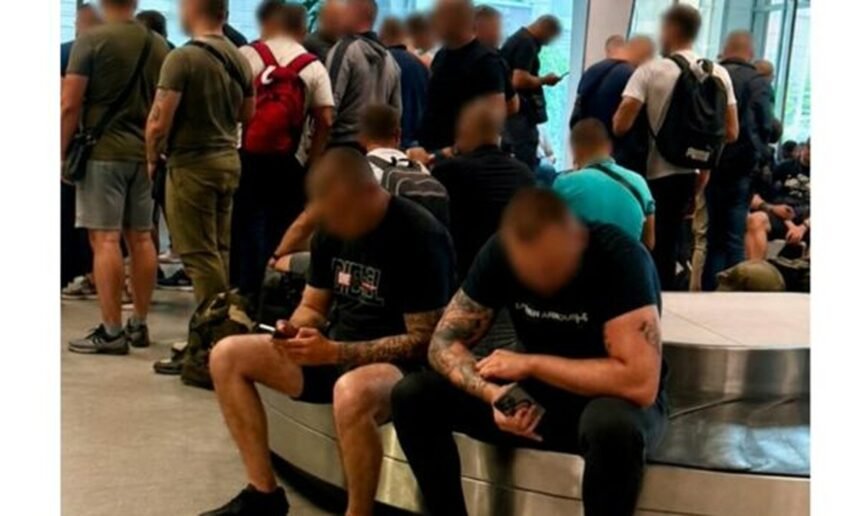
A group of Serbian citizens who were denied entry into Montenegro a few days ago were allegedly planning to organize a series of support rallies for Serbian President Aleksandar Vučić during his stay in Tivat.
According to the portal Nova.rs, the aim was to create the impression that Vučić enjoys strong support from the citizens of Montenegro as well.
While Montenegrin police announced that banners reading “Serbia Wins,” communication equipment, and two buses waiting at the airport were found in connection with the travelers, sources cited by the portal claim that the plan was far broader.
According to several sources familiar with the organization of the group’s arrival, the people who arrived on a charter flight from Belgrade were supposed to organize several “spontaneous” gatherings of support for Vučić during the summit.
The plan included appearing at various locations in Tivat and the surrounding areas, displaying banners, as well as organizing flare-lighting events and public gatherings. In this way, the goal was to create the impression that citizens of Montenegro were spontaneously offering support to the Serbian president.
According to Nova.rs sources, the goal was not only to send a message to the Serbian public but also to present Vučić as a leader who enjoys support beyond the borders of his country in front of international officials attending the EU–Western Balkans summit.
A Well-Known Method of Operation
According to information obtained by the portal, a similar model has been used before in several cities across the region, including North Macedonia.
During previous visits, activities were organized with the aim of creating the image of broad regional support for the authorities in Belgrade.
Sources emphasize that it is no coincidence that the group of 87 men arrived in Tivat two days before the summit in which the Serbian president was scheduled to participate.
It should be recalled that the group of 87 men, which arrived in Montenegro a day earlier on a charter flight, was returned to Belgrade by decision of the Montenegrin security services.
According to media reports and activists from Serbia, among them were individuals linked to violent incidents at protests and to the Serbian Progressive Party (SNS).
The incident occurred on the eve of the largest international summit in Montenegro’s history and has raised questions about whether this was a security failure, a message to European guests, or an attempt to divert attention from scandals in Serbia.
Tivat is hosting the European Union–Western Balkans summit, attended by senior regional and European leaders, including Emmanuel Macron, Friedrich Merz, Giorgia Meloni, Pedro Sánchez, António Costa, and Ursula von der Leyen.
According to the newspaper Vijesti, four Serbian citizens had arrived in Montenegro as early as June 2 in order to secure accommodation in luxury hotels in Tivat for the group that was later expelled.
The group of 87 people landed in Tivat on a charter flight operated by Air Serbia, contracted by the Happy Travel tourist agency from Bijeljina, and returned to Belgrade about five hours later.
Montenegrin security services stated that the group was denied entry because it posed a threat to national security.
According to the authorities, members of the group had participated in several public gatherings with a high security risk, while some of them had records of criminal offenses and misdemeanors involving violence.
When questioned by police about the reason for their arrival in Montenegro, members of the group refused to answer.
Many of the people returned to Serbia are described by the media, opposition politicians, and activists as SNS enforcers and operatives of Vučić’s regime.
They have been linked to the dispersal of student protests, the instigation of incidents at sporting events, and other similar activities in Serbia.
Reactions and Security Measures
The police and the National Security Agency of Montenegro confiscated banners bearing SNS slogans such as “Serbia Wins,” remote communication devices, and a marine radio station.
Two buses with Serbian license plates were also seized, which authorities suspect were intended to be used for transporting the group.
A police source told Vijesti that the flight from Belgrade had been placed under surveillance due to suspicions of “hybrid activities.”
Montenegrin Prime Minister Milojko Spajić had previously warned that the country is the target of malicious activities aimed at obstructing its European path.
Who Are the Deported Individuals?
Among those returned to Belgrade are individuals with criminal backgrounds who have for years been linked by Serbian media to activities carried out in service of the ruling structures and the SNS.
Among them are Dalibor Stanojević Boške, Aleksandar Janković known as Aca Hari, Nemanja Naračić, Stefan Kojović, and several others whom student organizations and the Serbian opposition accuse of attacks on protesters and citizens at various gatherings in Serbia.