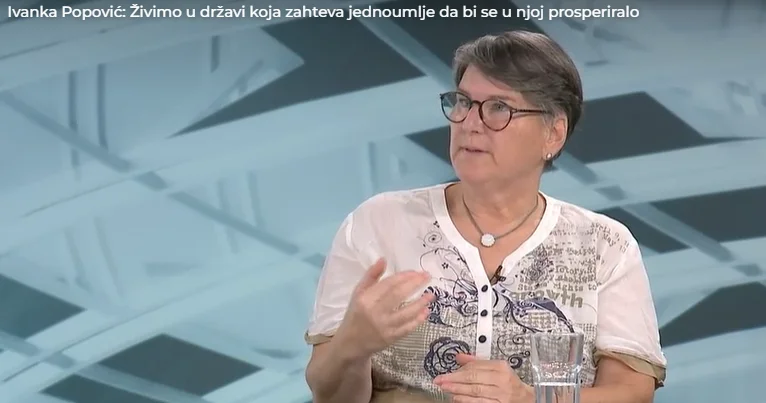
Former University of Belgrade Rector Ivanka Popović says political repression in Serbia is reaching a critical point, particularly in the education sector, and argues that upcoming elections could provide an opportunity to restore normal democratic and institutional functioning.
Popović told N1 that Serbia increasingly resembles a country where conformity is required to prosper, pointing to what she described as growing pressure on educational institutions and citizens who oppose the government.
“We are constantly witnessing this obsessive need of the authorities to satisfy only their own interests, while the needs of citizens are treated as secondary,” Popović said.
She argued that increasing pressure on those expressing disagreement with the way the state operates under the current government had been expected and was now approaching a peak.
Popović said elections, despite the likelihood that they would not be held under normal conditions, could represent an opportunity for political change.
“Elections provide an opportunity for something to change,” she said, describing the potential vote as a kind of referendum on the current state of Serbian society.
According to Popović, the issue is not primarily ideological but concerns whether citizens can return to normal democratic and civic functioning.
“If we want to live normally, we have to return to normal ways in which a state functions,” she said.
Pressure on universities
Popović said the treatment of universities reflected what she described as the authorities’ broader effort to restrict independent thinking.
She particularly criticized the situation at the Faculty of Philosophy in Niš, where employees have reportedly not received salaries after opposing the creation of a newly established Faculty of Serbian Studies.
Popović described the move as a “very perfidious” form of pressure, arguing that withholding salaries from everyone from cleaning staff and administrative employees to professors and the dean amounted to collective punishment.
She also questioned the legality of the process used to establish the new faculty, arguing that established procedures had been bypassed, including the role of the National Council for Higher Education.
“This is literally a punitive expedition against an institution, punishing people who have no influence over those decisions,” Popović said.
She warned that while some academic staff might be able to withstand several months without salaries, other employees could quickly face serious financial hardship.
Popović said the consequences could extend well beyond the immediate dispute, warning of long-term damage to Serbia’s education system and a loss of trust between state authorities and educational institutions.
Criticism of universities and knowledge
Popović also accused government officials of contributing to what she called the devaluation of knowledge and higher education.
She said developments in Serbia’s education system over the past several years had been “anything but stimulating,” arguing that pressure on universities could produce consequences that would remain after the current government leaves office.
“This is a form of the authorities exercising power over a part of the population that they see as not supporting them sufficiently,” she said.
Popović argued that the broader effect was the creation of an increasingly anti-intellectual environment in which independent thought and open debate were being restricted.
Debate over the role of the Church
Popović also criticized Education Minister Dejan Vuk Stanković’s proposal for a greater role for the Serbian Orthodox Church in education.
She described the proposal as unusual given that Serbia is constitutionally a secular state, while stressing that freedom of religion should not be questioned.
Popović said religious organizations could participate in establishing educational institutions where legally permitted and where citizens choose such institutions, but argued that the distinction between religious and state education must remain clear.
She also raised concerns about proposed changes to legislation governing churches and religious organizations, particularly provisions that could provide greater flexibility in the management and financing of educational institutions in which the Church is a founder or co-founder.
Student Parliament elections
Popović also addressed elections for student parliaments, arguing that the current system could be used to restrict political and organizational pluralism at universities.
She said the original purpose of student parliaments was to enable students to elect representatives and participate in decisions concerning student interests and the development of their institutions.
However, she argued that established student parliaments can now influence which organizations are recognized as registered student organizations, potentially preventing competition and limiting the number of voices represented on campuses.
According to Popović, university administrations can also play a role in the process, further weakening opportunities for pluralism.
She described this as another manifestation of what she considers systematic pressure on universities and a broader attempt to suppress free thought and open discussion.
Popović said Serbia needs a critical mass of citizens willing to engage in public life and work toward restoring institutions that function normally.
“The elections that are coming primarily represent an opportunity for us to return to normal forms of functioning,” she said.