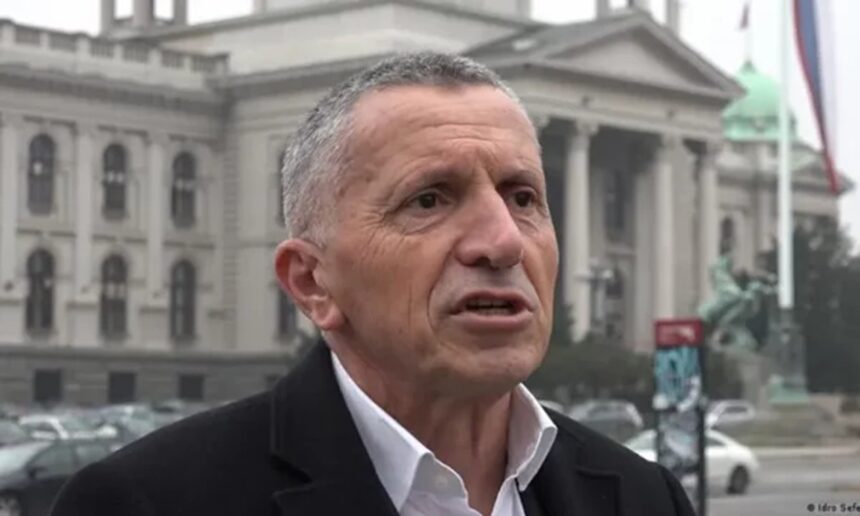
Shaip Kamberi, head of the “Albanian Coalition” electoral list, says the alliance of eight political entities aims to maximise the Albanian vote, while diaspora participation could prove decisive in increasing the number of parliamentary seats.
Ahead of Serbia’s parliamentary elections on October 25, the “Albanian Coalition” is entering the race with the aim of restoring stronger Albanian representation in the Serbian Parliament.
Speaking to albinfo.ch, Shaip Kamberi, head of the coalition’s electoral list, said the decision to unite eight Albanian political entities followed the experience of previous elections, when the division of votes significantly weakened Albanian political representation.
“Common sense prevailed, and we decided to set aside our local differences and focus on what unites us,” Kamberi told albinfo.ch.
According to him, the joint electoral bid has a clear objective: to strengthen the Albanian vote and increase the number of Albanian MPs.
“This time, eight Albanian political parties are united, and our aim is to maximise our vote. We are hoping to win three seats in these elections,” Kamberi said.
He believes the Albanian electorate has the potential to secure as many as four parliamentary seats, but reaching that figure depends in part on the diaspora.
“Albanians in the Preševo Valley and across Serbia have the potential to win four seats. However, there is no established procedure or tradition that enables our diaspora to participate,” he said.
Kamberi noted that the timing of the elections presents an additional obstacle, as many Albanians living abroad are not in their hometowns when voting takes place.
For this reason, diaspora participation remains a factor that could directly influence the coalition’s final electoral result.
Asked whether the coalition had launched a broader campaign to mobilise the diaspora ahead of the October 25 elections, Kamberi said that, so far, contacts had largely been informal and conducted with individuals.
“We have not yet established more extensive contacts. We have spoken with individuals, but not with organisations. In the coming days, we will explore the possibility of holding discussions with them as well,” he said.
For Kamberi, diaspora members returning home to vote should not be seen merely as an electoral mobilisation effort. He links their participation to the broader need for Albanians to have a more visible presence in Serbia’s institutions.
“Albanians are coming to strengthen their own political representation and to make their presence visible,” Kamberi told albinfo.ch.
He stressed that the number of votes and parliamentary seats directly affects the ability to raise issues concerning Albanians in Presheva, Bujanoc and Medvegja. These include the use of the Albanian language, national symbols, proportional representation in state institutions, the recognition of diplomas and the practice of administrative address deregistration, known as address passivisation.
For Kamberi, the October 25 elections are a test not only of unity among Albanian political forces, but also of their ability to translate the Albanian vote into concrete parliamentary representation.
In this equation, the diaspora remains a significant source of electoral potential one that has yet to be fully mobilised.
With just three days remaining until election day, voters will head to the polls on October 25. The Albanian Coalition hopes to turn the unity of eight political entities and the mobilisation of Albanian voters, including those from the diaspora, into stronger representation in Serbia’s Parliament.