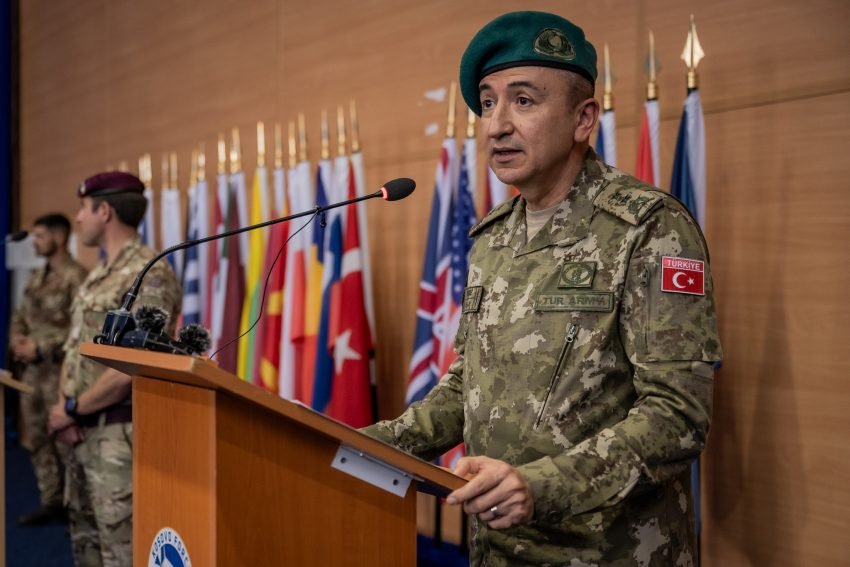
The Commander of NATO’s peacekeeping mission in Kosovo (KFOR), Major General Özkan Ulutaş, informed NATO ambassadors on Wednesday that while Kosovo has remained generally calm since October 2025, the security landscape remains “fragile” with a high potential for renewed friction in the north.
Speaking at a high-level meeting with NATO members and partner nations in Brussels on April 29, 2026, the Turkish Major General provided a candid assessment of the risks facing the region nearly three years after the peak of civil unrest.
A Fragile Calm: The Legacy of 2023
General Ulutaş noted that the mission has successfully prevented a repeat of the large-scale violence seen in 2023. However, he cautioned that the underlying drivers of conflict have not been resolved.
- Absence of Violence: “We have not seen a recurrence of the violence we witnessed in 2023,” Ulutaş stated. “Nevertheless, the situation remains fragile, with the potential for new tensions, especially in northern Kosovo.”
- The Shadow of Banjska: The commander’s briefing alluded to the 2023 attacks in Banjska, where an armed Serbian group killed Kosovo Police Sergeant Afrim Bunjaku. The incident remains a central point of friction, with NATO Secretary General Mark Rutte recently reiterating that the alliance still expects Serbia to ensure full accountability for the perpetrators.
Diplomacy vs. Violence: The NATO Mandate
Ulutaş emphasized that KFOR’s military presence is a stabilizer, not a solution. He underscored that the path to long-term peace is strictly political.
“The road to long-lasting peace is political, not military. Stability ultimately depends on all parties choosing diplomacy over violence,” Ulutaş told the ambassadors.
Key Institutional Stances:
- Support for Dialogue: NATO continues to offer full backing to the EU-mediated dialogue between Prishtina and Belgrade.
- Urgent Need for Solutions: The General cited an “urgent need for a long-term political solution” to move beyond the current cycle of “crisis management.”
The Diplomatic Deadlock
The Commander’s warning comes amid a prolonged diplomatic vacuum. There has been no high-level political meeting between Kosovo Prime Minister Albin Kurti and Serbian President Aleksandar Vučić since September 2023—a meeting that took place just days before the Banjska attack.
Current Security Dynamics (April 2026):
| Factor | Current Status | Impact on Stability |
| KFOR Presence | Increased/Reinforced | High deterrence against paramilitary incursions. |
| EU Dialogue | Stalled at High Level | Prevents implementation of past agreements. |
| Northern Municipalities | Contested Legality | Local administrative friction remains high. |
| Justice for Banjska | Pending Accountability | Remains a primary source of mistrust between parties. |
As Kosovo approaches extraordinary elections in June 2026, KFOR remains on high alert. General Ulutaş reaffirmed that the mission will maintain its third-responder status (after Kosovo Police and EULEX) but remains ready to intervene should the “fragile” stability be threatened.