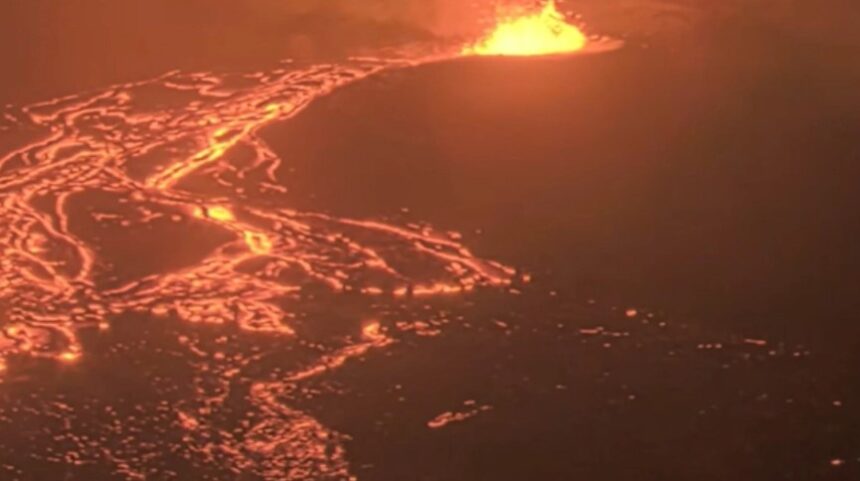
Hawaii’s highly volatile Kilauea volcano has re-entered an active eruptive state, prompting scientists to elevate monitoring protocols as massive fountains of molten rock break through the surface.
According to official advisories from the United States Geological Survey (USGS) and the Hawaiian Volcano Observatory (HVO), the volcano’s internal activity rapidly escalated over the weekend, leading to a surge of high-intensity lava fountains and sluggish overflows concentrated within the summit caldera.
Eruptive Progression and Volcanic Fountaining
The latest activity marks Episode 48 of Kilauea’s ongoing, highly episodic eruption cycle inside the Halemaʻumaʻu crater. Following a series of localized spatter explosions and deep seismic tremor shifts, precursory lava overflows officially breached the volcano’s south vent.
Geologists tracking the phenomenon expect the main lava fountaining phase to peak in intensity around June 1, 2026.
Hazard Analysis and Public Alerts
In response to the sudden surface breach and a sharp rise in volcanic gas emissions, the USGS officially raised the Volcano Alert Level to WATCH and adjusted the Aviation Color Code to ORANGE.
Because the eruption is completely confined within a closed, restricted section of Hawaiʻi Volcanoes National Park, authorities confirm there is no immediate threat to residential structures or down-slope infrastructure. However, the event has triggered localized air quality and environmental warnings:
- Vog (Volcanic Air Pollution): The vents are releasing massive volumes of water vapor, carbon dioxide ($CO_2$), and sulfur dioxide ($SO_2$). The $SO_2$ is interacting with sunlight and atmospheric moisture to generate thick plumes of “vog,” which winds are carrying downwind, prompting health warnings for individuals with pre-existing respiratory conditions.
- Tephra and Pele’s Hair: Intense fountaining is ejecting lightweight volcanic glass fragments, ash, and fine threads of volcanic glass known as “Pele’s hair” into the atmosphere. The National Weather Service (NWS) has issued a special weather statement warning neighboring communities to the southwest and northeast of potential light ashfall.
Live Digital Monitoring
To accommodate immense public and scientific interest without compromising physical safety, the USGS is utilizing an array of high-definition thermal and optical cameras to livestream the entire geological event.
The real-time digital broadcasts allow global researchers and the public to monitor the generation of lava channels, crater wall fractures, and gas-pistoning seismic events minute by minute as Kilauea continues to reshape the landscape of Hawaii’s Big Island.