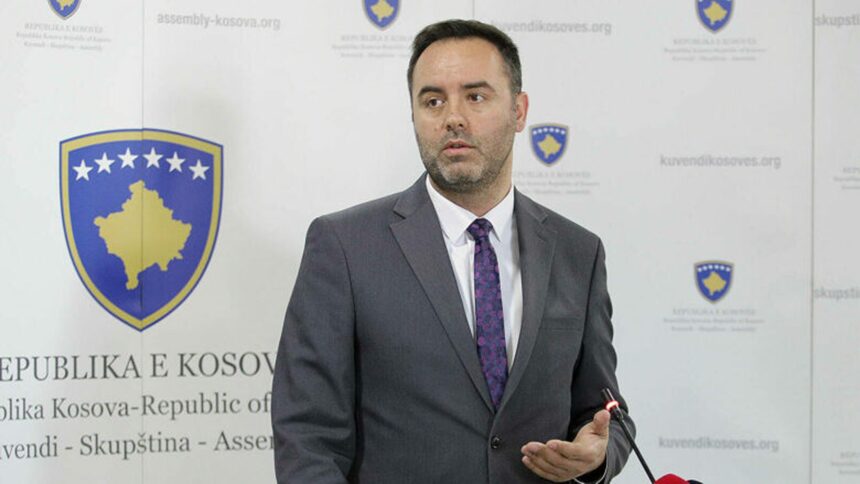
Kosovo’s Minister of Foreign Affairs, Glauk Konjufca, reacted in a post on “X” regarding the honoring of war criminal Ratko Mladić after his death. Konjufca described the action of the official authorities in Belgrade as an act of deep moral and political shame.
He wrote that Serbia’s decision to honor a figure whose crimes were described by an international court as among the most heinous against humanity demonstrates a deep political continuity with the regime of the 1990s.
According to him, for the Republic of Kosovo this is not an abstract historical debate, as the people of Kosovo still carry the memory of massacres, mass expulsions and systematic violence carried out by Serbian forces. He rejected any attempt to transform crimes established by a court into matters of national interpretation.
Konjufca expressed his full solidarity with the Bosniak people, the victims and survivors of Srebrenica, stressing that they can never reconcile themselves with the glorification of those responsible for these crimes.
Full reaction:
Honoring a convicted war criminal, whose crimes were described by an international court as “among the most heinous known to humanity,” is an act of deep moral and political shame. The military honors given to Ratko Mladić, together with the participation of ministers of the caretaker government in honoring him, constitute an act of institutional glorification of a man convicted of genocide.
This is the choice that Belgrade made today. This choice also speaks to a deeper political continuity. Serbia is today led by Aleksandar Vučić, who served as Minister of Information in Milošević’s regime.
Decades later, the Serbian state continues to legitimize figures and narratives rooted in the same policy of ethnic cleansing, territorial expansion and mass atrocities that devastated our region in the 1990s. Honoring Mladić through state institutions shows how much of that political legacy Serbia still refuses to confront. For the Republic of Kosovo, this is not an abstract debate about history.
Our people carry the memory of massacres, civilians and children killed, mass expulsions and systematic violence carried out by Serbian state forces. Therefore, we unequivocally reject any attempt to transform crimes established judicially into matters of national interpretation, or convicted perpetrators into figures worthy of honor.
Genocide does not acquire another meaning with the passage of time, and denial cannot erase the dignity of those who were killed, persecuted and expelled. We stand with the Bosniak people, with the victims and survivors of Srebrenica, and with all families whose suffering can never be reconciled with the glorification of those responsible for it.
There can be no genuine reconciliation without the truth, nor any credible European future built on honoring the perpetrators of crimes that shocked the conscience of humanity.