The European Parliament’s Foreign Affairs Committee (AFET) is set to vote this afternoon on a significantly expanded and hardened draft resolution on Serbia. The compromised text, leaked to media networks, portrays an institutional gridlock, targeting Belgrade’s electoral irregularities, Russian intelligence ties, and controversial new judicial laws.
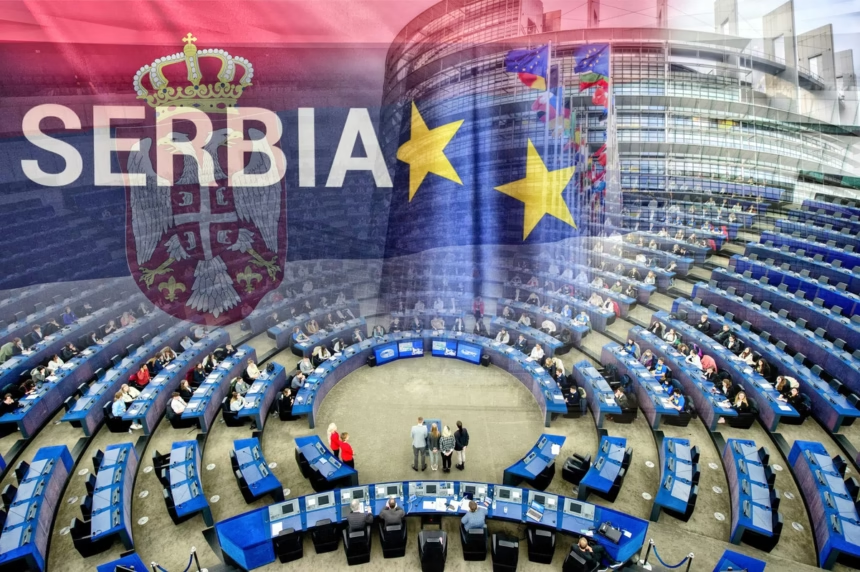
The European Parliament’s Foreign Affairs Committee (AFET) is scheduled to vote this afternoon on the final version of the Report on Serbia, compiled by Rapporteur Tonino Picula.
The harmonized text—which includes a series of newly integrated “compromise amendments”—presents a drastically harsher and more detailed critique of Belgrade than the initial draft made public on March 17.
The baseline assessment remains unyielding: Serbia’s accession progress toward European Union membership has ground to a complete halt. However, rather than smoothing over diplomatic cracks, the final text systematically documents a laundry list of democratic backsliding, state-sponsored crackdowns, and geopolitical double-dealing.
Accession Declared ‘Reversible’ Amid Funding Freeze Threats
The text explicitly reminds Belgrade that the enlargement framework is not a one-way street, characterising the integration process as strictly merit-based and inherently “reversible.”
MEPs sharply criticize the growing chasm between Serbia’s nominal alignment with EU laws on paper and its actual implementation on the ground. Crucially, the document highlights that obligations from the November 2024 non-paper—vital for unlocking Cluster 3 negotiations—remain completely unfulfilled.
Consequently, the European Parliament formally demands that the European Commission directly tie the scale and speed of financial support to the country’s democratic performance.QA21
Institutional Crisis, Protests, and ‘Electoral Fraud’
The report dives deep into the domestic political crisis gripping Serbia since late 2024, explicitly validating the continuous mass street demonstrations:
- Public Unrest: The text recognizes ongoing citizen and student protests since November 2024 as a legitimate reaction against systemic corruption and institutional opacity.
- Mission Findings: Citing an internal EP fact-finding mission to Belgrade in January, the report blames the crisis on severe societal polarization, a paralyzed parliamentary dialogue, and a collapse of public trust in state machinery.
- Electoral Violations: The draft strongly condemns the atmosphere surrounding local elections held on March 29, 2026, across ten municipalities. It documents violent incidents, parallel voter registries, vote-buying, voter-busing from external cities, and coordinated raids on opposition headquarters.
The Novi Sad Disaster and the Controversial ‘Mrdić Laws’
In a sharp blow to Belgrade’s domestic judicial narrative, the European Parliament heavily sharpens its language regarding the fatal canopy collapse at the Novi Sad railway station. The text expresses deep alarm over the stagnation of the investigation, explicitly citing official contradictions, potential negligence, evidence tampering, and illicit political pressure exerted on prosecutors.
Simultaneously, the report singles out a controversial set of judicial statutes pushed through on January 28, 2026.
┌────────────────────────────────────────────────────────────────────────┐
│               The 'Mrdić Laws' Judicial Crisis: Jan 2026               │
├────────────────────────────────────────────────────────────────────────┤
│  CRITIQUE 1: Procedural Violations                                     │
│  Passed under an urgent, fast-track procedure completely bypassing     │
│  public debate and independent judicial consultation.                  │
├────────────────────────────────────────────────────────────────────────┤
│  CRITIQUE 2: Executive Encroachment                                    │
│  Severely guts the institutional independence of courts and neutralizes │
│  prosecutorial autonomy.                                               │
├────────────────────────────────────────────────────────────────────────┤
│  CRITIQUE 3: Purging Anti-Corruption Units                             │
│  Directly resulted in the removal of key organized crime prosecutors,  │
│  nullifying constitutional reforms achieved in 2022.                   │
└────────────────────────────────────────────────────────────────────────┘
Russian Spyware, Huawei Face-Recognition, and Retaliation
The report dedicates extensive new subsections to what it characterizes as state-sponsored digital repression against critics:
- Illicit Surveillance: MEPs cite documented reports of military-grade spyware—including Pegasus—deployed against independent journalists and civil activists.
- Chinese Tech & Russian Procurement: The report flags Belgrade’s “Safe City” project powered by Huawei facial-recognition technology. Shockingly, it notes that pre-accession EU funds were allegedly diverted to buy biometric software from a sanctioned Russian firm.
- State-Backed Thugs: The document demands immediate investigations into police brutality and condemns the use of informal, pro-regime vigilante groups who attack peaceful demonstrators with total impunity.
Geopolitical Hedging and the ‘Serbian World’ Concept
In the sphere of foreign policy, where Serbia maintains one of the lowest EU alignment rates among all candidate states, the European Parliament pulled no punches regarding Belgrade’s tight alignment with Moscow and Beijing.
The document demands the immediate closure of the Russian-Serbian Humanitarian Center in Niš, flatly designating it an active operational base for Russia’s military intelligence service (GRU). It further condemns Belgrade’s ongoing acquisition of Chinese heavy weaponry and surveillance infrastructure.
Escalation in Kosovo Dialogue
The report sets down absolute parameters regarding regional normalization. It demands unconditional cooperation in bringing the perpetrators of the 2023 Banjska attack to justice, specifically calling out Serbia’s failure to prosecute paramilitary leader Milan Radoičić. Furthermore, it logs a formal condemnation of the sabotage attack on the vital Ibar-Lepenac canal in northern Kosovo in November 2024.
The European Parliament warns that EU integration is structurally incompatible with the ethno-nationalist ideology of the “Serbian World” (Srpski svet), which it classifies as an explicit threat to regional peace and stability.
Demanding an Immediate Freeze on EU Funds
The report concludes with an aggressive financial warning. While expressing deep concern over the European Commission’s decision to greenlight a preliminary financial release to Serbia under the Western Balkans Growth Plan in January 2026, the text demands that all subsequent funding passing directly through the Serbian government be immediately suspended.
The position of the European Parliament is clear: no further European taxpayer money should flow to Belgrade until a credible, verified reversal of its autocratic drift is achieved.
Next Steps in Strasbourg
Following its expected adoption by the AFET committee today, the text will be elevated to an official European Parliament Resolution. MEPs are scheduled to hold a plenary debate on the file on July 6, with a final, binding vote set to take place in Strasbourg on July 7.