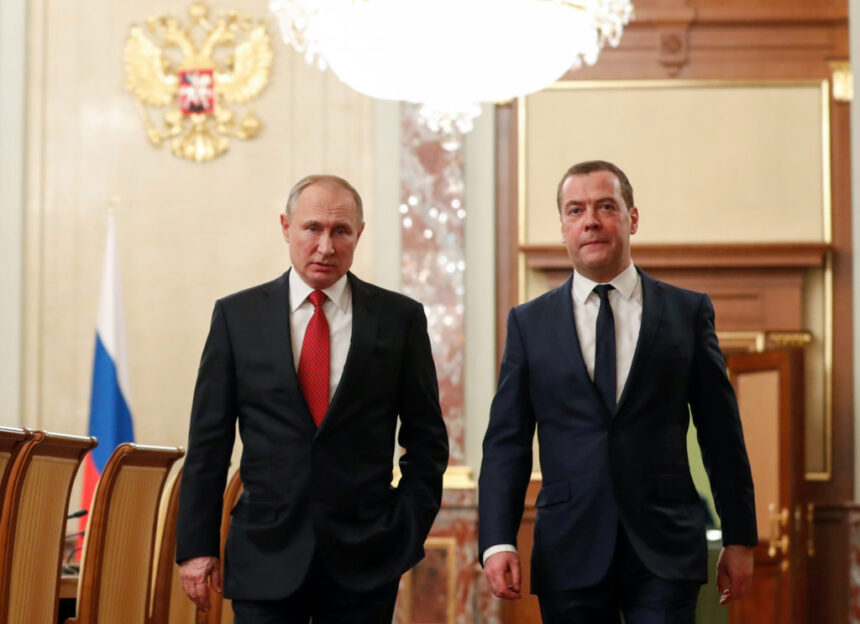
Russian Security Council Deputy Chairman Dmitry Medvedev has once again invoked Kosovo as part of Moscow’s narrative about alleged Western “double standards,” arguing that Western countries recognized Kosovo’s independence while refusing to recognize Abkhazia and South Ossetia as independent states.
Medvedev made the comparison while discussing Russia’s relations with the West, presenting Kosovo as evidence of what he described as Western hypocrisy.
However, the comparison overlooks significant differences in the historical, political and legal circumstances surrounding Kosovo, Abkhazia and South Ossetia.
ICJ ruling challenges Moscow’s interpretation of Kosovo
One of the most significant elements absent from Medvedev’s argument is the 2010 advisory opinion of the International Court of Justice (ICJ).
In response to a question from the UN General Assembly, the ICJ concluded that Kosovo’s declaration of independence of February 17, 2008, did not violate international law.
The court also found that the declaration did not violate UN Security Council Resolution 1244 or the constitutional framework established during the international administration of Kosovo.
The ruling did not establish that every separatist territory automatically has a right to independence. However, it did conclude that Kosovo’s declaration of independence, in itself, was not contrary to international law.
Kosovo is not a direct equivalent of Abkhazia and South Ossetia
Medvedev’s argument presents a simplified equation: Kosovo declared independence, Abkhazia and South Ossetia did the same, and Western countries recognized Kosovo while rejecting the independence claims of the two Georgian regions.
The circumstances surrounding the Georgian territories, however, are substantially different.
Russia recognized Abkhazia and South Ossetia as independent states on August 26, 2008, following the Russia-Georgia war. The European Union continues to support Georgia’s territorial integrity within its internationally recognized borders and considers Russia’s military presence in the regions contrary to international law.
The issue, therefore, is not simply which territories have been recognized and by whom. It also concerns the circumstances in which territorial status was changed, the role of military force and the consequences for the territorial integrity of another sovereign state.
“Double standards” as a political argument
Medvedev’s use of the “double standards” argument reflects a broader form of whataboutism: instead of addressing the legal and political basis of Russia’s policy toward Georgia, the focus is shifted toward Western policy on Kosovo.
The underlying argument is straightforward: if Western countries recognized Kosovo, they supposedly have no grounds to criticize Russia for recognizing Abkhazia and South Ossetia.
But the fact that two cases can be compared politically does not make them identical from a historical or legal perspective.
For that reason, invoking Kosovo without addressing the ICJ’s 2010 opinion presents only part of the relevant legal context. The court specifically concluded that Kosovo’s declaration of independence did not violate international law.
Moscow’s policy toward Georgia remains disputed
Russia’s recognition of Abkhazia and South Ossetia did not settle the international dispute over their status.
The European Union continues to support Georgia’s territorial integrity and has repeatedly criticized Russia’s military presence in the two regions, as well as steps aimed at their further integration into Russian political and institutional structures.
Against that backdrop, Medvedev’s claim that the West simply refuses to “accept reality” is not a neutral description of the dispute but part of a broader Russian political narrative.
From Kosovo to Ukraine: A broader Russian narrative
Medvedev’s reference to Kosovo is also significant because it is part of a wider argument frequently used by Russian officials to challenge Western criticism of Moscow’s actions in other countries.
In this narrative, Russia presents itself as responding to alleged Western aggression, while territorial changes supported by Moscow are portrayed as expressions of self-determination.
The approach shifts the focus away from questions surrounding military intervention and territorial change and toward accusations that Western governments are hypocritical.
That makes Kosovo a particularly useful political reference for Moscow.
Conclusion
Medvedev’s claim that Kosovo demonstrates Western “double standards” relies on a selective presentation of the relevant facts. It places Kosovo, Abkhazia and South Ossetia into the same framework despite significant differences in their historical, political and legal circumstances.
A key fact omitted from his argument is the 2010 ICJ advisory opinion, which concluded that Kosovo’s declaration of independence did not violate international law.
At the same time, the EU continues to support Georgia’s territorial integrity and considers Russia’s military presence in Abkhazia and South Ossetia inconsistent with international law.
Medvedev’s invocation of Kosovo therefore serves less as a neutral legal comparison than as a political tool for challenging Western criticism of Russia’s policies toward Georgia and other disputed territories.