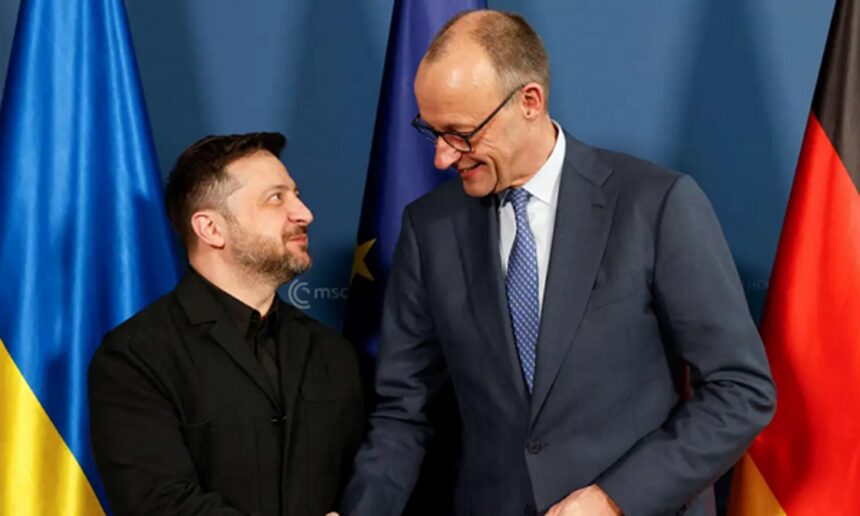
German Chancellor Friedrich Merz has proposed granting Ukraine a temporary form of European Union membership without voting rights, while still supporting its eventual full membership.
Merz suggested that Ukraine could become an “associate member” of the EU as a way to bring it closer to the bloc before completing the full accession process.
Ukraine is seeking to join the EU as part of its effort to strengthen security and prosperity while fighting against Russian forces occupying its territory, especially as the United States has so far rejected the idea of its NATO membership.
What did Merz propose?
In a letter addressed to EU leaders Ursula von der Leyen and Antonio Costa, seen by news agencies on Thursday, the German leader proposed allowing Ukrainian officials to participate in EU summits and ministerial meetings, but without voting rights.
A “reversibility mechanism”
Merz also suggested that any such arrangement could include a “reversibility mechanism” that would suspend Ukraine’s associate membership if Kyiv violates rule-of-law standards required for full EU accession.
“My proposal reflects the special situation of Ukraine, a country at war. It would help facilitate ongoing peace talks as part of a negotiated settlement,” Merz wrote.
He added that this is “essential not only for Ukraine, but for the security of the entire continent.”
Merz said he intends to discuss the idea with other European leaders, aiming to quickly establish a dedicated task force to work out the details.
Possible skepticism in the EU and Ukraine
The proposal may face skepticism from both EU partners and Ukraine itself, which fears that such temporary arrangements could leave it in a prolonged state of uncertainty without a clear path to full membership.
Long EU accession process
Although 2027 was suggested as a possible accession date in a 20-point peace plan discussed by the US, Ukraine, and Russia, European officials believe full membership is unlikely in the coming years.
EU accession is typically a long process requiring countries to meet strict democratic and economic standards.
All 27 EU member states must approve and ratify any new accession, adding further obstacles.
Ukraine’s progress was previously slowed by former Hungarian Prime Minister Viktor Orbán, although his successor Péter Magyar has raised hopes of renewed momentum.