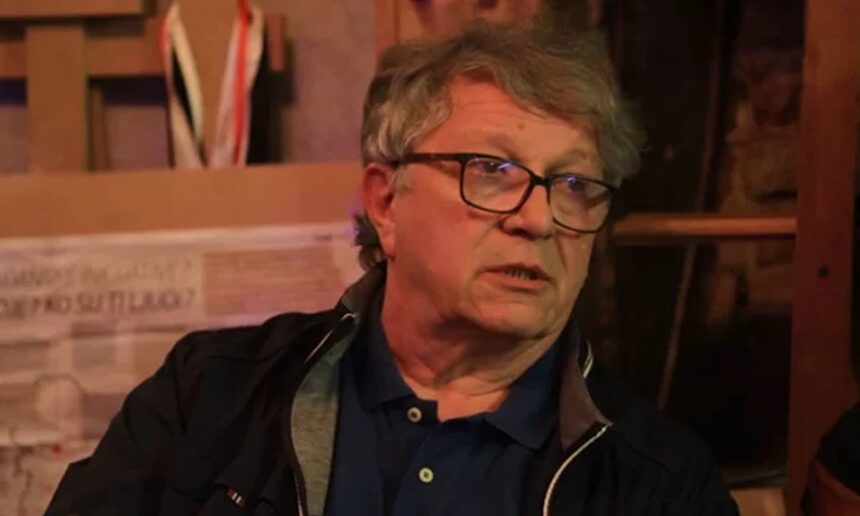
Belgrade-based journalist and writer Rade Radovanović says the denial of crimes committed during the wars of the 1990s remains one of the major problems facing Serbian society.
In an interview with RTKLive, Radovanović, author of Laughter Under the Rope, spoke about the crimes committed in Kosovo in 1999, the transfer of Albanian civilian bodies to Serbia, mass graves, and the way these events continue to be relativized and denied in Serbia.
Referring to the regime of Slobodan Milošević, Radovanović says that after crimes were committed against Albanian civilians, a process began to conceal the evidence.
“‘No body, no crime,’ Milošević told his associates, after which refrigerated trucks carrying the bodies of Albanian civilians began moving, followed by mass graves and then the restoration of the terrain,” he said.
According to Radovanović, the strategy was direct and responsibility, in his view, went all the way to Milošević himself.
“Personally. Operationally, Interior Minister Vlajko Stojiljković was in charge of it,” he said, adding that the objective was to move the bodies of Albanian civilians killed in Kosovo to mass graves in Serbia in order to conceal the crimes.
Radovanović also referred to the discovery of a refrigerated truck near Kladovo on April 5, 1999, in which, according to him, the bodies of 83 Albanian civilians were found.
He linked this to what he described as the continued denial of crimes within Serbian society.
“For some people, documents, facts about crimes and concrete deeds mean nothing; to everything they see and hear, they respond briefly: ‘Yes, and so what?!’ And they move on,” Radovanović said.
He argued that the victims of Milošević’s policies had been systematically dehumanized through propaganda for years.
“For the past thirty years, before they were killed, the victims of Slobodan Milošević’s criminal policy were publicly, constantly and systematically dehumanized,” he said.
Radovanović also criticized the lack of response from Serbian institutions following the discovery of mass graves containing the bodies of Albanians killed during the Kosovo war.
“There was none, which is to be expected. The news was published by several independent media outlets in Serbia, but that was it. Mass graves and the crimes committed by Serbian forces during the wars of the 1990s have not been news in Serbia for years,” he said.
He said the issue of missing persons and the lack of cooperation between Prishtina and Belgrade remain another major problem.
According to him, around 1,700 Serbs and no fewer than 2,000 Albanians are considered missing, while the search for their remains is hampered by the lack of cooperation.
“The entire story of the missing is a sad testimony to our ethical and civilizational attitude toward the people who lost their lives in the wars and conflicts of the Balkans in the 1990s,” Radovanović said.
The “Serbian World” and the continuation of old nationalist ideas
Speaking about Serbia’s policies toward Kosovo and the region, Radovanović said the idea of a “Greater Serbia” continues to exist among Serbian nationalists.
“You don’t understand. This question isn’t even asked. Among Serbian nationalists, the idea of a ‘Greater Serbia’ survives despite everything. Thanks to Aleksandar Vulin and Russian influence, it has recently been translated into the idea of the ‘Serbian world’ as part of the ‘Russian world,’” he said.
He linked the concept to nationalist ideas that developed decades ago and also referred to the slogan “Next year in Prizren,” which he said continues to be repeated by Serbian nationalist circles.
“Nationalists continue to dream their imperial dreams. ‘Next year in Prizren,’ they repeat,” Radovanović said.
He views the denial of crimes and glorification of figures convicted of war crimes as part of a broader problem within Serbian society.
Radovanović also challenged figures that, according to him, are used in Serbia to portray the number of victims of NATO’s bombing campaign.
At the same time, he cited data from five non-governmental organizations stating that 13,535 people were killed or went missing during the Kosovo war, including 10,812 Albanians, 2,197 Serbs and 526 members of other communities.
Radovanović said such data should serve as a basis for confronting the past rather than political manipulation.
Despite the painful subjects addressed in his book, Radovanović said he does not regret publishing it.
“I believe it is important that the truth, which is currently Serbia’s number one enemy in the ethical and historical sense, finds its way to the public,” he concluded.