Twenty-six years after the execution of 42 Albanian civilians shook the world and triggered NATO’s intervention, Kosovo prosecutors have officially indicted 21 high-ranking Serbian military and police officials, building a watertight case through international war crimes archives.
The Special Prosecution Office of the Republic of Kosovo (PSRK) has launched a momentous judicial operation, filing a comprehensive indictment against 21 former Serbian military, police, and paramilitary leaders accused of orchestrating the Reçak Massacre.
The legal document, officially compiled by Special Prosecutor Ilir Morina, moves forward with a mandate for an in-absentia trial. It marks the most aggressive domestic attempt to date to hold the architects of the January 15, 1999 atrocity legally accountable.
The state’s case builds directly upon physical evidence, open-source intelligence, and extensive classified dossiers transferred from the archives of the International Criminal Tribunal for the former Yugoslavia (ICTY) in The Hague. The Special Prosecution asserts that the legal thresholds required to try the fugitives in absentia have been completely fulfilled.
The Rogues’ Gallery: High-Profile Defendants Indicted
The 21 indicted individuals span the entire operational chain of command of the Yugoslav Army (VJ) and the Serbian Ministry of Internal Affairs (MUP) who deployed tactical units to the municipality of Shtime. The primary defendants named in the indictment include:
- Obrad Stevanović (Former Assistant Minister of Internal Affairs / Police Colonel General)
- Radomir Marković (Former Chief of Serbia’s State Security Service – RDB)
- Goran “Guri” Radosavljević (Former Commander of the Serbian MUP Special Police Units – PJP)
- Krsman Jelić (Former Commander of the Yugoslav Army’s 243rd Mechanized Brigade)
The remaining co-conspirators charged with executing the field-level massacre are Zhivko Trajkoviq, Bogoljub Janiqeviq, Milan Leçiq, Radomir Mitiq, Dragan Gjorgoviq, Branko Mladenoviq, Dragan Jasoviq, Momqilo Sparavalo, Darko Amanoviq, Srboljub Vujnoviq, Bozhidar Marinkoviq, Zoran Stanojeviq, Milan Josanoviq, Goran Petkoviq, Dragoslav Nikoliq, Çedomir Aksiq, and Zvonimir Janiqijeviq.
Star-Studded International Witness Cadre
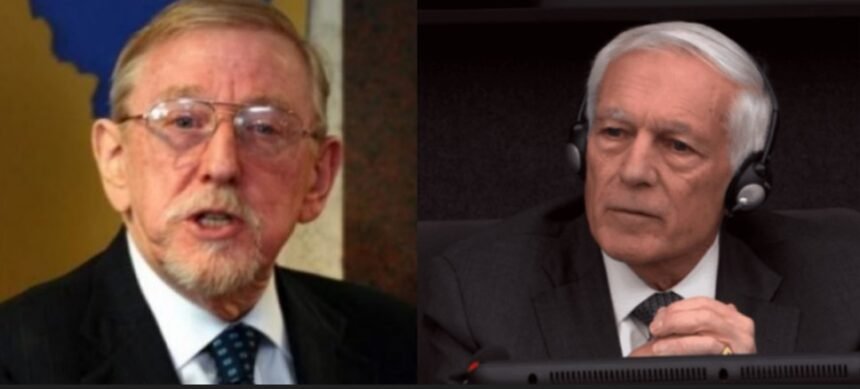
To fortify the prosecution’s case before the Basic Court of Prishtina, Prosecutor Morina has proposed the testimonies of 52 direct victims and survivors, alongside seven pivotal expert and international oversight witnesses whose findings fundamentally altered global foreign policy in 1999.
┌────────────────────────────────────────────────────────────────────────┐
│               Reçak Indictment: Star International Witnesses           │
├───────────────────────┬────────────────────────────────────────────────┤
│ WITNESS               │ HISTORICAL ROLE & EVIDENCE MANDATE             │
├───────────────────────┼────────────────────────────────────────────────┤
│ Amb. William Walker   │ Former Head of the OSCE Kosovo Verification    │
│                       │ Mission (KVM); first responder to the scene.   │
├───────────────────────┼────────────────────────────────────────────────┤
│ Gen. Wesley Clark     │ Former NATO Supreme Allied Commander Europe;   │
│                       │ will testify on the military chain of command. │
├───────────────────────┼────────────────────────────────────────────────┤
│ Dr. Helena Ranta      │ Renowned Finnish forensic dentist who led the  │
│                       │ EU independent forensic investigation.         │
├───────────────────────┼────────────────────────────────────────────────┤
│ Flamur Blakaj         │ Kosovan forensic expert handling localized     │
│                       │ exhumation and trauma documentation.           │
└───────────────────────┴────────────────────────────────────────────────┘
The indictment concludes with a harrowing log naming the 42 executed civilians, supplemented by an additional registry of 32 residents who were systematically tortured, terrorized, and severely brutalized during the initial MUP mop-up operation.
Walker’s Testimony: What the OSCE Chief Witnessed on the Ridge
A substantial portion of the newly unsealed indictment details the explicit deposition of Ambassador William Walker. His eyewitness testimony recalls the gruesome scene he encountered on January 16, 1999—less than 24 hours after the executions took place in Reçak.
According to the indictment, Walker was alerted to the unfolding horror by OSCE General Drewienkiewicz (referenced logistically as General Meizon), who confirmed that over 15 bodies had been discovered in a ravine outside the village.
Upon advancing up the muddy hillside accompanied by international journalists, Walker documented rows of executed villagers:
“The victims were clad entirely in heavy winter civilian clothes, typical of the farmers residing in the valley,” Walker’s deposition states. “There were absolutely no insignia, uniforms, or gear identifying them as combatants of the Kosovo Liberation Army (KLA).”
Walker detailed walking through a narrow gully containing 17 to 19 bodies, consisting primarily of young and middle-aged men, alongside several elderly village elders still wearing traditional white plis caps. The vast majority of the dead had been executed at close range, bearing devastating, catastrophic gunshot wounds to the upper torso and head.
Forensic Blueprint Confirms Execution, Not Crossfire
The indictment legally incorporates the spatial and ballistics analysis conducted by the original OSCE verification teams. Belgrade has historically claimed that the casualties in Reçak were active KLA combatants killed during a dynamic, long-range crossfire engagement. However, the physical evidence tells a drastically different story.
International verifiers determined that the fatal shots were fired from dominant, fortified positions situated higher up on two flanking ridges surrounding the trapped civilians. The discovery of concentrated piles of discharged shell casings and discarded rifle magazines at these specific high-elevation coordinates proves that Serbian forces ambushed and systematically liquidated the cornered group from above.
Before exiting the ravine, Walker issued an immediate, binding directive ordering all available OSCE monitors to comprehensively map, measure, and photograph the position of every single casualty—ensuring a pristine evidentiary record that would withstand decades of institutional denial. Twenty-six years later, those exact photographs and forensic sketches form the backbone of Kosovo’s push for judicial closure.