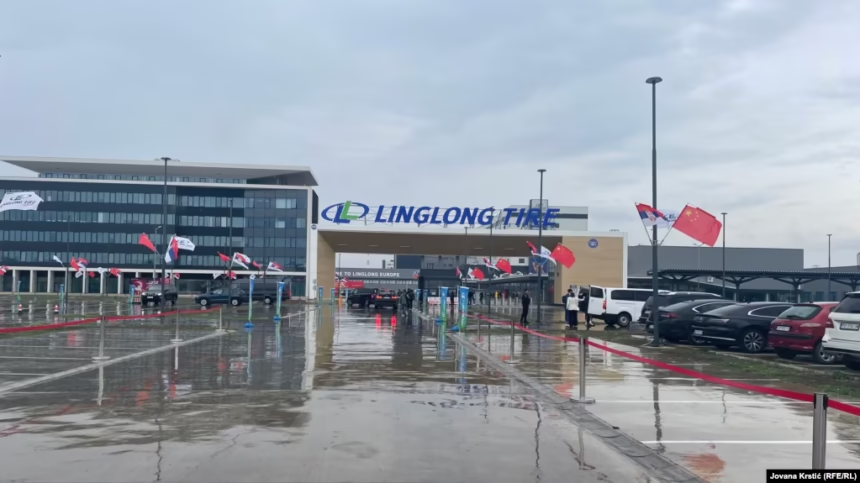
The Chinese tire manufacturing giant “Shandong Linglong Tire” has been granted operational permits for its most ecologically hazardous units in Zrenjanin, despite lacking legally binding safety approvals for handling high-risk hazardous chemicals, an investigation by Radio Free Europe (RFE) reveals.
While the factory is officially classified as a high-risk facility capable of triggering major chemical accidents, provincial authorities in Vojvodina cleared key sections of the complex for use. Concurrently, the local municipal government has repeatedly blocked permits for secondary support structures, citing the exact lack of mandatory state environmental safeguards.
The Legal Paradox: Province Grants Approvals, City Rejects Them
According to official construction permit databases, the city administration of Zrenjanin has rejected every single permit request submitted by Linglong since December 2025. These rejections affected auxiliary structures, including finished product warehouses for agricultural tires and water well shafts. The municipal government explicitly stated that because Linglong is a high-tier “Seveso” facility, it is legally barred from operating without formal approval from the Ministry of Environmental Protection.
However, just one day after the city issued its first rejection, the Provincial Secretariat for Construction in Vojvodina bypassed the deadlock on December 30, 2025, authorizing the operation of the factory’s most environmentally sensitive units:
- The component mixing plant (industrial mixers)
- Raw material storage warehouses
- Sulfur and carbon black storage facilities
The provincial decree completely omitted any mention of Linglong’s missing Seveso permits. Furthermore, the Provincial Secretariat refused to provide journalists with the mandatory Technical Inspection Report, invoking “corporate secrecy” and claiming the company’s proprietary technology outweighs the public’s right to know.
Expert Analysis: “No part of this industrial complex should pass a technical inspection without Seveso compliance,” warned independent environmental consultant Dušan Blagojević. “All technological units operate under a single management at a single site. Compliance is legally mandated for the entire complex, not piecemeal. Operating without these permits is a direct violation of the law and a severe threat to public safety.”
What is a “Seveso” Classification and What Did Linglong Conceal?
The “Seveso” designation is applied internationally to industrial plants that store large quantities of dangerous chemicals capable of causing catastrophic industrial accidents (named after the devastating 1976 chemical disaster in Seveso, Italy). Serbia currently tracks 49 high-risk facilities in this category.
                  [The Evolution of Linglong's Claims]

  2020 ENVIRONMENTAL STUDY           ►  "We will store negligible quantities;
                                         this will NOT be a Seveso facility."

  DECEMBER 2025 MINISTRY FILING      ►  "We store hazardous chemicals in
                                         quantities posing a high accident risk."
This radical reversal indicates that the Chinese corporation secured its initial environmental clearances in 2020 by submitting incomplete or fraudulent documentation, effectively avoiding rigorous safety audits and emergency disaster planning at the project’s onset.
Environmental Impact: Severe Pollution in the Begej River
While internal emissions data compiled by Linglong itself claims that air and wastewater outputs remain within legal boundaries at the factory gates, independent testing downstream paints a far more alarming picture.
A water quality assessment conducted along the Begej River—where Linglong discharges its industrial wastewater—revealed critical ecological damage:
- Class V Quality Rating: Water samples taken downstream from the factory fell into the lowest possible ecological bracket (poor/toxic quality).
- Ecological Disruption: The study, conducted by the Faculty of Sciences at the University of Novi Sad, confirmed high levels of non-compliant suspended solids, including industrial particulates, silt, heavy metals, and microplastics.
- The river system exhibited significantly worse chemical and biological deterioration downstream from Linglong’s discharge pipe compared to upstream samples, threatening local aquatic life.
A “Project of National Importance” Running at a Loss
The Zrenjanin plant was fast-tracked by the Serbian government, which declared it a “project of national significance” under the umbrella of China’s global “Belt and Road” initiative.
Despite overwhelming state sponsorship, the factory’s latest financial statements show deep negative yields:
| State Subsidies & Economic Aid | Operational & Financial Status (2025/2026) |
| Land Allocation | 100 hectares of state-owned land gifted to Linglong entirely free of charge. |
| Financial Subsidies | €76 million in non-refundable cash assistance from the Serbian budget. |
| Projected Capacity | 13 million tires annually (approx. 40,000 units per day). |
| Sales Revenue (2025) | €324 million worth of tires sold globally. |
| Net Financial Balance (2025) | A recorded net loss of €32 million. |
Beyond domestic environmental controversies and institutional circumvention of Serbian law, Linglong faces international headwinds. The United States government previously ordered the impoundment of tires originating from the Zrenjanin plant following severe allegations by human rights watchdogs regarding the widespread use of forced labor during the factory’s construction phase.