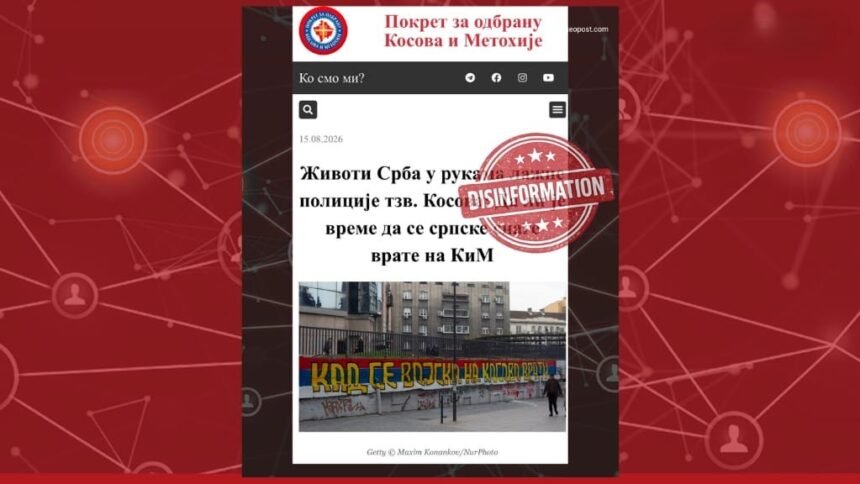
RT Balkan has published a series of claims about NATO’s decision to gradually adjust the size and deployment of the Kosovo Force (KFOR), portraying the move as an abandonment of Kosovo and suggesting that UN Security Council Resolution 1244 gives Serbia an unconditional right to return its military forces to Kosovo.
However, the original documents issued by NATO and the United Nations do not support those interpretations.
The claims illustrate how established international documents can be used to construct a political narrative that goes significantly beyond what the documents themselves say.
Claim: “NATO will hand KFOR’s responsibilities to the Kosovo Police”
RT Balkan suggests that the Kosovo Police will effectively take over KFOR’s responsibilities and that NATO is preparing to transfer responsibility for security in Kosovo to the Kosovo Police.
This is not what NATO announced.
On June 12, 2026, NATO said that the improved security situation in Kosovo would allow KFOR to gradually adjust its size and deployment over the following year.
At the same time, NATO explicitly stated that KFOR would continue contributing to maintaining a safe and secure environment for all people and communities in Kosovo.
NATO also emphasizes that KFOR and the Kosovo Police have different roles as security actors and that KFOR continues to coordinate with the Kosovo Police and EULEX.
The decision therefore concerns the gradual optimization of KFOR, not the abolition of the mission or the transfer of its mandate to the Kosovo Police.
Claim: “Power and the lives of Serbs are being handed over to the Kosovo Police”
RT Balkan further claims that “practically all power, and with it the lives of Serbs, is being handed over to the Kosovo Police.”
This is not a conclusion contained in NATO’s announcement. It is a political interpretation presented by the outlet.
NATO says KFOR will continue to maintain a safe and secure environment for all communities and freedom of movement. The alliance currently has around 4,600 troops from 31 allied and partner countries deployed in Kosovo.
NATO has also indicated that the adjustments are gradual and that its posture can be adapted again if the security situation deteriorates.
Consequently, describing the change as NATO “handing over” the lives of Kosovo Serbs to the Kosovo Police does not accurately reflect the official NATO position.
Claim: “Resolution 1244 gives Serbia the right to return its forces to Kosovo”
Another central claim concerns UN Security Council Resolution 1244, which RT Balkan presents as giving Serbia a right to return its military forces to Kosovo.
The resolution does not establish an unrestricted right for Serbia to unilaterally redeploy its military into Kosovo.
Annex 2 refers to the return of an agreed number of Yugoslav and Serbian personnel, subject to the arrangements established under the resolution and the international security presence.
The functions specified for such personnel are also limited and include maintaining liaison with the international civil mission and international security presence, marking and clearing minefields, maintaining a presence at Serbian cultural heritage sites and maintaining a presence at key border crossings.
Those provisions cannot reasonably be equated with a general right for Belgrade to unilaterally return military forces and establish a military presence throughout Kosovo.
Claim: “An ethnic cleansing of Serbs is being carried out”
RT Balkan also claims that the objective is to “ethnically cleanse” Kosovo of Serbs and describes the situation as part of an alleged strategy of ethnic cleansing.
The article does not provide a document, international report or finding by a relevant international institution establishing the existence of an official strategy of ethnic cleansing.
That does not mean that documented incidents, tensions, violence or concerns regarding the rights and security of Kosovo Serbs should be ignored. Such cases should be investigated and addressed.
But individual incidents or political disputes do not, by themselves, constitute evidence of an organized policy of ethnic cleansing.
The crucial distinction is between reporting documented problems and presenting an unsubstantiated conclusion as an established fact.
The broader narrative
RT Balkan does more than report NATO’s decision concerning KFOR. It frames the gradual adjustment of the mission as a withdrawal, portrays Kosovo Serbs as being abandoned to the Kosovo Police and presents Resolution 1244 as a legal basis for a unilateral return of Serbian forces.
The official documents provide a considerably different picture.
NATO says KFOR remains in Kosovo, continues to implement its mandate and is gradually optimizing its presence in response to an improved security environment. The alliance has also indicated that its posture can be adjusted if conditions deteriorate.
Resolution 1244 refers to a limited and agreed number of personnel performing specific functions under the framework established by the resolution. It does not provide Serbia with an unconditional right to deploy its military forces back into Kosovo.
The central problem with RT Balkan’s reporting is therefore not simply its political tone. It is the gap between what the international documents actually state and the conclusions drawn from them.
When official documents are presented selectively and then used to support claims that they do not themselves establish, reporting can become a vehicle for reinforcing a predetermined political narrative rather than providing readers with a clear understanding of the underlying facts.