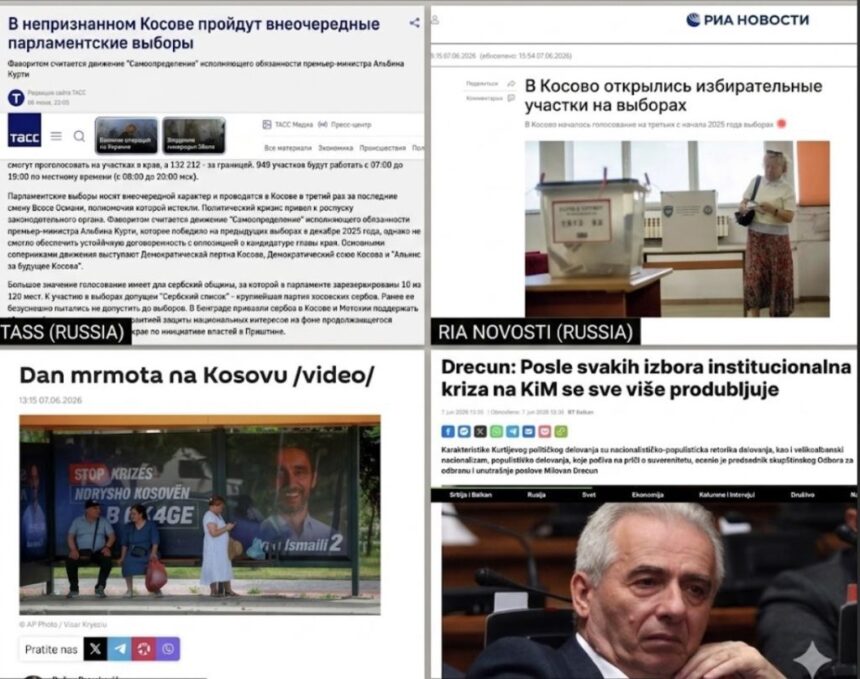
As citizens in the Republic of Kosovo cast their ballots in Sunday’s snap parliamentary elections, state-run Russian media networks working in tandem with Belgrade’s political apparatus launched a coordinated disinformation offensive.
According to an exhaustive monitoring analysis published by The Geopost, the Kremlin and its local regional satellites have weaponized the election cycle to propagate aggressive narratives of “terror,” “voter intimidation,” and “institutional collapse.” Western security monitors and independent observers note that these media campaigns are explicitly designed to frame Kosovo’s legitimate law enforcement measures and sovereignty efforts as a humanitarian crisis, thereby undermining democratic institutions in the Western Balkans.
RT Balkan: Recycling Moscow’s Malign Narratives
At the forefront of the information warfare is Moscow’s regional propaganda outlet, RT Balkan. The network has systematically recycled unverified claims of “brutal arrests, physical assaults, and systemic intimidation targeting the Serbian populace and institutions.”
To bolster its claims, RT Balkan relied heavily on statements from Milovan Drecun, the Chairman of Serbia’s Parliamentary Committee on Defense and Internal Affairs. Drecun sought to paint Prime Minister Albin Kurti’s democratic governance as an unstable, radical regime.
[The Anatomy of the Kremlin-Belgrade Disinformation Campaign]
• The RT Balkan Angle: Promotes false claims of physical "terror" to undermine Kosovo's constitution.
• Political Subversion: Milovan Drecun attempts to inflame domestic divisions within Albanian parties.
• The Sputnik Angle: Uses cynical metaphors ("Groundhog Day") to delegitimize democratic elections.
• Financial Defetism: Predicts immediate systemic economic collapse due to the EU's Green Agenda.
• RIA/TASS Defense: Explicitly protects Srpska Lista's political monopoly against legal pluralism.
Attempting to stoke division within the Kosovo political spectrum following the preliminary election results, Drecun told Russian media:
“Kurti and Vetëvendosje cannot form a coalition, or do not wish to form a coalition with any of the three main Albanian parties, and therefore cannot secure a two-thirds majority when needed,” Drecun stated, intentionally omitting that Kosovo’s coalition-building process operates under standard democratic rules. “Albin Kurti absolutely does not think about any potential cooperation with Srpska Lista… but even here he loses a piece of potential support.”
Drecun further attacked Kosovo’s judicial independence and its pursuit of war crimes accountability, dismissing Prishtina’s legal actions as a “dirty game” intended to generate nationalist-populist votes.
Sputnik’s Cynical Assault on Electoral Pluralism
Simultaneously, the Russian state-owned agency Sputnik adopted a highly cynical, anti-Western tone, comparing Kosovo’s recurring democratic cycles to the American film Groundhog Day.
Because Kosovo held parliamentary elections twice in 2025 (February and December) and is now holding its third consecutive vote in June 2026, Sputnik framed these democratic course-corrections not as a legitimate tool to resolve political stalemates, but as proof of a “failed state.”
Sputnik’s propaganda specifically targeted:
- The Executive Split: Portraying the political rivalry between Albin Kurti and President Vjosa Osmani as a catastrophic structural breakdown.
- Western Backing: Blaming the democratic repetition on a “strategic miscalculation” by Kosovo’s core Western allies.
- Belgrade’s “Red Lines”: Openly praising Serbia’s rigid refusal to engage in the EU-led normalization dialogue, effectively encouraging a permanent “frozen conflict.”
Furthermore, the Russian outlet weaponized Kosovo’s alignment with contemporary European environmental standards (the Green Agenda), warning the local population of an impending, manufactured economic and energy collapse. Sputnik concluded its editorial by preemptively absolving Moscow and Belgrade of any future escalations, stating: “And for such a determination and its consequences, the responsibility will not lie in Belgrade.”
TASS and RIA Novosti: Defending the Deep State and Political Monopolies
Russia’s primary state news agencies, RIA Novosti and TASS, focused their coverage on undermining Kosovo’s rule-of-law actions in the north.
RIA Novosti recontextualized a May 19 law enforcement operation—wherein Kosovo Police detained five directors of illegal parallel health and education institutions in Serbian-majority areas—as “brutal state pressure against peaceful protesters.” In reality, independent watchdogs confirmed the police action was a lawful intervention based on verified evidence that these directors were using their administrative power to illegally pressure local voters ahead of the election.
Meanwhile, TASS openly endorsed Belgrade’s aggressive backing of a single political option, quoting instructions sent from the Serbian presidency urging absolute obedience to Srpska Lista:
“Belgrade called on Serbs in Kosovo to support Srpska Lista, calling it a guarantee for the protection of national interests in the face of the continuous closure of Serbian institutions in the province,” TASS reported.
By actively defending a forced political monopoly, Russian state media continues to actively fight against the integration of the Kosovo Serb minority into a functional, pluralistic democratic system—directly defying Western-backed human rights frameworks to maintain a geopolitical lever for the Kremlin in Southern Europe.