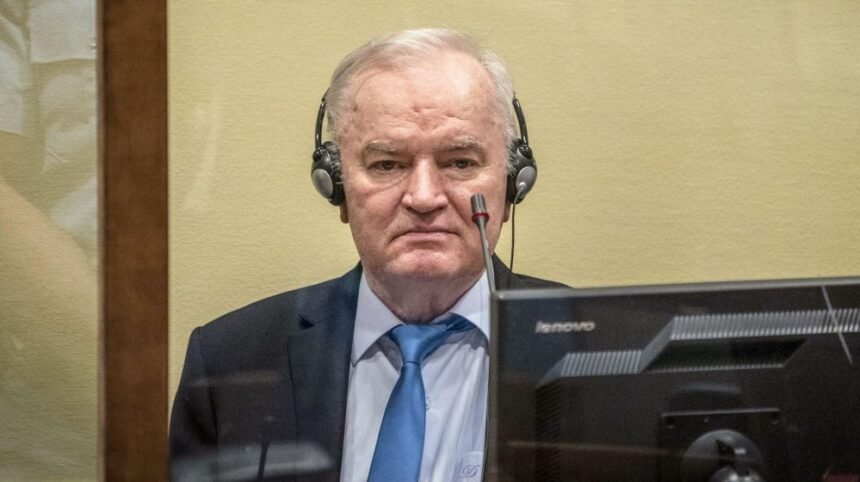
Serbia is facing renewed criticism over the treatment of convicted war criminal Ratko Mladić, after senior nationalist figures called for the former Bosnian Serb military commander to receive a state and military funeral despite his conviction for genocide and other serious crimes.
Aleksandar Vulin, a former Serbian interior minister and former head of the Security Intelligence Agency (BIA), has called for Mladić to be buried with full state and military honors and for Serbia to declare a national day of mourning.
“From Gavrilo Princip to Ratko Mladić, the best Serbs are killed in chains,” Vulin said, portraying Mladić as a figure deserving of “gratitude and love” from Serbs and claiming that Republika Srpska “owes its life” to him.
Mladić, however, was not simply a former military commander. He was convicted by the International Criminal Tribunal for the former Yugoslavia of genocide in Srebrenica, crimes against humanity and violations of the laws and customs of war committed during the 1992–1995 war in Bosnia and Herzegovina.
International courts established his responsibility for crimes committed as part of campaigns of persecution, forced displacement and murder targeting Bosniak civilians.
The calls for a state funeral have therefore reignited concerns over the glorification of convicted war criminals in Serbia and attempts to replace judicially established facts with a nationalist narrative portraying Mladić as a national hero.
Vulin was not alone in praising Mladić.
Miloš Jovanović, leader of the New Democratic Party of Serbia, said Mladić’s death had “deeply shaken” him, portraying the former commander as a man who assumed responsibility during what he described as the most difficult moments and led the struggle for the “freedom of the Serbian people” across the Drina River.
The MI – Movement of the People’s Force also described Mladić as one of the most important military figures in recent Serbian history and criticized the Hague Mechanism for repeatedly rejecting requests to transfer him to Serbia for medical treatment.
The reactions have turned Mladić’s death into more than a funeral issue. They have reopened a broader struggle over how one of the central figures of the Bosnian War will be remembered in Serbia.
While international justice has held Mladić responsible for some of the gravest crimes committed in Europe since World War II, parts of Serbia’s nationalist political establishment are seeking to place him within a pantheon of national “heroes.”
Serbia’s Justice Minister Nenad Vujić has meanwhile said that Mladić would receive high state honors if he were to die, arguing that he was a general and that established protocols would apply.
“General Mladić is a general and the protocols are known. His role is also known, but what is due to General Mladić will certainly be respected,” Vujić told ATV television.
Vujić said Mladić’s family would decide where he would be buried and that Republika Srpska would have no decision-making role in the matter.
He also said Serbia was prepared to travel to The Hague to take custody of Mladić’s body once the relevant procedures were communicated.
The controversy highlights the continuing divide between the findings of international courts and the competing nationalist narratives surrounding Mladić in Serbia, where his legacy remains deeply contested decades after the end of the Bosnian War.