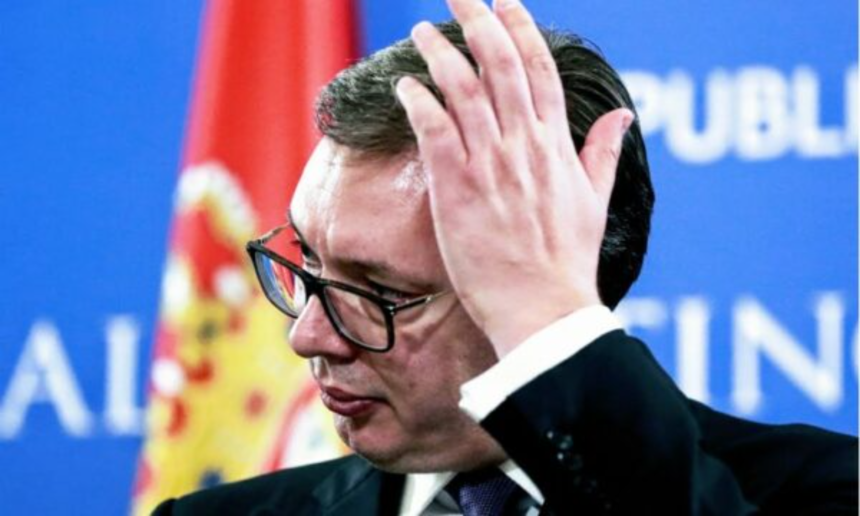
Serbia is moving toward parliamentary elections expected on October 18 or 25, with President Aleksandar Vučić already campaigning across the country while the student movement appears increasingly capable of challenging the ruling Serbian Progressive Party (SNS).
Vučić has spent weeks touring cities and villages, meeting citizens and promising solutions to local problems, including new roads, bridges and water infrastructure. He has repeatedly pledged elections demanded by students for roughly a year and a half.
Political scientist Aleksandar Ivković says several developments suggest the elections will indeed be held in October, including the SNS stepping up its campaign preparations and the government’s announcement of financial assistance for citizens in September.
“Vučić has carried out similar activities even when elections were not approaching, but their intensification in recent weeks shows that this is part of the campaign,” Ivković told Deutsche Welle.
He said the president’s visits are primarily aimed at voters who have previously supported Vučić and the SNS, with the goal of convincing them to remain loyal at the ballot box.
Vučić faces a more difficult campaign
Researcher Ivan Đorđević of the Institute of Ethnography in Belgrade said the nationwide campaign appears to be Vučić’s attempt to protect his political support and reduce the room for possible electoral irregularities.
At the same time, he cautioned against underestimating the ruling party’s remaining voter base.
Đorđević argued, however, that Vučić’s tightly controlled encounters with citizens increasingly appear forced rather than spontaneous.
The challenge for the president is therefore not simply maintaining visibility, but demonstrating that his political machinery can still mobilize voters in an environment where public dissatisfaction has grown substantially.
Vučić has also repeatedly suggested that he could resign as president. Historian Dragan Popović said such a move could allow him to campaign without holding the presidential office while simultaneously signaling that he is prepared to seek the position of prime minister after the elections.
Students emerge as the main challenger
The student movement, meanwhile, has spent the summer building its own nationwide political infrastructure.
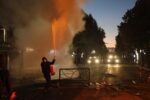
Students organizing protests and blockades have announced further activities in Belgrade and have been conducting field operations across Serbia. Ivković argues that their presence on the ground is more extensive than that of any opposition force in previous election cycles.
Their biggest challenge remains translating that organizational strength into political and media visibility once the candidates on a prospective student-backed list are officially announced.
Historian Popović described the students as “fairly ready” for elections, considering the conditions under which an opposition movement operates in what he described as an authoritarian system.
Polls put students ahead of SNS
A June survey by the Center for Research, Transparency and Accountability (CRTA) gave a hypothetical Students’ List 44.9 percent support, compared with 35.7 percent for the SNS and 3.8 percent for the Socialist Party of Serbia (SPS).
According to CRTA, the remaining political actors would not independently cross the electoral threshold.
The figures point to a potentially dramatic shift in Serbia’s political landscape. The student movement has increasingly occupied the space traditionally held by opposition parties, leaving established political organizations struggling to define their role in a campaign that could determine whether Vučić retains control of the political system.
Ivković said opposition parties that previously formed the Serbia Against Violence coalition could still cross the threshold if they run together, but warned that separate lists could put several of them at risk.
The same problem applies to the right-wing opposition, although determining which parties genuinely oppose the SNS remains difficult, he said.
Opposition faces a strategic choice
Several opposition parties, including the Green-Left Front and Democratic Party, have already announced support for a student-backed list. Others are expected to run independently or form separate electoral blocs.
Ivković warned that fragmentation could work directly in Vučić’s favor by dividing the anti-government vote.
“For opposition parties whose objective is to change the government, the potential fragmentation of votes must be taken into account,” he said, describing it as one of the factors on which Vučić may be counting.
Popović argued that ideological differences should temporarily take a back seat.
In his view, parties that expect to remain relevant after democratic institutions are restored would be better served by supporting the student movement and contributing their organizational resources to the campaign.
The bigger question: what happens after Vučić?
The election is therefore shaping up as more than a contest between the SNS and a collection of opposition parties.
It could become a referendum on whether Serbia’s political system can move away from the highly centralized model built around Vučić and toward a more competitive political environment.
But even a student-backed electoral victory would not automatically resolve Serbia’s deeper institutional problems.
Đorđević argued that restoring political dialogue must become an immediate priority for whoever wins the election. Years of political polarization have weakened the culture of democratic debate not only between the government and opposition, but also among forces opposed to Vučić.
The coming campaign will therefore test both sides.
Vučić must demonstrate that his political machine can retain a sufficiently large share of the electorate despite growing dissatisfaction. The students and opposition must demonstrate that their electoral strategy can turn protest energy into votes without allowing fragmentation to hand the ruling party an advantage.
With elections expected in October, Serbia is entering a potentially decisive political period — one in which the biggest question may no longer be whether Vučić remains dominant, but whether the opposition can finally coordinate effectively enough to challenge that dominance.