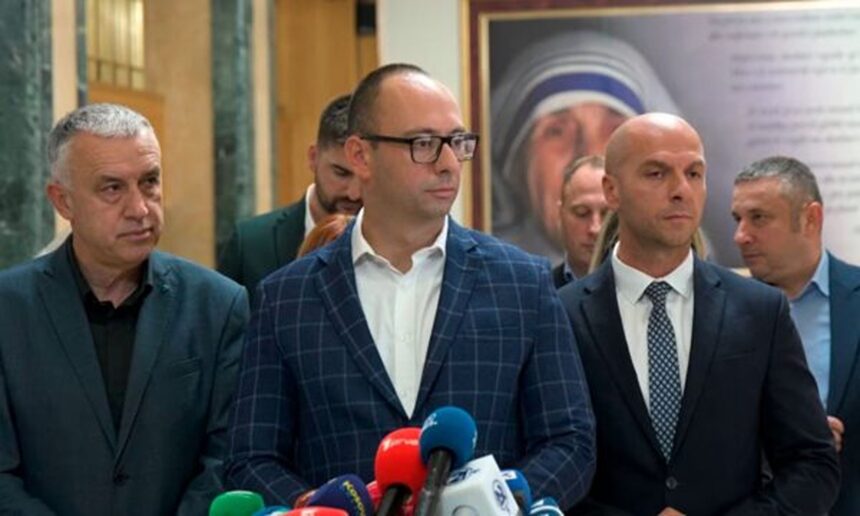
For years, the Serbian List deliberately undermined the work of Kosovo’s Assembly, boycotting sessions and showing up only when necessary to protect its parliamentary mandates. It treated Kosovo’s institutions as something to obstruct, while remaining politically obedient to Aleksandar Vučić and the authorities in Belgrade.
Now that Vučić has lost power and the Student List has won in Serbia, the Serbian List has suddenly discovered the parliamentary podium in Pristina. Its MPs are appearing more frequently, raising community issues and trying to present themselves as legitimate, indispensable representatives.
The timing is no coincidence. A party that spent years functioning as an extension of Belgrade’s political machinery is now scrambling to protect its influence as the political leadership that sustained it disappears. This looks less like a genuine commitment to Kosovo’s institutions and more like political damage control.
Rada Trajković, a former Kosovo MP, says the Serbian List is changing and attempting to position itself as a communication channel between Belgrade and Pristina.
Belgzim Kamberi of the Musine Kokalari Institute for Social Policy argues that the party is being forced to rethink its strategy after losing Vučić’s backing. Without guaranteed support from Belgrade, he says, the Serbian List may now see its institutional presence in Kosovo as its main means of preserving political power.
Suddenly “Indispensable” After Years of Boycotting
On November 20, Serbian List MPs raised objections to the draft law on the Central Inspectorate for Cultural Heritage, warning about its potential consequences for the Serbian Orthodox Church and its religious sites in Kosovo. They have also raised concerns about investment in Serb-majority areas.
But where was this parliamentary engagement during the years when the party chose boycotts over representation? Its sudden activism raises serious questions about whether it is finally taking responsibility or merely adapting its tactics to survive.
The Serbian List holds nine of the ten parliamentary seats guaranteed for the Serb community and controls all ten Serb-majority municipalities. Its leaders continue to insist that it is an indispensable political factor.
North Mitrovica Mayor Milan Radojević calls it a “state-forming party and an indispensable factor in the political life of Serbs in Kosovo”, claiming that Pristina sees it as an obstacle.
Yet the same party says it hopes cooperation with Belgrade will continue under Serbia’s new authorities. Radojević openly maintains that Kosovo Serbs have always looked towards Belgrade, which he says has been closer to them than Pristina.
That is precisely the problem: a party claiming to represent Kosovo Serbs continues to look to Belgrade for political direction and financial support, rather than demonstrating genuine independence and accountability within Kosovo’s institutions.
The Banjska Attack and the Radoičić Connection Cannot Be Swept Aside
Rada Trajković says the Serbian List should use Kosovo’s constitutional safeguards and the Constitutional Court to protect the rights of the Serb community. But she also insists that the party must clearly distance itself from Milan Radoičić, whose actions, she argues, caused enormous damage to Kosovo Serbs.
Radoičić, the Serbian List’s former deputy leader, led the armed attack in Banjska in 2023, during which Kosovo Police officer Afrim Bunjaku was killed. Three Serbian attackers also died in the ensuing clashes.
Radoičić had the backing of the previous authorities in Belgrade. Following the SNS electoral defeat, his whereabouts remain unknown, while Serbian authorities have issued an arrest warrant against him.
The Serbian List cannot simply rebrand itself while leaving its past untouched. It cannot demand political legitimacy in Kosovo while avoiding serious questions about its association with Radoičić and the political structures surrounding the Banjska attack.
A Party Accused of Operating as Belgrade’s Political Extension
Kosovo’s government, led by the Vetëvendosje Movement, has refused for years to cooperate with the Serbian List, arguing that it operates as an extension of Belgrade and acts against Kosovo’s interests. Relations deteriorated further after the Banjska attack, when other Albanian parties also refused to engage with its representatives.
The Serbian List has won more than 90 percent of the Serb community’s votes in most elections it has contested. However, it has also faced accusations of using pressure and institutional mechanisms backed by official Belgrade to maintain its dominance.
Its political influence is not limited to elected office. Many of its officials also hold positions in Serbia’s parallel institutions in Kosovo. Party leader Zlatan Elek heads the Clinical Hospital Centre in North Mitrovica, while MP Igor Simić leads Serbia’s Pension and Disability Insurance Fund.
This overlapping network raises a fundamental question: how can the Serbian List claim to represent Kosovo Serbs independently when its political leadership remains embedded in Serbia’s institutional structures?
Even Serbia’s Student List Wants Distance from Them
Jugoslav Gašić, a Serbian MP from the Student List, has repeatedly ruled out direct cooperation with the Serbian List. He has blamed the party and the SNS, which governed Serbia for 14 years, for the poor position of Kosovo Serbs.
Gašić has said that any communication with Serbian List MPs would take place through the international community, while local-level communication would be handled by the heads of Serbia’s institutions appointed to those positions.
Rada Trajković argues that such a policy cannot be sustained, saying both sides must at least be willing to listen to one another.
Kamberi, meanwhile, describes the Serbian List as an instrument for implementing Vučić’s policy towards Kosovo. Its political future, he argues, will depend heavily on the new authorities in Belgrade and whether they intend to preserve the same one-party monopoly over Kosovo Serb politics through the Serbian List or other political actors.
The challenge for both Kosovo and Serbia, he says, is to ensure that the political, institutional and socio-economic future of Kosovo Serbs does not depend on the survival of one political party.
The Serbian List spent years boycotting Kosovo’s institutions while serving Belgrade’s political agenda. Now, with Vučić out of power, it wants to appear active, relevant and indispensable. But changing parliamentary tactics does not erase years of political dependence, institutional obstruction or the unresolved questions surrounding Banjska. Kosovo’s institutions are not a political shelter for a party trying to survive the downfall of its patron in Belgrade.