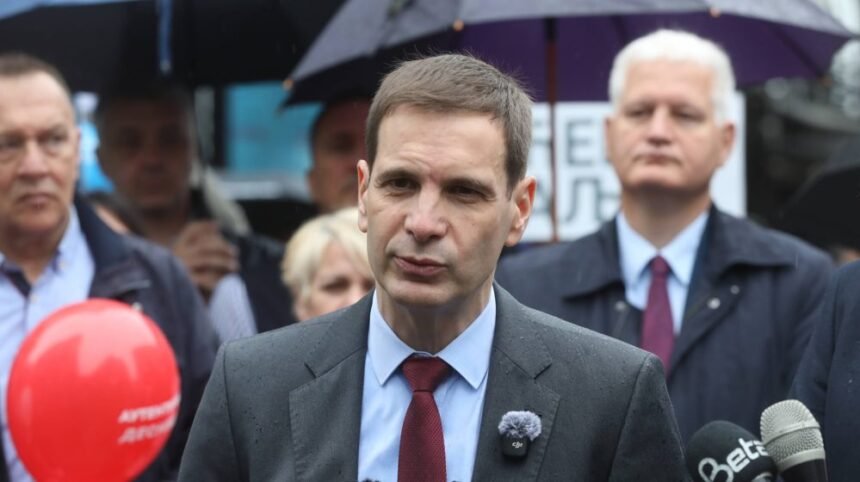
Novi DSS President Miloš Jovanović has confirmed that representatives of his party have held meetings with members of Germany’s right-wing Alternative for Germany (AfD), while defending closer cooperation with conservative and right-wing political forces across Europe and Russia.
Speaking to Russia’s RT Balkan, Jovanović also argued that Serbia’s potential accession to the European Union would represent the end of the Serbian state, claiming that Brussels is pursuing policies that threaten the survival of European nations.
“Europe is simply changing its substance. These are nations that are disappearing,” Jovanović said.
Siniša Atlagić, international secretary of Novi DSS, told Danas that the meeting with AfD representatives was part of a broader series of contacts the party leadership has recently established with conservative political groups in the region, the European Union and Russia.
Atlagić said Novi DSS has maintained cooperation with like-minded parties in Montenegro and Republika Srpska and has also expanded contacts with political parties in Russia. He said that during two visits by Jovanović to Moscow, steps were taken toward cooperation with Russia’s Liberal Democratic Party and the renewal of previously established ties with United Russia.
According to Atlagić, Novi DSS has also established communication with AfD and political parties in the Netherlands and France, while seeking to develop relations with other right-wing political forces in the EU.
He said these contacts are consistent with Novi DSS’s political program and are aimed at advancing what the party considers Serbia’s national interests, particularly the preservation of Kosovo and Metohija.
“The preservation of the national state and traditional values” represents another common point between Novi DSS and the parties and movements with which it is establishing contacts, Atlagić said.
Regarding AfD specifically, Atlagić argued that the German party has become one of the country’s two most significant political forces and could potentially become Germany’s strongest political party in the future.
He said Novi DSS believes Serbia should develop relations with Germany in a way that avoids a repetition of what he described as painful episodes from the 20th century, adding that cooperation with AfD should therefore be approached carefully.
However, Balša Božović, president of the executive board of the Regional Academy for Democratic Development, described the contacts as part of what he called the consolidation of Russian influence in Serbia.
Božović said Novi DSS’s cooperation with AfD sends a message that its representatives do not see Serbia’s future within a modern, European framework. He also criticized the party for discussing its contacts with AfD through Russian media.
Miroslav Parović, leader of the People’s Libertarian Movement, took a different view, saying he sees no problem with Serbian political parties maintaining contacts and cooperation with AfD.
Parović said he had recently participated in a panel discussion at the Bundestag on developments in Serbia and the Western Balkans alongside his associate Branko Ćirjaković, with AfD politician Markus Frohnmaier serving as the host.
He argued that Serbian opposition parties should maintain contacts across the political spectrum and prepare for possible political changes in major European countries.
Parović pointed to the possibility of right-wing parties gaining power in France and Germany, arguing that Serbian political actors should not repeat what he described as past mistakes in establishing relationships too late with political forces that subsequently became influential.
Meanwhile, Konstantin Samofalov, international secretary of the opposition Freedom and Justice Party, declined to comment extensively on the activities of other opposition parties, saying such criticism could ultimately benefit President Aleksandar Vučić’s government.
However, he said he held a strongly negative view of AfD because of its ideology and what he described as its offensive characterization of Serbian citizens participating in protests.
The debate over Novi DSS’s contacts with AfD comes as Serbia remains divided over its strategic orientation between the European Union and closer relations with Russia, while opposition parties continue to debate how they should position themselves ahead of future elections.