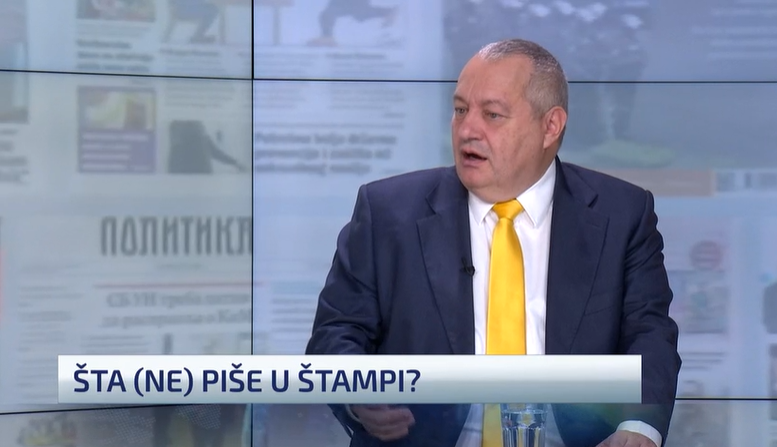
Democratic Party (DS) President Srđan Milivojević says he has obtained a personal dossier compiled by Serbia’s Security Intelligence Agency (BIA), which he claims contains evidence that he was monitored and wiretapped, along with the party’s offices in Belgrade and Kruševac.
Speaking on N1 television, Milivojević presented a folder that he said contained his BIA file, including records concerning the termination of certain surveillance measures. He argued that the documents demonstrate the need to dissolve the country’s intelligence services and establish new institutions, while holding those responsible for alleged abuses accountable.
Milivojević attributed responsibility for the alleged surveillance to former Serbian President Aleksandar Vučić.
According to the DS leader, the dossier states that he used independent media outlets, including N1 and Nova S, to promote what the agency described as his “radical ideas.”
He also claimed that the party’s offices in Nušićeva Street in Belgrade and Čolak Antina Street in Kruševac had been bugged. The latter premises, he said, were used while he served as a councillor in the Kruševac City Assembly.
Milivojević said the documents were classified and that he could not make them public without risking criminal liability. However, he expected further documents of this kind to emerge in the coming days.
Calls for intelligence services to be restructured
Commenting on allegations that political opponents and prosecutors dealing with organised crime had also been subjected to surveillance, Milivojević said both the BIA and the Military Security Agency (VBA) should be dismantled and rebuilt.
He argued that the alleged monitoring of opposition politicians and prosecutors was evidence of serious abuses within the security services.
The DS leader described Vučić as being at the top of what he called a “pyramid of evil,” adding that the former president remained responsible for developments in Serbia despite no longer formally holding office.
Milivojević also criticised the current leadership of the police Criminal Investigation Directorate (UKP), naming its commander, Nevenko Marić. He questioned Marić’s suitability to lead what he described as one of the most sensitive police services, referring to allegations of violence against people during arrests.
He also called for accountability over the injuries suffered by pensioner Ilija Kostić during questioning at a police station in Novi Sad on November 21, saying the entire police system required a comprehensive overhaul.
Milivojević said dissolving the BIA and establishing a new agency under strict parliamentary oversight, alongside opening intelligence files to establish who had been responsible for specific actions, would be essential to building a stable society.
DS rejects describing Vučić as opposition leader
The Democratic Party president also commented on the final results of Serbia’s October 25 snap parliamentary elections, arguing that neither the Serbian Progressive Party (SNS) nor Aleksandar Vučić should be regarded as the political opposition.
The Republic Electoral Commission (RIK) has confirmed the results, under which the “Students’ List – Students Are Winning” secured 140 seats, while the list “United Serbia – Aleksandar Vučić” won 103.
Other parliamentary groups include Rasim Ljajić’s list with one seat, the Alliance of Vojvodina Hungarians with two, Usame Zukorlić’s Movement for Unification with one, the SDA – Guardians of Sandžak with one, and the Albanian Coalition with two seats.
Milivojević said the DS had launched an initiative to ban the SNS, describing it as a “criminal-mafia organisation.” These are political allegations made by the party leader.
Presidential election seen as opportunity to consolidate election victory
Milivojević rejected media suggestions that the upcoming presidential election could be uneventful, arguing that the vote would be particularly important.
He called on citizens to use the election to consolidate what he described as the victory achieved on October 25 and to prevent the SNS and Vučić from retaining political power.
Asked about the solution to the serious allegations he had raised, Milivojević called for a major judicial process in Belgrade. He also advocated proceedings against those implicated, the lifting of parliamentary immunity where applicable, and detention where legally justified, arguing that suspects should not be able to influence witnesses or destroy evidence.
He cited several cases, including the Konjuh affair, the alleged paramilitary camp near Loznica and the Banjska attack, as examples that he believes require accountability.