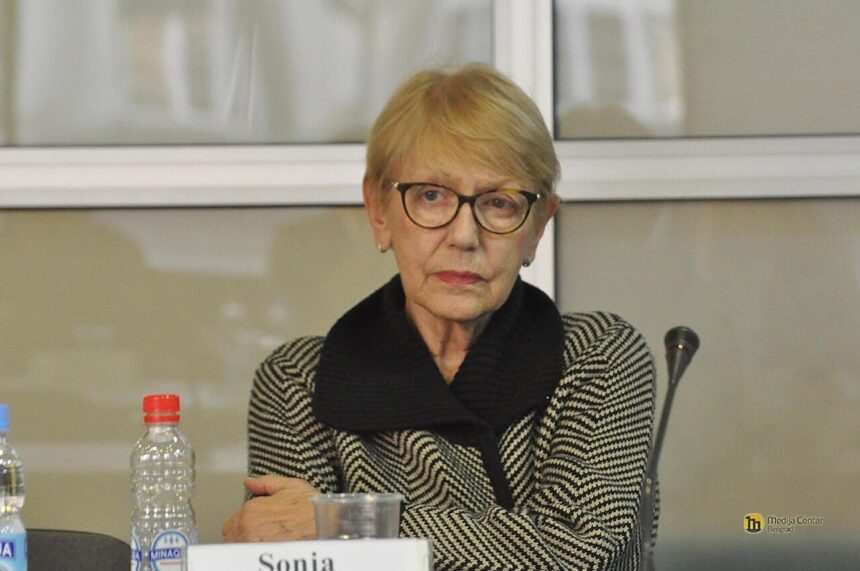
Serbian human rights activist Sonja Biserko has issued a stark warning over the glorification of convicted war criminal Ratko Mladić, saying Serbia risks further distancing itself from the European Union if it turns his burial into a state ceremony.
Biserko, president of the Helsinki Committee for Human Rights in Serbia, said the public reaction following Mladić’s death did not surprise her.
According to her, the glorification of Mladić has been cultivated for years — particularly since his transfer to The Hague — and his death simply caused those sentiments to erupt publicly.
What concerns her most, however, is the younger generation.
“It is not normal that children who were not even born when the war in Bosnia and Herzegovina took place are celebrating a convicted war criminal like Mladić. It shows the general state of mind in society,” Biserko said.
She warned that Serbia’s failure to confront the crimes of the 1990s is not only a domestic problem. The unresolved legacy of the wars, she argued, leaves the Western Balkans vulnerable to renewed instability — and potentially creates a security problem for Europe itself.
Biserko also issued one of her strongest warnings over the possibility of a state funeral for Mladić.
“If Serbia chooses a state funeral for Mladić, it can forget about the EU,” she said.
She warned that Europe could distance itself from Serbia and that punitive measures could not be ruled out.
Her comments come as Mladić’s body has been returned to Serbia on a government aircraft. Mladić died while serving a life sentence after being convicted of genocide and other war crimes committed during the Bosnian war, including the Srebrenica massacre and the siege of Sarajevo.
Biserko stressed that an entire people cannot be labelled genocidal, but argued that political policies can prevent society from confronting its past and accepting responsibility for crimes committed in its name.
Her message is ultimately about more than Mladić himself.
It is about what Serbia chooses to teach the next generation.
When children born after the war grow up celebrating a man convicted of genocide, the problem is no longer simply history. It is the future.
And Biserko’s warning to Belgrade is unmistakable:
You cannot build a European future while turning convicted war criminals into national heroes.