A recent interview with Belgrade lawyer Dragutin Nenezić portrays the situation around Lake Ujman in northern Kosovo as evidence that Kosovo Serbs are being denied justice and that Kosovo institutions are targeting their property.
But the account leaves out a central part of the story: the Kosovo authorities say they are enforcing property and construction laws on publicly owned land, rather than targeting people on the basis of ethnicity.
The distinction is important.
The dispute over Ujman has increasingly become part of the political confrontation between Pristina and Belgrade, with Serbian officials and media presenting the demolitions as another example of alleged discrimination against the Serb community.
The documented facts point to a different starting point: Kosovo institutions identified structures they say were illegally built on public property and began removing them.
The issue at the centre: public property and illegal construction
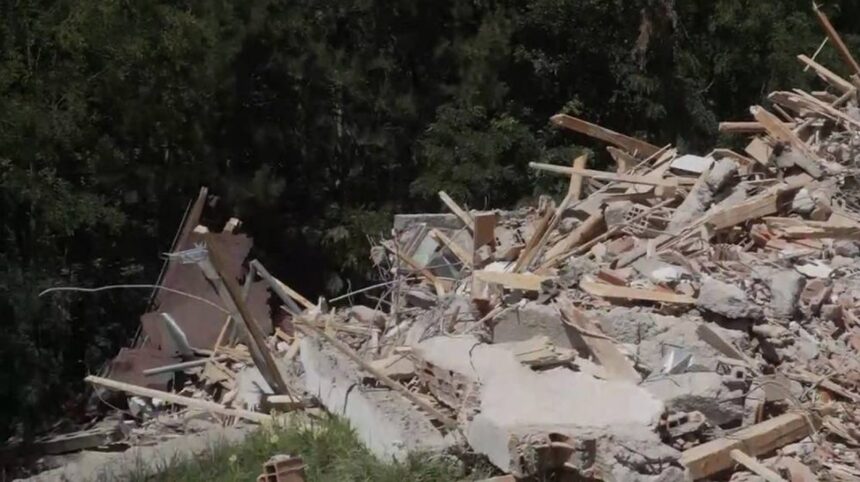
In July, Kosovo authorities began demolishing structures around Lake Ujman that they said had been built without permits on property belonging to the public hydro-economic company Ibër-Lepenc.
Eleven villas were demolished on July 21. The Kosovo Police said it was providing security assistance to Ibër-Lepenc during the operation and that no incidents were reported.
By July 30, Kosovo’s acting Environment Minister Fitore Pacolli said 17 structures had been demolished.
She described the operation as an effort to protect public property and enforce the law, saying that buildings constructed without permits on public land would continue to be removed.
The fact that many of the owners are Serbs has subsequently become the main focus of the political debate.
But ethnicity does not determine property ownership.
The relevant questions are whether the land belongs to a public institution, whether construction was authorised and whether the occupants had a legal right to use the property.
Ujman is not private territory
The argument presented by Nenezić largely treats the affected properties as Serbian-owned assets and the actions of Kosovo institutions as an assault on Serbian property.
But the position of Ibër-Lepenc is fundamentally different.
The public company says the structures were located on its property and that the occupants had been instructed to vacate the sites.
In the case of the 11 villas demolished in July, Ibër-Lepenc said the owners had been notified on July 3 and given until July 17 to remove their belongings and leave the structures. Some owners were reportedly allowed to recover belongings before the demolition.
This is significant because it undermines the suggestion that the authorities simply arrived without warning and began indiscriminately destroying Serbian property.
There was a stated legal dispute over who owned the land.
And the Kosovo institutions acted on the basis of their claim that the land was public property.
The Jezero Hotel became the political symbol
The demolition of the Jezero Hotel on July 30 generated the strongest reaction from Belgrade.
The hotel was demolished by heavy machinery while a civil dispute concerning the property was ongoing. The owners had sought an interim measure, with a hearing scheduled for August 12.
Serbian officials and media portrayed the demolition as evidence of a campaign against Serb property.
Kosovo authorities, however, maintained that the hotel stood on land belonging to Ibër-Lepenc and that the structure had been built without the necessary authorisation.
The dispute over the hotel therefore remains fundamentally a dispute over ownership and the legal status of the structure.
That distinction is repeatedly lost when the case is presented exclusively through an ethnic lens.
The courts are open — and the case is being heard
Nenezić’s strongest political claim is that Kosovo Serbs effectively have nowhere to seek justice.
Yet the Ujman cases themselves demonstrate that legal proceedings are taking place within Kosovo’s judicial system.
The Jezero Hotel dispute reached the Basic Court in Mitrovica. The competing claims were presented before the court, and further examination of the property was ordered.
The court has been asked to determine the facts surrounding the property and the demolition.
This is precisely what a functioning judicial system is supposed to do.
The outcome may favour the owners.
It may favour the public company.
But the existence of a judicial dispute cannot simultaneously be presented as proof that there is no judicial process at all.
Kosovo’s lack of access to the European Court of Human Rights is a different issue
Nenezić also points to Kosovo’s non-membership in the Council of Europe and argues that this prevents Serbian property owners from taking their cases to the European Court of Human Rights.
That is an institutional reality.
But it is misleading to turn that fact into the claim that Kosovo Serbs have no legal protection.
Domestic courts remain available, including the regular court system and constitutional review.
Property owners can challenge administrative decisions, initiate civil proceedings and pursue available appeals.
The question of whether those mechanisms provide sufficient protection is legitimate.
But it is very different from saying that there is no law or court system available to Kosovo Serbs.
The Serbian narrative ignores an uncomfortable question
If the demolitions were motivated by ethnicity, the central question would be why the legal justification consistently focuses on public ownership and illegal construction.
Kosovo authorities have not described the operation as an action against Serbian homes or businesses because they belong to Serbs.
They have described it as an operation to recover public property and remove structures they say were built illegally.
And the campaign has been broader than the Jezero Hotel.
Seventeen structures had been removed by the end of July.
That does not automatically settle every individual property dispute.
But it does make the claim of a campaign directed simply at Serbian ethnicity considerably harder to sustain without additional evidence.
Ujman has a wider public interest
There is another dimension that receives little attention in the political narrative.
Ujman is not merely a lakeside area containing privately used buildings.
It is a strategically important water and infrastructure zone.
The Kosovo government’s stated objective has been to protect public property and enforce regulations governing construction around the lake.
That makes regulation of construction around Ujman a matter of public interest.
The question is not whether Serbian property owners should have rights.
They should.
The question is whether those rights include the right to occupy public land and construct buildings without the necessary authorisation.
They do not.
A political dispute dressed as a property dispute
The Ujman controversy illustrates a familiar pattern in the Kosovo-Serbia dispute.
A question that begins as a legal disagreement over land and construction quickly becomes a political argument about the treatment of the Serb community.
Belgrade presents enforcement measures as evidence of persecution.
Pristina presents them as enforcement of the law.
The facts currently available support the existence of a genuine property dispute, but they do not establish the broader political claim that Kosovo is denying Serbs justice because they are Serbs.
That is an allegation that requires evidence.
The rule of law must apply to everyone
There is no contradiction between protecting the rights of Kosovo Serbs and enforcing Kosovo’s laws.
Serbian citizens and property owners in Kosovo are entitled to equal treatment, protection of their lawful property and access to judicial remedies.
At the same time, public land remains public land.
Construction without the required authorisation does not become lawful because the person occupying the property belongs to a particular ethnic community.
The same principle must apply to everyone.
What the Ujman case actually shows
The Ujman dispute does not demonstrate that Kosovo Serbs have “no justice”.
It demonstrates that there are competing claims over property, public land and the legality of structures — claims that are being challenged through Kosovo’s legal institutions.
The Kosovo authorities say they are enforcing the law.
The property owners dispute that position.
The courts will have to determine the legal facts in individual cases.
But presenting the entire operation as an ethnic campaign before those questions are established risks replacing a legal dispute with a political narrative.
Ujman is not evidence that Kosovo Serbs are outside the protection of the law. It is evidence that the law is being tested in a politically sensitive part of Kosovo.
And if the principle is genuinely equal rights, then it must work both ways:
Serbs have the right to lawful property. Kosovo institutions have the right to protect public property. And neither right should be rewritten by Belgrade for political purposes.