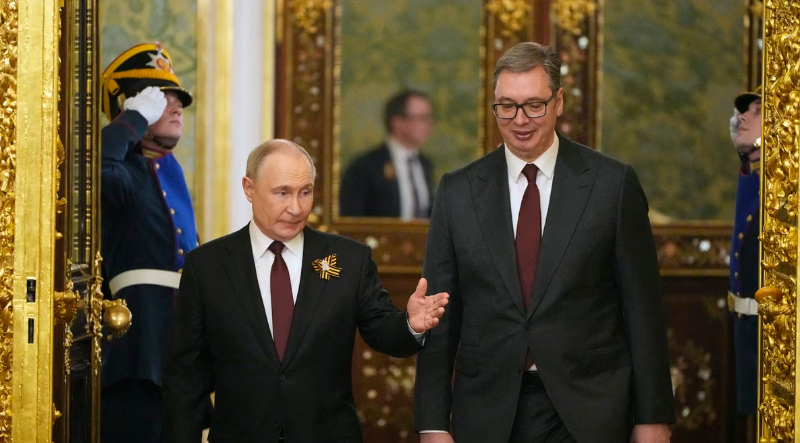
Russia is closely monitoring Serbia’s political situation as the country moves toward possible early parliamentary elections amid months of mass, student-led protests, with Moscow increasingly warning of what it describes as the risk of a “color revolution.”
Senior Russian officials have repeatedly raised the possibility of political upheaval following the elections, prompting questions over why the Kremlin is taking such a direct interest in Serbia’s domestic political developments.
Russian Ambassador to Serbia Aleksandar Botsan-Kharchenko has warned Serbian authorities to prepare for such a scenario, claiming that large-scale protests require foreign funding and support.
“It has been several years since protests of this scale have been organized, but this requires support, it requires money. And that comes from the West,” the ambassador said, adding that the possibility of a “color revolution” after the elections could not be ruled out regardless of the outcome.
Political analysts in Serbia have interpreted the remarks as going beyond traditional diplomatic messaging and potentially serving as political support for President Aleksandar Vučić at a sensitive moment.
Foreign-policy and security expert Srđan Cvijić argues that Moscow is far from indifferent to the outcome of Serbia’s elections and that statements by Russian officials may also have a political function.
“If they get into trouble, if they lose the elections, if they try to rewrite the election results in some illegal way, certainly it will not be the European Union or any Western power that will come to their aid, but Moscow,” Cvijić said.
Russian and pro-Vučić narratives increasingly overlap
Beyond diplomatic statements, analysts have also pointed to similarities between the rhetoric coming from Moscow and narratives promoted by Serbian tabloids supportive of Vučić’s government.
Cvijić described the relationship as a visible “symbiosis” between Moscow’s public discourse and the narratives promoted by pro-government media in Serbia.
“This narrative is absolutely identical to the narrative in the regime tabloids of Aleksandar Vučić,” he said, referring to portrayals of protesters and allegations of foreign interference.
According to Cvijić, pro-government media frequently portray protesters and political opponents through a framework of alleged foreign manipulation, narratives that are subsequently reinforced by statements from Russian officials.
He argued that the alignment is not a new phenomenon but a relationship that has become increasingly established over the years.
Political support for Vučić has also been reflected in statements by Russian Foreign Minister Sergei Lavrov.
Speaking about the Serbian president, Lavrov said Vučić was facing pressure from the European Union.
“It is not easy for Aleksandar Vučić. He is a very experienced politician and is committed to the course of European integration. At this stage, the European Union is harassing him and simply blackmailing him,” Lavrov said.
Russia’s Foreign Ministry has also commented on developments involving Kosovo and KFOR, demonstrating that Moscow’s interest extends beyond Serbia’s domestic political situation to the broader relationship between Belgrade, Prishtina and Western institutions.
Why would political change worry Moscow?
According to Cvijić, one of the main reasons lies in the nature of the relationship between Moscow and Serbia’s current political leadership.
He argues that Russian President Vladimir Putin’s authoritarian system is more compatible with Serbia’s centralized political structure than a democratic government that could pursue a clearer orientation toward European institutions.
“An authoritarian regime in Moscow suits this regime in Serbia. Regime change frightens them because a democratic government would not be guided by the interests of the ruling clique and oligarchy, but would have to respond to the interests of all citizens, which generally do not coincide with Moscow’s interests,” Cvijić said.
He argues that it would be difficult to expect a new government in Belgrade to continue representing Russian interests to the same extent as the current authorities.
Among the areas of concern, he cited cooperation with Russian intelligence services and allegations involving the persecution of Kremlin opponents in Belgrade.
Serbia caught between Moscow and Brussels
Serbia officially continues to identify European Union membership as its strategic objective, while maintaining close political and security ties with Russia.
That dual position makes Serbia one of the most strategically important countries in the Balkans for Moscow, particularly as Russia’s political influence in much of Europe has declined since the invasion of Ukraine.
Against this backdrop, repeated Russian references to a potential “color revolution,” foreign-backed protests and post-election instability can be viewed not only as assessments of Serbia’s political environment, but also as attempts to shape perceptions of any potential transfer of power.
If early parliamentary elections produce a change of government or trigger a new political crisis, Moscow’s response could become an important indicator of how far Russia is prepared to go to preserve its influence in Serbia.
The central question is therefore whether Moscow’s warnings about a “color revolution” represent a genuine assessment of political risks in Serbia or a pre-emptive message aimed at deterring forces that could challenge the current leadership in Belgrade.