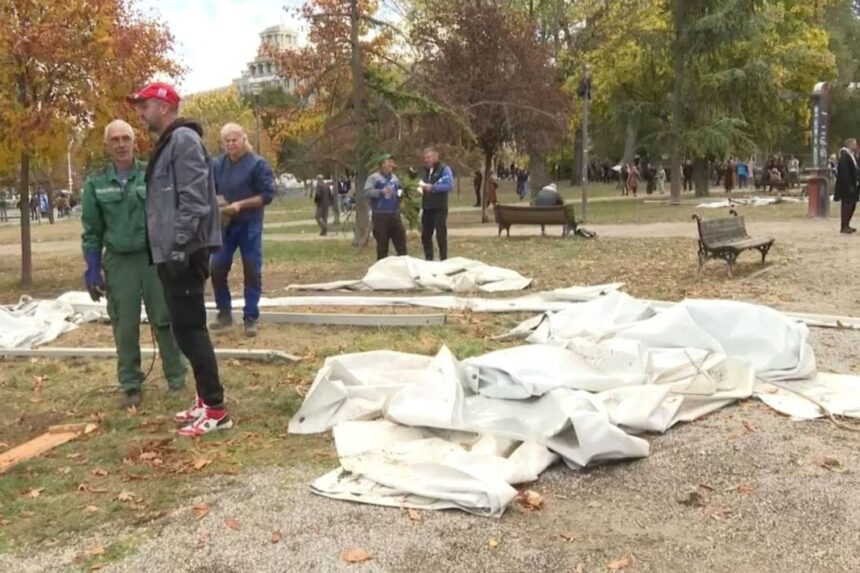
Citizens and workers from several public utility companies have launched a major cleanup operation in Belgrade’s Pionirski Park, one day after tents and other structures were removed from the area known as Ćacilend.
The park had been occupied for an extended period by people whose presence led to it being nicknamed Ćacilend. As the area gradually returns to its original appearance, participants in the cleanup say the operation represents not only the restoration of a public space but also an opportunity for broader social change.
According to N1, citizens were collecting rubbish and remnants of the structures and belongings left behind during the occupation. Teams from several public companies, including Beograd Vode, Gradska Čistoća, Gradsko Zelenilo and Belgrade Waterworks and Sewerage, also took part in the operation.
Workers say they were unable to enter the park
An N1 reporter asked employees of Gradsko Zelenilo why the waste had not been removed earlier. Most workers avoided speaking to the media, but one employee said they had been unable to enter the park because the area had been closed off.
“How were we supposed to enter?” the worker asked, explaining that employees followed instructions from the relevant authorities.
“Nobody was allowed to do anything until the order came,” he added.
Citizens describe a new sense of solidarity
Among those taking part was a Belgrade resident who said the turnout demonstrated growing solidarity among citizens.
“I’m absolutely delighted. I was just commenting with my colleagues that we had come out of work to clean together,” she told N1.
She recalled passing the park the previous week while feeling angry and powerless, adding that the cleanup should have happened much earlier.
Asked whether she believed the gathering reflected a renewed sense of solidarity, she replied: “Definitely. Absolutely. Serbs have come together.”
Another participant said the operation represented more than removing rubbish and restoring access to the park. She described it as the beginning of changes she believes Serbian society needs.
“From today, we are clearing away everything that happened. Everyone is cleaning the park in their own way, doing what they can — a park where we and our children were forbidden to walk. This is literally the beginning of a new state, a new society,” she said.
She added that restoring the park was important for creating a society in which people could live normally and feel secure about their future.
However, she stressed that the removal of the structures must not lead people to forget what happened during the occupation.
“This absolutely must not be forgotten for a single moment — what we experienced, what we were allowed to go through, the conditions we lived under and what was imposed on us,” she said, warning that society must ensure such circumstances do not happen again.
She described the physical cleanup as only the beginning of a much broader task, arguing that changes in social attitudes and habits would also be necessary.
Emotional return to a familiar public space
Another Belgrade resident who lives near Pionirski Park said she had avoided walking along the side of the street next to the park for almost two years.
“This is phenomenal. I live across the street. For two years, I haven’t even walked along this side of the street where the park is. I’m emotional. I feel like crying, and I’m very happy. This is the real Serbia,” she told N1.
The cleanup began a day after the removal of the tents and structures from Ćacilend, with citizens and municipal services working together to restore the park for ordinary public use.
For many participants, however, the operation carries a wider message: while the physical space is being cleaned and restored, the experiences of the past period should remain part of the public memory, and the work of rebuilding trust and solidarity in society is far from over.