An investigation by Radio Free Europe (RFE) has ignited a fierce political storm in Serbia, revealing that the government is utilizing taxpayer funds to finance the “Red Berets” Veteran Association. The organization serves as a collective for former members of the Special Operations Unit (JSO)—a disbanded elite security force whose legacy is inextricably linked to the most notorious war crimes of the 1990s and the 2003 assassination of Serbian Prime Minister Zoran Đinđić.
According to financial analysis of state records, the Ministry of Labour, Employment, Veteran and Social Affairs has funneled approximately €23,000 to the association over the last two fiscal years (2024–2025).
The Architects of Funding: A Shift to the Far-Right
The surge in state support coincides with the 2024 appointment of Milica Đurđević Stamenkovski as Minister. Stamenkovski, the leader of the ultra-nationalist “Zavetnici” party, has faced long-standing criticism for her proximity to paramilitary figures.
Under her leadership, the “Red Berets” have secured funding for several projects with ambiguous objectives:
- “Veterans’ Decathlon”: An annual sporting event that has previously received support from the Vojvodina provincial government.
- “The Status of Fighters in Society Today”: A project aimed at rehabilitating the public image of former JSO members.
- “Covenant of Freedom”: A state-funded initiative for which no public record of implementation exists.
Despite formal inquiries, the Ministry has refused to define the “public interest” served by financing a group whose primary members were instrumental in the downfall of the first democratic government in modern Serbian history.
A Legacy of Violence and Convictions
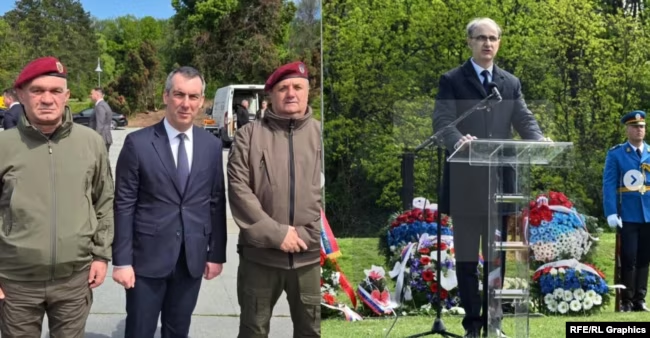
The JSO, or the “Red Berets,” was established in the early 1990s by the State Security Service (RDB) under the direction of Jovica Stanišić and Franko Simatović. In 2023, both men were sentenced by the Hague Tribunal to 15 years in prison for aiding and abetting war crimes in Bosnia and Herzegovina.
The unit’s domestic record is even more grim. Former members currently serving life or long-term sentences include:
- Milorad “Legija” Ulemek: The unit’s commander, convicted of organizing the assassination of Prime Minister Zoran Đinđić in 2003 and the murder of former President Ivan Stambolić.
- Zvezdan Jovanović: The sniper who pulled the trigger on Đinđić.
Critics argue that the current government is engaged in “historical revisionism by stealth,” attempting to transform convicted terrorists and assassins into state-venerated “patriots.”
The “Great Alexander” and Political Loyalty
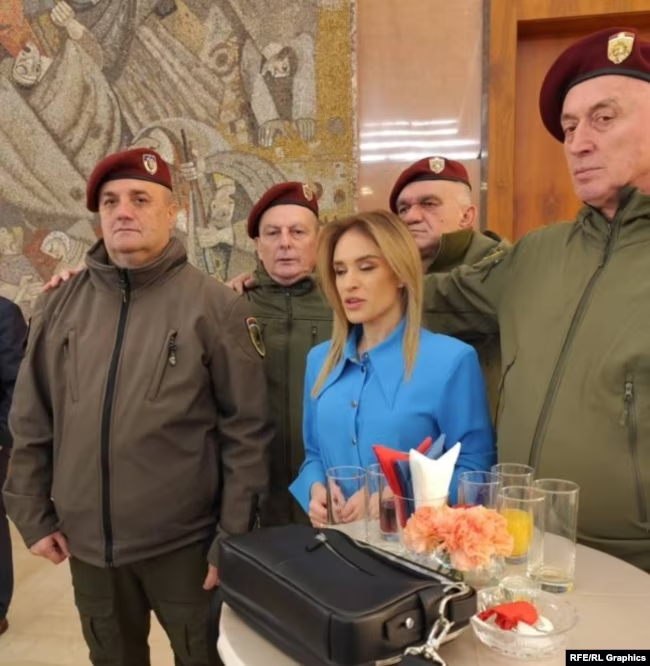
The funding appears to be part of a broader symbiotic relationship between the ruling Serbian Progressive Party (SNS) and the veteran group. In exchange for state patronage, the “Red Berets” have become a visible force in pro-government counter-protests and rallies.
In March 2025, veterans led by Živorad “Žika” Ivanović—the association’s legal representative—maintained a presence in Belgrade’s Pioneer Park to protect pro-government supporters from opposition activists. More recently, on May 4, 2026, during the 35th-anniversary celebration of the unit’s founding, veteran Vasilije Mijović publicly bestowed the pseudonym “Alexander the Great” upon President Aleksandar Vučić, praising his role in “restoring the unit’s glory.”
“It is particularly perverse,” says Filip Švarm, editor-in-chief of Vreme and a leading expert on the unit. “To see these men honored by the state just days away from the anniversary of the Prime Minister’s murder speaks volumes about the values this administration is propagating.”
Regional Implications: “The Drina is Not a Border”
The state-funded “Veterans’ Decathlon” in 2025 featured banners declaring “The Drina is a river, not a border,” a slogan directly challenging the sovereignty of Bosnia and Herzegovina. This rhetoric, coupled with state funding, has raised alarms in Sarajevo and Pristina, where the “Red Berets” are remembered for their role in ethnic cleansing and massacres.
As Serbia seeks to balance its EU candidacy with its domestic nationalist base, the formal financing of a group linked to political assassinations represents a significant departure from European values of the rule of law and transitional justice.