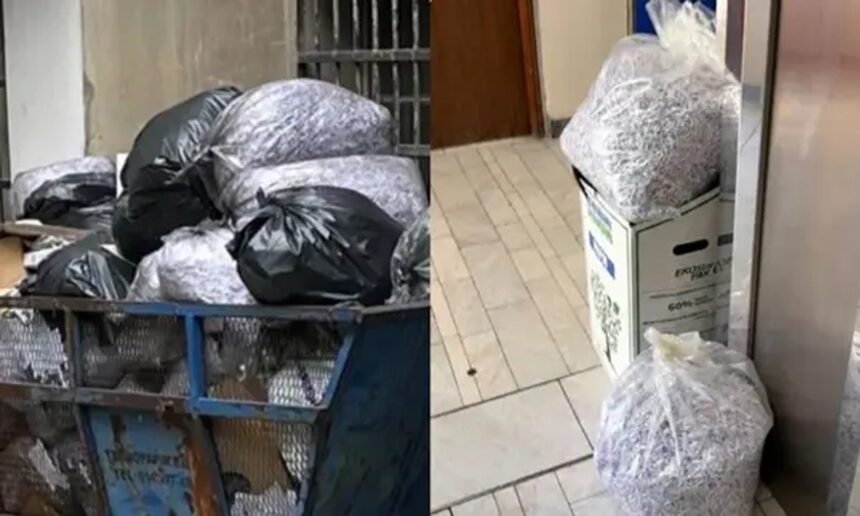
Black garbage bags filled with shredded documents, locked offices in state institutions, and activities reportedly taking place at night, according to employees’ accounts.
These are the reports and photographs emerging publicly after the Student List won the October 25 elections against the Serbian Progressive Party (SNS), which lost after holding power for the past 14 years.
The latest suspicions of the destruction of important records have emerged at Serbia’s Republic Pension and Disability Insurance Fund (PIO).
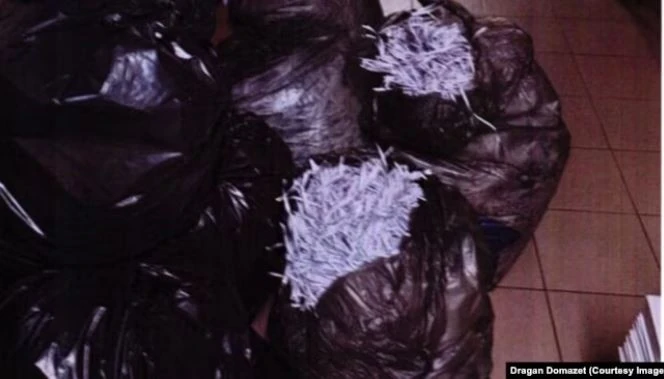
Dragan Domazet, the chief representative of the Association of Free and Independent Trade Unions (ASNS) for employees of the Republic PIO Fund, confirmed to Radio Free Europe/Radio Liberty (RFE/RL) that the photographs showing bags of destroyed documents were authentic.
“Something extraordinary and unusual is happening at night,” Domazet said, adding that employees had managed to save some of the documents from destruction.
RFE/RL reviewed an email that Domazet had sent, together with the photographs, to the Association of Free and Independent Trade Unions in an effort to alert the public.
Black bags allegedly containing destroyed documents at Serbia’s Republic Pension and Disability Insurance Fund.
As of the publication of the article, the PIO Fund had not responded to the allegations.
On October 29, Serbia’s State Prosecutor Zagorka Dolovac instructed all chief public prosecutors and acting chief public prosecutors to urgently contact the police and request measures to prevent the destruction of official records and other documents.
According to the directive, reports circulating publicly concern the destruction of documents in state institutions, banks, the Security Intelligence Agency (BIA), the Military Intelligence Agency, and other institutions important to Serbia’s economic, financial and legal security.
Document Destruction Also Suspected at Serbian Institutions in Kosovo
A group of students from the university in North Mitrovica who support the Student List announced that they had received information about the destruction of documents at the Clinical Hospital Center in North Mitrovica and at temporary municipal authorities.
The university in North Mitrovica and the Clinical Hospital Center operate within Serbia’s system.
The temporary municipal authorities also operate within that system, but Kosovo authorities have closed them over the past two years, arguing that they are illegal parallel structures.
In their statement, the students said that, according to the information they had received, activities were underway to destroy and remove documentation, as well as to destroy records and potentially misuse funds related to doctors’ salaries.
Zllatan Ellek, director of the Clinical Hospital Center in North Mitrovica, denied the allegations in a response to RFE/RL, describing them as false and unfounded.
“At the Clinical Hospital Center in Kosovska Mitrovica, no one is destroying, removing or concealing official documentation, as there is absolutely no reason for such actions. We consider it unacceptable for such serious accusations to be made public without any concrete evidence, damaging the reputation of the institution and its employees,” the response stated.
He also argued that such attacks “could jeopardize the work of one of the most important institutions for members of the Serb community.”
Ellek is also the leader of the Serbian List, the main party representing Serbs in Kosovo. It was established with the support of the Serbian Progressive Party and Serbia’s former president, Aleksandar Vučić.
What Does the Law Say?
Under Serbia’s Criminal Code, destroying, concealing or falsifying an official document constitutes a criminal offence punishable by three months to five years in prison.
Before Dolovac issued her directive, the Student List, which emerged from student protests against corruption, called on employees of state institutions to alert the public and report any destruction of documentation.
“We call on you to prevent any abuse that outgoing government officials may attempt during the transition period,” student Filip Ubović said at a news conference in central Belgrade.
RFE/RL contacted the Serbian Progressive Party for comment on allegations that people close to the party were destroying official records in state institutions but received no response.
What Else Is Being Reported?
Opposition politician Đorđe Miketić posted on X on October 28 that documents were also allegedly being destroyed at night at the Ministry of Construction and the Ministry of Finance.
Neither ministry has responded to the allegations so far.
Serbia’s Ministry of Construction, Transport and Infrastructure had responsibilities related to the reconstruction of the railway station in Novi Sad, where the entrance canopy collapsed on November 1, 2024. The disaster, which killed 16 people, triggered mass student protests demanding accountability.
The protests quickly expanded to include demands for action against corruption and an end to pressure on institutions.
Meanwhile, Student List representative Nemanja Karović said during an appearance on Serbia’s public broadcaster RTS that there had been attempts to withdraw around one billion dinars from the Postal Savings Bank. According to him, this could have jeopardized the bank’s liquidity and the regular payment of salaries and pensions.
However, the Postal Savings Bank denied these claims on October 29.
The bank stated that it was a financially stable, liquid and systemically important institution operating in accordance with applicable regulations.
“Linking an event that never occurred to claims that the Bank’s liquidity, the regular payment of salaries and pensions, and even the stability of the entire financial system are at risk amounts to an unfounded questioning of the security of an institution that has enjoyed the trust of Serbian citizens for more than a century,” its statement said.
During its election campaign, the Serbian Progressive Party had claimed that Serbian citizens would stop receiving their regular income if the Student List won.
Who Should Investigate the Alleged Destruction of Documents?
Lawyer Ahmed Delimegjac told RFE/RL that the competent Serbian prosecutors should respond to the allegations because destroying official documentation constitutes a criminal offence.
“There is no doubt that if it is established that someone is destroying official documentation, they are committing a criminal offence. I believe the prosecutor and the police, which are obliged to intervene immediately when they learn that a crime is being committed, must respond,” he said.
He expects Serbian prosecutors to act and prevent the destruction of official records following State Prosecutor Zagorka Dolovac’s directive. He also recalled that, two days earlier, Dolovac had sent all public prosecutors another directive concerning access to every case they were handling.
In his assessment, the prosecutor’s actions followed the change in political power and reflected an attempt, as he put it, to “court” the incoming authorities.
“It is right to take these steps, but, on the other hand, I fear these people are trying to remain in their positions and avoid dismissal. They are now competing to prove first that they are loyal to the new government,” he said.
How Is Official Documentation Preserved?
Dragan Domazet, the chief representative of the Association of Free and Independent Trade Unions for employees of the Republic PIO Fund, said there were serious suspicions that electronically stored data was also being destroyed.
“If some enthusiastic individual has not created a backup copy, there is a significant risk that a considerable amount of evidence relating to various proceedings could be destroyed,” he said.
Domazet believes the destruction of evidence has been “systematically planned and organized.”
However, Rodoljub Šabić, a lawyer and former Serbian Commissioner for Information of Public Importance and Personal Data Protection, believes that destroying electronically stored official documentation is difficult in 2026.
“That is my assessment. But, you know, over the past 10 to 15 years, we have been an extremely non-transparent country — or, more precisely, we have had a non-transparent government. Only they know how they stored and organized the documents. This makes it difficult to identify the relevant issues,” he said.
He added that when an autocratic regime falls, there is always a risk that documents exposing human rights violations, crimes, criminal activity or major financial manipulation will be deleted or destroyed. Nevertheless, he reiterated that erasing the traces is significantly more difficult today.