In Serbia, political battles are fought not only through elections, official statements and institutional decisions, but also through information. Every day, millions of citizens are exposed to a media environment that helps define who is portrayed as a threat, who is labeled a traitor or enemy, and who is presented as the defender of the state.
At the center of this system is a powerful media ecosystem that has developed and consolidated during Aleksandar Vučić’s years in power, where the line between political propaganda and news reporting has increasingly become blurred.
Freedom House’s 2026 assessment describes Serbia’s media environment as being marked by extreme propaganda and manipulation of facts on certain issues, including Kosovo. The organization has also highlighted the influence of the state and ruling party over private media through advertising, indirect subsidies and economic relationships.
That does not mean every Serbian media outlet operates according to the same model. The broader problem is structural: when a large number of widely followed platforms repeatedly present the same political framework, the space for genuine pluralism and debate becomes increasingly narrow.
And within that system, Kosovo remains one of the most powerful tools for emotional mobilization.
Modern propaganda does not always need to invent an event. Often, it is enough to decide which element of an event should receive the greatest attention.
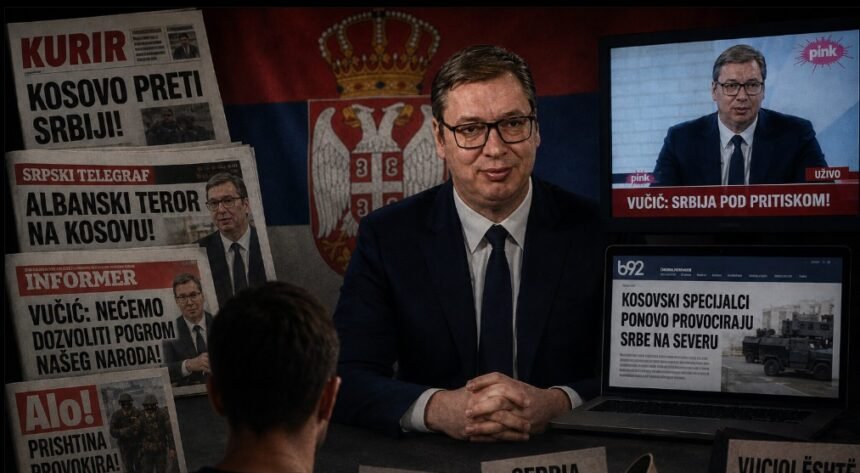
An incident in northern Kosovo can be presented as a security issue, a political dispute or part of a broader conflict. But when the same event is repeatedly described using terms such as “terror,” “ethnic cleansing,” “attack on Serbs” or “provocation by Prishtina,” audiences receive not only information but also a ready-made interpretation.
The more important question, therefore, is not simply whether an individual headline is false. It is what kind of reality is created when thousands of headlines, photographs, statements and commentaries repeatedly reinforce the same political message.
Vučić at the Center of the Narrative
One of the most powerful mechanisms is the personalization of politics.
An analysis by Raskrikavanje of Serbian media coverage during 2025 highlighted the scale of manipulation in a number of mainstream outlets considered close to the authorities. Monitoring of six newspapers — Alo, Informer, Srpski telegraf, Politika, Večernje novosti and Kurir — identified 1,863 manipulative articles on their front pages during the year.
Aleksandar Vučić occupied an extraordinary amount of space in this media landscape. He appeared more than 1,000 times on the front pages of the monitored newspapers, while the particularly striking feature was how he was portrayed: none of those appearances were negative.
The individual figures are also significant. Alo recorded 529 manipulative articles, followed by Informer with 399, Srpski telegraf with 294, Politika with 253, Večernje novosti with 197 and Kurir with 191.
The figures point to more than isolated examples of biased reporting. They suggest a recurring editorial pattern in which the authorities, particularly Vučić, are systematically presented in a favorable light, while political opponents and actors perceived as threats are framed more negatively.
In this environment, front pages do not function solely as sources of information. They also become instruments for shaping public perception and political agendas.
The result is the construction of a political figure who is simultaneously presented as a guarantor of stability and as a permanent victim of external and internal attacks.
On one side, Vučić is portrayed as the leader who “defends Serbia.” On the other, he is presented as a politician constantly facing pressure from foreign powers and domestic opponents.
When this logic is extended to Kosovo, every crisis can become further evidence that Serbia is surrounded and that the government needs continued public support.
Why Kosovo Is So Powerful as a Propaganda Tool
Kosovo has a propagandistic advantage that few other political issues possess because it combines history, national identity, territory, security and emotion.
For that reason, a development in Kosovo does not necessarily need to be significant to receive enormous attention in the Serbian media environment. It only needs to fit an existing narrative.
Within that narrative, Serbs in Kosovo are portrayed as an unprotected community, Prishtina as the principal source of pressure, and the West as an actor that either tolerates or supports the situation.
The Banjska armed attack in September 2023 demonstrated how quickly a political interpretation can be built around a security incident. Rather than limiting public discussion to verifiable facts, parts of the media environment were filled with emotional headlines, accusations and interpretations that placed the event within a broader narrative of Serbian victimization.
Another important element is the use of alarmist language.
Words shape public reactions before audiences have time to analyze an event. An alarming headline demands an immediate emotional response rather than reflection.
That is why references to war, terror, attack, betrayal or catastrophe appear so frequently in politically oriented tabloids. They shift attention away from facts and toward emotion.
In the case of Kosovo, the strategy has a dual function: it strengthens the perception of threat while simultaneously reinforcing the need for strong leadership.
The message is not simply that “Kosovo is a problem.” A broader political equation is constructed in which Kosovo represents the threat, Serbia is the state under pressure, and Vučić is portrayed as the only leader capable of defending it.
Propaganda Does Not Always Need to Convince
If one outlet repeats an accusation against Kosovo for days, even critical media may eventually be forced to cover the issue.
That is one of propaganda’s greatest strengths. It does not necessarily have to convince everyone. It can simply determine what everyone is talking about.
Freedom House has reported that Serbian journalists face threats, editorial pressure, economic difficulties and pressure from political actors and media outlets linked to the authorities.
In June 2025, Vučić described reporting by N1 and Nova S as “pure terrorism” and referred to the possibility of prosecutorial intervention. The comments prompted concern among journalists’ organizations and the Council of Europe’s Platform for the Safety of Journalists.
Such confrontational rhetoric toward independent media is part of a broader political communication strategy in which critical reporting is frequently portrayed as hostile activity rather than as a legitimate component of democratic debate.
The same logic has also been applied to student protests and opposition movements, which Raskrikavanje’s analysis found were often portrayed as threats or components of broader conspiracies.
The Russian Connection
Russian narratives also form part of this information environment.
Messages portraying the West as hypocritical, NATO as a threat, Ukraine as an instrument of foreign powers and Kosovo as the product of a Western conspiracy create an environment in which the propaganda interests of Moscow and Belgrade can overlap.
For Kosovo, the challenge is therefore not only what pro-Vučić media say about it. It is also the fact that a significant part of the Serbian public can be exposed repeatedly to a narrow version of reality in which Prishtina is almost always presented as the source of a crisis and compromise is frequently portrayed as weakness.
Dialogue requires at least a minimum of shared reality. When parties disagree not only over possible solutions but also over basic facts, reaching compromise becomes significantly more difficult.
In that sense, propaganda is not merely a media problem. It is also a political problem because it influences the boundaries within which solutions to the Kosovo issue can be imagined and debated.
Pro-Vučić media do not need to invent a new story about Kosovo every day. It is enough to keep alive the idea that Serbia is always under threat, that Serbs are always victims and that the government is always the last line of defense.
That is how a propaganda machine operates — not necessarily by producing one enormous lie, but by producing small versions of the same reality every day, repeating them so frequently that they can eventually appear unquestionable.
As long as Kosovo remains one of the most powerful symbols of identity and insecurity in Serbian politics, it is likely to remain one of the most important sources of fuel for this media machinery.