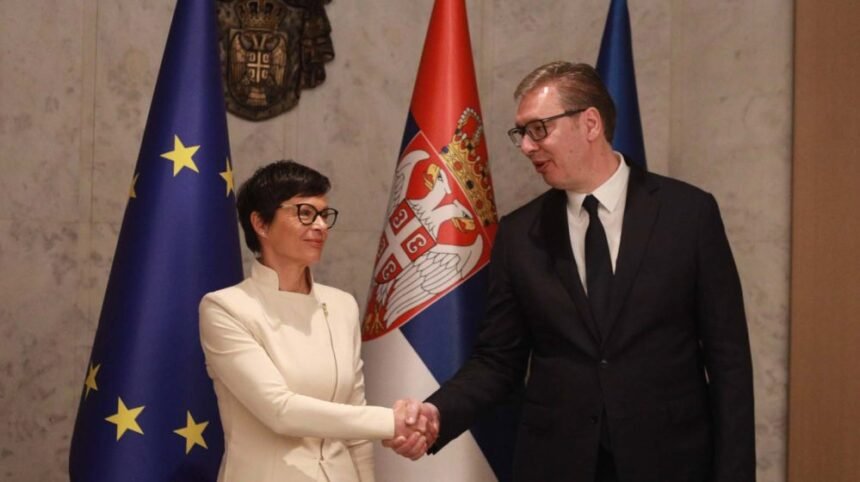
Serbian President Aleksandar Vučić has framed controversial remarks by European Union Enlargement Commissioner Marta Kos as a sobering “reality check” for the Western Balkans, asserting that the EU’s hesitation has inadvertently given Belgrade more strategic independence.
Speaking to journalists during his official state visit to Georgia, Vučić reacted to Kos’s policy statements regarding candidate states losing certain national veto powers. He used the moment to criticize Brussels’ long-term expansion policy, stating flatly that if Western European powers truly wanted the region integrated, it would have happened years ago.
1. The Flaw in the Promise: Facing Geopolitical Reality
While other prospective EU hopefuls—including Ukraine and Georgia—reacted with visible anger to the proposed multi-year transition timelines and “safeguard measures,” Vučić adopted a pragmatically detached stance.
Vučić's Analysis of European Integration Delays

 [ THE ACCUSATION ] ──► INTENTIONAL INSTITUTIONAL DELAY
 • "If they wanted all of us in Europe much faster, they could have done it 5, 7,
   or 10 years ago. Of course they didn't want to."

 [ DEFEATING ILLUSIONS ] ──► THE REALITY CHECK
 • Vučić thanked Commissioner Kos for stripping away the diplomatic window-dressing:
   "She has faced many others with reality... I have long ceased to deceive Serbian citizens."

 [ STRATEGIC AUTONOMY ] ──► "GREATER FREEDOM OF MOVEMENT"
 • The President claimed the EU's rigid, shifting goalposts actually grant Belgrade
   "somewhat greater freedom in our behavior and in our relationships with others."
“It is up to us to see what our interests are. Someone simply needed to understand the situation, be rational, and stop misleading their own people.”
— Serbian President Aleksandar Vučić in Tbilisi
2. Recalibrating Serbia’s Key Priorities
Despite his sharp critique of the EU’s political demands, Vučić carefully separated political alignment from economic necessity. He reiterated that Serbia’s core regional and continental goals remain deeply tied to Western markets, even if full political integration remains stalled.
Belgrade's Two-Tiered Strategy Moving Forward
┌────────────────────────────────────────────────────────────────────────┐
│                                                                        │
│  [ THE PRIMARY INTERESTS ] ────────────────────────────────────────┐   │
│  • Open borders across the Western Balkans (via Open Balkan initiatives)│   │
│  • Full access and integration into the Single European Market.        │   │
│                                                                        │   │
│  [ THE CONCESSIONS UNDER FIRE ] ───────────────────────────────────┤   │
│  • Vučić criticized the heavy price of entry, noting that Brussels     │   │
│    demands absolute, 100% alignment with EU foreign policy just to     │   │
│    gain market access or border openings.                              │   │
│                                                                        │   │
│  [ THE PIVOT TO INTERNAL RAST ] ───────────────────────────────────┘   │
│  • Rather than focusing exclusively on satisfying European political    │
│    benchmarks, the administration plans to aggressively target         │
│    domestic industrial and macroeconomic growth.                       │
└────────────────────────────────────────────────────────────────────────┘
3. The Regional Balancing Act
The shifting dynamics come at a time when Serbia is actively diversifying its global trade profile, balancing its European economic integration with high-yield commercial accords across Asia and bilateral treaties signed during the President’s trip to Tbilisi.
| Priority Arena | Brussels’ Demand | Serbia’s Stance (2026) |
| Foreign Policy Alignment | Absolute compliance with Western sanctions and geopolitical stances. | Resisted; Belgrade intends to use its “greater freedom” to maintain balanced ties with non-EU global powers. |
| Economic Integration | Implementation of strict regulatory and marketplace adjustments. | Accepted; viewed as vital for driving Serbia’s domestic growth and regional trade dominance. |
| Balkan Borders | Fulfillment of specific political criteria to unlock growth funds. | Conditional; Belgrade supports open borders but rejects political ultimatums that threaten sovereign choice. |
Vučić concluded by noting that while the upcoming diplomatic negotiations with Brussels will bring “complex and difficult consequences” for Serbia, the ultimate outcome is not necessarily negative. By forcing candidate countries to drop unrealistic expectations, the current EU stance allows Belgrade to shed political illusions and focus entirely on its own economic self-reliance.