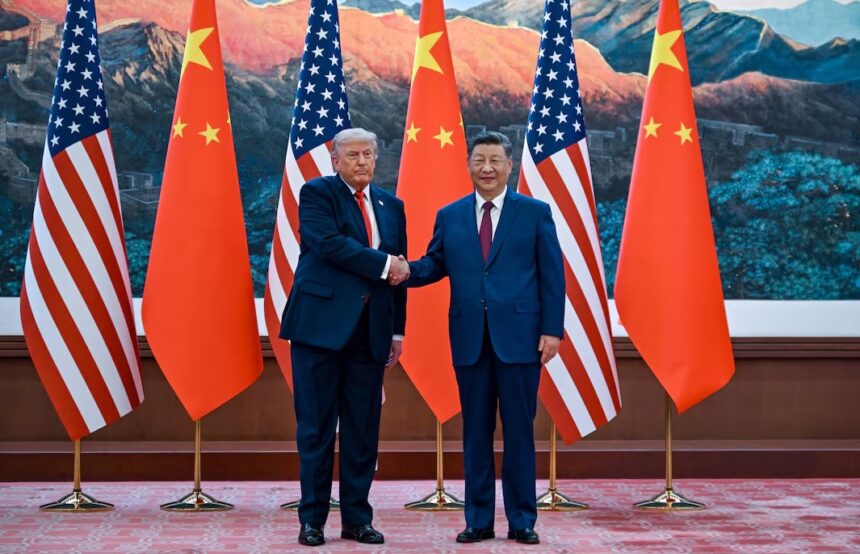
In a historic meeting that captured the world’s attention, U.S. President Donald Trump and Chinese President Xi Jinping held nearly two hours of talks in Beijing today. This visit marks Trump’s return to the Chinese capital for the first time since his 2017 presidency, occurring at a moment when China is striving to project itself as a stable global superpower.
The summit is particularly critical given the ongoing military conflict involving the U.S., Israel, and Iran, and the resulting paralysis of the Strait of Hormuz.
A Delegation of Tech Giants
President Trump arrived with a high-profile delegation that signaled a heavy focus on the technological “arms race.” Accompanying him were:
- Elon Musk: CEO of Tesla and SpaceX.
- Jensen Huang: CEO of Nvidia.
The presence of these industry leaders underscores that, despite the diplomatic formalities, the competition over semiconductors, Artificial Intelligence, and green energy remains at the heart of the U.S.-China relationship.
“Partners, Not Rivals” vs. The Taiwan Warning
The summit was characterized by a sharp contrast between public diplomatic warmth and underlying geopolitical tensions:
- The Rhetoric: President Xi opened the talks by calling for the two nations to be “partners, not rivals.” President Trump reciprocated the sentiment, labeling Xi a “great leader” and predicting that the relationship would be “better than ever before.”
- The Reality: Almost immediately after the meeting began, Chinese state media released comments from Xi warning of potential “conflict” over Taiwan. Beijing continues to view the island as a red line, especially as U.S. military posturing in the Pacific remains firm.
Key Agenda Items
The two leaders tackled a series of “tough” topics that have strained global stability:
- The Iran Conflict: Discussions on how to resolve the crisis in the Persian Gulf and the blockade of the Strait of Hormuz.
- Trade & Tariffs: Negotiations over the future of economic barriers and market access.
- Technology Competition: Addressing the dominance of companies like Nvidia and Tesla in the global supply chain.
- Taiwan: Navigating the most sensitive security flashpoint in Asia.
While the “handshake” provides a momentary sense of diplomatic relief, the outcome of these two-hour talks will determine whether the two superpowers can successfully de-escalate a world increasingly defined by trade wars and hot conflicts.