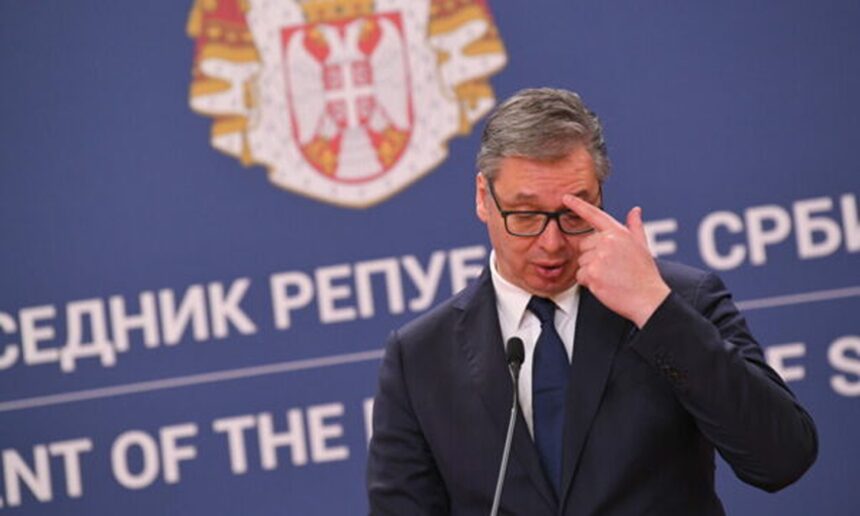
President of Serbia Aleksandar Vučić has escalated his rhetoric against Montenegro, accusing it of “exporting” criminal clans into Serbia, just one day after the arrest of Belgrade police chief Veselin Milić over allegations of covering up a murder tied to organized crime.
As public pressure mounts in Serbia for answers about the arrest of the capital’s top police official, Vučić has shifted attention away from the domestic scandal and instead launched sweeping accusations against Montenegro, claiming that “criminal clans from Kotor have killed half of Serbia.”
Authorities in Podgorica have remained silent in response, with neither the government nor the Interior Ministry addressing the claims.
Opposition MP Nikola Zirojević strongly rejected Vučić’s narrative, describing it as selective and politically motivated.
“If you listen to Vučić, all of us in Montenegro are Serbs, except when it comes to criminals—then suddenly they are Montenegrin,” he said.
He added that Vučić’s framing avoids the real question: how and why Serbia has become a safe operating ground for organized criminal networks.
“Instead of accountability at home, the blame is being exported across the border,” Zirojević stated.
At the center of the controversy is former Belgrade police chief Veselin Milić, who was arrested on suspicion of participating in the concealment of a brutal murder inside a Belgrade restaurant. Prosecutors allege he contacted the victim directly and lured him to the location without security protection, where the suspects were already waiting.
The victim’s body has still not been found, while Serbian authorities have even involved the army in the search.
Despite the gravity of the case involving senior police structures, Vučić provided few explanations about the arrest itself, instead devoting his public remarks almost entirely to Montenegrin criminal clans.
Former Serbian Interior Minister Božo Prelević said Vučić’s reaction appeared to be a calculated attempt to redirect public attention away from a scandal inside Serbia’s own security apparatus.
“The state is obligated to explain how a serious murder could happen in a controlled setting and why members of the Interior Ministry are now under arrest,” he said.
Vučić again highlighted the “Kavač” and “Škaljari” clans from Kotor, long associated with violent criminal activity across the Balkans and Europe, portraying them as central to regional insecurity.
However, investigative journalist Vuk Cvijić said such groups cannot be simplified through national labels, arguing that they operate in a deeply interconnected criminal ecosystem.
“These networks are not divided by nationality. Many actors hold dual citizenship and operate seamlessly across borders,” he noted.
He added that their presence in Serbia reflects not foreign intrusion, but weaknesses within Serbia’s own institutions that allow such groups to operate freely.
Vučić also referenced convicted Montenegrin figure Miloš Medenica, claiming he is being protected by criminal networks—an allegation that remains unverified by judicial authorities.
The political escalation comes just ahead of the 20th anniversary of Montenegro’s independence, which Vučić has openly refused to commemorate, calling it a “humiliation” to celebrate Montenegro’s separation from Serbia.
Montenegro’s Foreign Ministry condemned his statements as irresponsible and inflammatory, warning that they further damage already fragile regional relations.