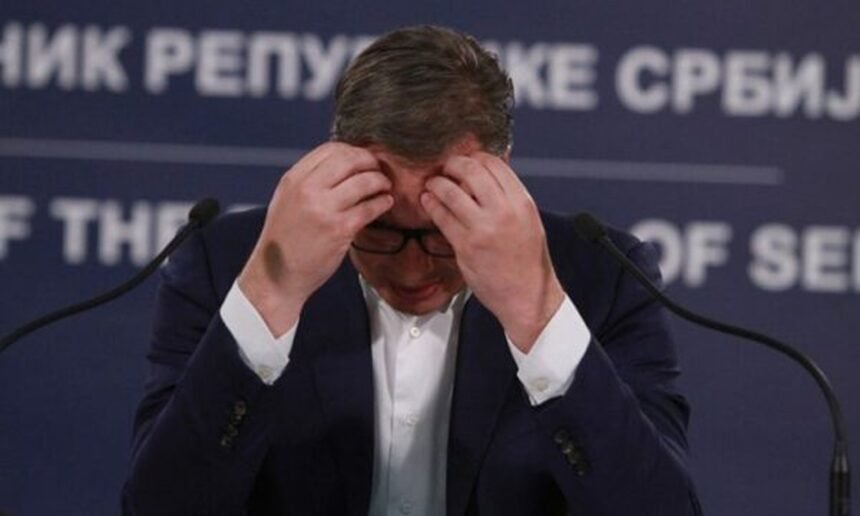
Serbian President Aleksandar Vučić is facing mounting pressure over the timing of snap parliamentary elections, with political analysts arguing that another postponement of the vote—now expected in October or November—could come at a significant political cost.
The debate intensified after Serbia’s National Assembly voted to uphold confidence in the government, removing the final legal obstacle to calling early parliamentary elections that Vučić has repeatedly promised for this autumn.
Recent public opinion polls indicate that support for the student-backed opposition bloc and parties aligned with Vučić’s ruling coalition is nearly level, prompting renewed speculation over whether the Serbian president might once again delay the elections.
Political analyst Dejan Bursać said the ruling Serbian Progressive Party (SNS) is likely seeking to hold parliamentary elections before the next presidential race, arguing that the latter poses a much greater risk because Vučić cannot seek another presidential term.
According to Bursać, parliamentary elections still provide the ruling party with greater opportunities to secure a majority through coalition-building and electoral strategies, while a presidential contest would be a direct head-to-head race in which public dissatisfaction could prove decisive.
Former Vojvodina Premier Bojan Pajtić argued that Vučić has narrowed his own room for maneuver by repeatedly insisting that citizens would decide the country’s future through elections.
“If elections do not take place after so many public promises, it would no longer appear as a statesmanlike decision, but as a political retreat driven by uncertainty over the outcome,” Pajtić said, adding that such a move could also disappoint part of Vučić’s own electorate.
Journalist Nedim Sejdinović said he believes Vučić will attempt to postpone the elections for as long as possible, arguing that the Serbian president is seeking to buy time while facing declining public support and a political system under increasing strain.
Sejdinović also suggested that stronger election monitoring by the opposition and increased international scrutiny could make it more difficult for the authorities to influence the electoral process than in previous elections.
The debate over the election timetable comes amid growing political tensions in Serbia, where opposition parties and the student movement have repeatedly accused Vučić of delaying elections because of fears that his ruling coalition could lose power.