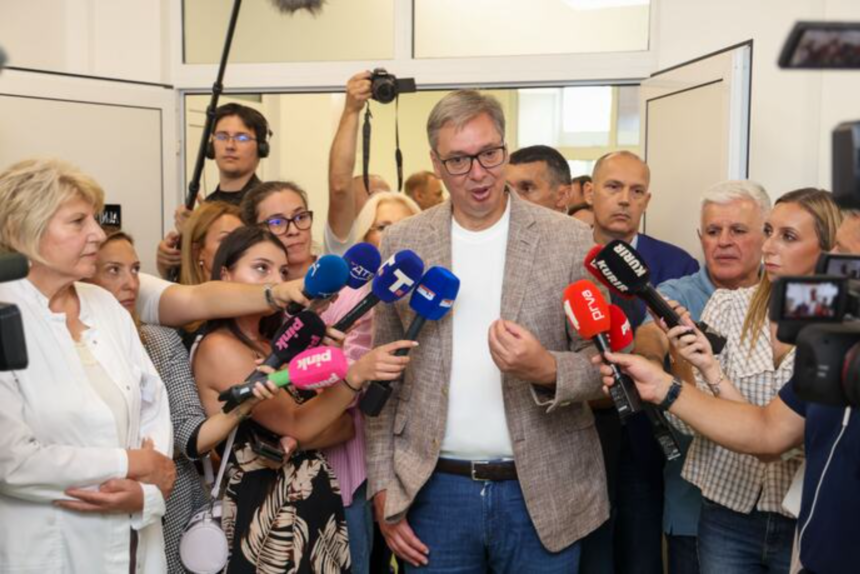
Serbian President Aleksandar Vučić has presented the country’s upcoming elections as a choice between his “United Serbia” list and the so-called “blockaders,” claiming that any vote for a political list other than his own would effectively be a vote for the opposition movement.
Speaking during a visit to Kuršumlija, Vučić told citizens that there would be only “two options” at the elections and portrayed his political camp as the only “safe choice.”
The statement is not an objective description of the electoral landscape. It is a political message designed to reduce a complex election involving multiple parties and political positions to a simple binary choice: vote for Vučić’s camp or supposedly support his opponents.
Vučić also dismissed the existence of a student political option, saying there were “no students” and instead referring to his opponents as “worn-out” and “wasted” politicians. The rhetoric reflects a broader strategy in which political opponents and critics are repeatedly grouped together and presented as a single threat.
But a vote for another political party does not automatically constitute a vote for the blockaders. Voters can support different parties for entirely different reasons, and Serbia’s electorate cannot legitimately be reduced to supporters of one ruling list and an alleged opposition bloc.
By declaring that “whoever you vote for, except for the United Serbia list, is a vote for the blockaders,” Vučić is effectively attempting to define the meaning of every vote before citizens even cast their ballots.
That is not a neutral electoral argument. It is political pressure.
The president’s message also comes amid sustained political tensions in Serbia, where student-led protests and blockades have challenged the government and demanded political accountability. Rather than addressing the substance of those demands, Vučić continues to frame the political conflict as a confrontation between his camp and an undefined enemy.
His comments about N1 and Nova S further reinforce this approach. Vučić accused the broadcasters of spreading “lies” and claimed that there was no falsehood they had not invented, without providing evidence for such sweeping allegations.
The pattern is familiar: political criticism is portrayed as hostility, independent media are portrayed as enemies, and voters are told that supporting anyone other than the ruling camp amounts to supporting a supposed national threat.
Vučić may tell voters to “let the people choose,” but his own message attempts to narrow that choice in advance.
Serbia’s voters are entitled to choose among competing political options based on their own interests, priorities and judgment—not according to a definition imposed by the country’s president.
The elections should be a contest of policies and ideas, not a campaign built around fear, false equivalences and the claim that every vote against Vučić is automatically a vote for his opponents.