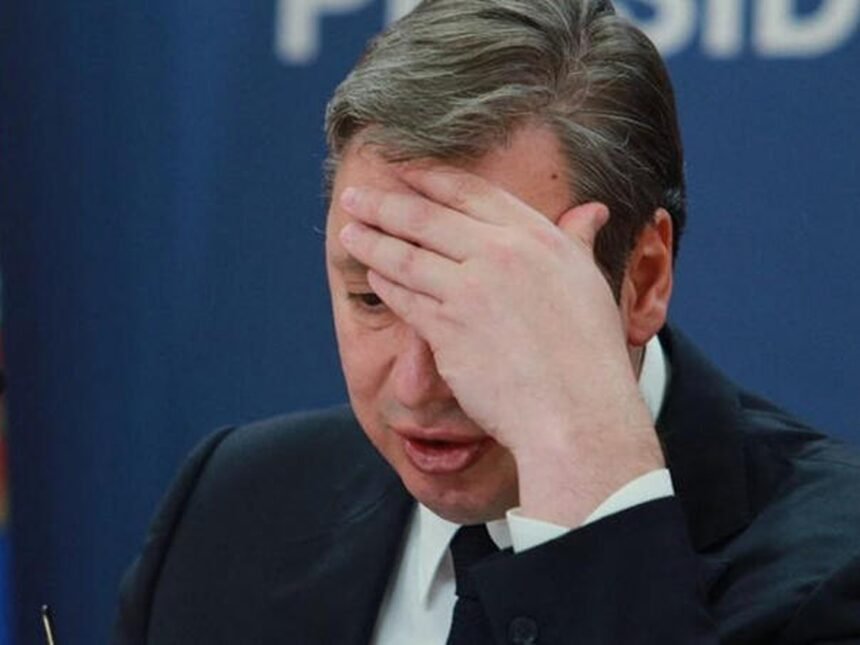
Serbian President Aleksandar Vučić has increasingly turned public appearances across the country into confrontations with local officials, openly criticizing and humiliating mayors and party figures while they largely remain silent, according to analysts and political opponents cited by Danas.
The pattern has become particularly visible in recent weeks, as Vučić seeks to reinforce support for the ruling Serbian Progressive Party (SNS) ahead of future elections. While presenting himself to citizens as a leader who can personally solve local problems, he has simultaneously publicly reprimanded local officials, portraying them as responsible for failures and declining support for the ruling party.
Political observers argue that the strategy serves two purposes: reassuring SNS voters that Vučić is aware of problems at the local level and demonstrating that he is willing to discipline even his own officials.
Public confrontations with local officials
During a visit to Kraljevo on Monday, Vučić interrupted Mayor Predrag Terzić while he was speaking and questioned whether anyone was interested in his explanation.
“Do you really think anyone in the world is interested in what you just said?” Vučić asked, before criticizing Terzić over the handling of local administrative issues.
Terzić did not publicly challenge the president.
A similar scene occurred in Gornji Guberevac, where Vučić directly addressed Leskovac Mayor Goran Cvetanović, Jablanica District head Miloš Ćirić and Oliver Antanasijević.
“I know you think I’m crazy and that you can’t wait for me to leave so you can continue doing things your own way,” Vučić told them, referring to what he said were their views expressed at an internal meeting.
None of the officials publicly responded.
“Don’t insult my intelligence”
During a separate visit to Medveđa, Vučić also confronted members of his entourage and local officials who attempted to interrupt or redirect his conversation with a citizen who was discussing a serious family problem.
“Don’t interrupt me when I’m talking to people,” Vučić said, insisting that local officials should be dealing with citizens’ problems even when the president is not present.
He also rejected attempts by aides to determine whom he should speak to and what information he should hear.
“Don’t pull me away from people so I don’t hear something, as if I’m incapable of judging whether something is rational or not. Don’t insult my intelligence,” he said.
Mayor challenged over water project
At another stop in Vladičin Han, Vučić told residents that a new water-supply system would require between €20 million and €25 million in state funding.
Mayor Goran Mladenović attempted to intervene, saying that an already completed project estimated the cost at around €10 million.
Vučić responded sharply.
“I can ask you one thing: whenever you think I’m stupid, think twice about whether I am,” he told the visibly uncomfortable mayor.
Nenad Mitrović, a Democratic Party (DS) parliamentarian from Vladičin Han, described the incident as humiliating and argued that Mladenović should have left the event rather than apologize to Vučić.
“Vučić knows whom he can speak to in this way — only those whose careers he holds in a drawer,” Mitrović told Danas.
He argued that the mayor had simply attempted to correct the president’s estimate of the project’s cost.
“Without me, you do not exist”
PSG Vice President Aris Movsesijan said Vučić had spent years sending local officials the message that their positions, political careers and electoral results depended on him.
“The essence is: ‘Without me, you do not exist,’” Movsesijan said.
He argued that declining support for SNS and increasing uncertainty surrounding future elections had made Vučić increasingly concerned about whether local party structures could deliver the results he needs.
“Today he has to prove ever more loudly that he is the only person who can deliver a result,” Movsesijan said.
A calculated political performance?
Vladan Slavković, an activist with the Local Front in Kraljevo, described Vučić’s current campaign as having two parallel elements.
On one side, he said, the president presents himself as someone who brings benefits directly to citizens. On the other, he publicly reprimands local officials who are portrayed as incompetent or responsible for local problems.
Slavković argued that the officials targeted by Vučić were themselves products of the political system he controls.
“They are only accomplices,” he said, arguing that Vučić bears ultimate responsibility for the system in which they operate.
Đorđe Vukadinović, editor of Nova srpska politička misao, similarly described the public confrontations as problematic and deliberately staged.
According to Vukadinović, the scenes send a message to dissatisfied SNS voters that the president is aware of problems on the ground and is willing to confront even members of his own political camp.
At the same time, he argued, the public humiliation of local officials provides voters with a form of psychological satisfaction, replacing institutional accountability with the spectacle of powerful officials being publicly reprimanded.
An authoritarian political dynamic
Sociologist Ivan Živkov linked the phenomenon to Erich Fromm’s analysis of authoritarian personalities, arguing that Vučić’s public appearances reinforce an image of strict hierarchy and centralized authority.
According to Živkov, such events project the idea that there is a supreme authority capable of maintaining order and controlling the political system.
The repeated public confrontations therefore appear to serve a broader political purpose beyond individual disputes with local officials. They reinforce Vučić’s image as the ultimate decision-maker, while simultaneously reminding local politicians that their political standing depends heavily on his approval.
As Serbia moves toward another potentially consequential electoral period, the question is whether this strategy can continue to strengthen Vučić’s position — or whether increasingly visible tensions between the president and his own local officials will instead expose the weaknesses of the political system he has built.