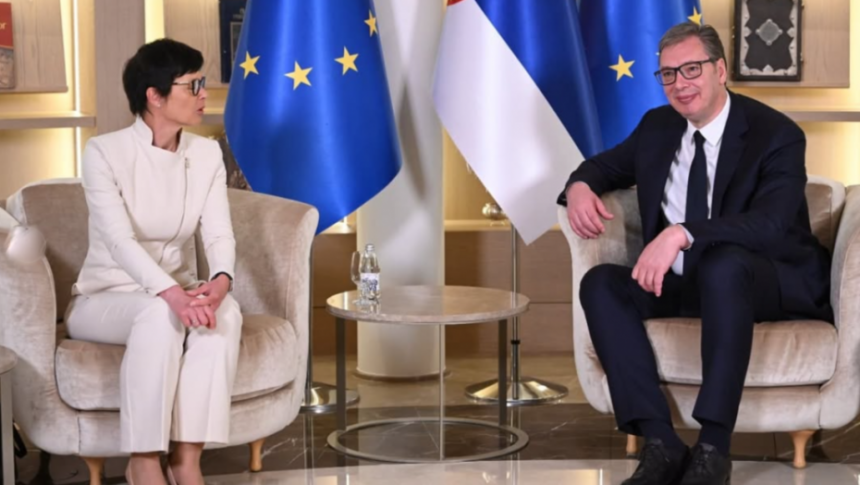
Serbian President Aleksandar Vučić said Tuesday that Serbia remains committed to its European path, while acknowledging that the country must accelerate its economic and institutional development following European Commissioner for Enlargement Marta Kos’ call for a new methodology for EU enlargement.
Commenting on Kos’ remarks that the European Union needs a new approach to enlargement and does not need “Trojan horses,” Vučić said Brussels was entitled to protect its own interests.
“They are doing their job and protecting themselves,” Vučić said during a visit to the Vučetić family household in Parcane, Varvarin municipality.
In a sarcastic response to Kos’ reference to “Trojan horses,” Vučić said he would jokingly suggest that Brussels might prefer “sheep” instead of horses, but added that he would not make such a comment.
“They do not need Trojan horses, or any other kind of horses. They need nothing. They are sufficient unto themselves,” he said.
Despite his criticism of the wording, Vučić stressed that Serbia wants to maintain constructive relations with the EU.
“I wish them all the best in life and the best possible cooperation. We will continue on the European path, but we need to grow a little faster and develop a little faster,” Vučić said.
He added that Serbia’s priority should be to strengthen its economy and improve living conditions.
“That is up to us — to grow faster, so that we can have good hosts, more children and for Serbia to progress faster,” he said.
EU Moves Toward a New Enlargement Model
Kos earlier presented the European Commission’s plans for reforming the EU enlargement process, including gradual integration of candidate countries, stricter monitoring of candidates and a new methodology for future enlargement.
Speaking at the Conference of Croatian Ambassadors in Zagreb, Kos said the world had changed and that the EU’s enlargement process must change with it.
She argued that enlargement should not simply mean creating a larger EU, but a stronger one capable of protecting its interests amid growing competition from other global powers.
“Enlargement is a geopolitical stabilizer for Europe,” Kos said, stressing that the EU can succeed only if it stabilizes the continent and integrates candidate countries that fulfill their obligations.
Kos said 2026 could become a record year for progress on EU enlargement and compared the current moment with the 1999 Helsinki process, when European leaders prepared the bloc for its largest-ever enlargement.
“A Helsinki moment is coming for our generation,” she said.
She announced that European leaders are expected to discuss enlargement at a European Council meeting in October, while the European Commission plans to present further proposals in September on how the EU should prepare as candidate countries approach the final stages of accession negotiations.
For Serbia, the proposed changes could create new opportunities for gradual integration with the EU, but they would also increase pressure on Belgrade to demonstrate faster progress in meeting the bloc’s political, institutional and rule-of-law requirements.