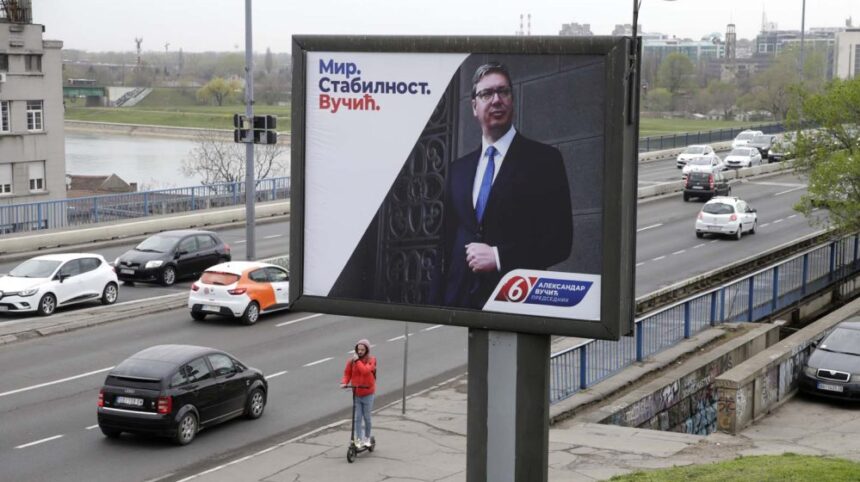
Political analysts and opposition leaders have characterized President Aleksandar Vučić’s recent remarks as a classic “divide and conquer” maneuver. The President recently claimed to admire student protesters for realizing that their “true political opponents” are the opposition parties—whom he predicted the students would eventually “trample” in the political arena.
According to critics who spoke to the daily Danas, this rhetoric is a transparent attempt to sow discord within the anti-regime front ahead of potential elections in June or July 2026.
The Opposition’s Rebuttal: “A Recipe for Survival”
Opposition figures across the spectrum were quick to dismiss Vučić’s comments as propaganda aimed at neutralizing the growing student movement.
- Stefan Janjić (Srbija Centar): Janjić argued that Vučić is trying to turn students into “extras in his propaganda.” He noted that students did not take to the streets because of the opposition, but because the regime has “destroyed institutions” and turned the state into a “party fiefdom.”
- Pavle Grbović (PSG): The leader of the Movement of Free Citizens stated that Vučić’s only hope for political survival is to provoke a conflict among his opponents. “We may have a thousand differences, but our common goal is to free Serbia from this cartel,” Grbović said.
- Radomir Lazović (ZLF): Lazović emphasized that the only effective response to these “obvious” attempts at division is cooperation. Notably, he stated that the Green-Left Front (ZLF) would support a separate student list in the event of rapid elections if such a list yields a better result for the anti-regime movement as a whole.
Strategic Objectives: “Zavadi pa vladaj” (Divide and Rule)
Journalist Aleksandar Ivković and Professor Radivoje Jovović identified several key goals behind the President’s rhetoric:
- Deterring Mobilization: By creating a narrative of internal conflict, the regime hopes to dampen the enthusiasm of citizens planning to attend the major rally scheduled for May 23.
- Discouraging Voters: History shows that fragmentation within the opposition (such as the 2024 split of “Serbia Against Violence”) leads to lower voter turnout. Vučić aims to repeat this effect by making opposition voters perceive the student movement as a rival rather than an ally.
- Reassuring the SNS Base: These statements signal to the President’s supporters that the threat is not directed at the government, but is merely a “civil war” within the opposition camp.
The “Threat” of the Student List
A significant takeaway from current political discussions is the emergence of the student movement as a unique threat. Unlike traditional parties, the student movement has successfully:
- Captured the support of traditional opposition voters.
- Engaged former abstainers (non-voters).
- Potential to peel away “soft” voters from the ruling coalition’s partners.
“The student movement has shown it is more astute than the aging autocrat,” noted Professor Jovović, predicting that the President’s attempt to plant a “wedge” between these groups would fail to gain long-term traction.