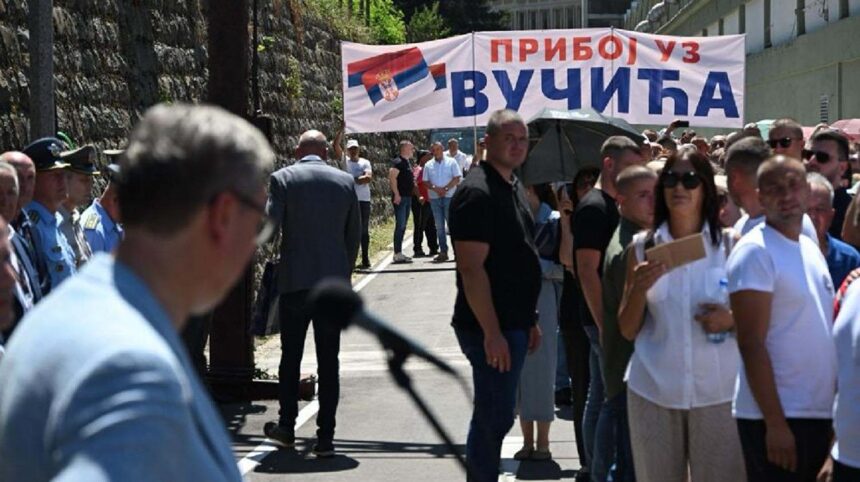
Aleksandar Vučić is once again placing himself at the centre of Serbia’s political campaign, while the ruling camp appears increasingly dependent on his personal authority and carefully controlled messaging.
But the problem goes beyond personality politics. The political model surrounding Vučić has repeatedly relied on nationalism, confrontation and the mobilisation of historical grievances to maintain political support.
Rather than offering a convincing vision of a modern European Serbia, critics argue that the ruling establishment frequently falls back on a familiar formula: present the country as permanently under threat, portray political opponents as enemies and use questions of national identity to dominate the public debate.
Nationalism as a political instrument
Serbian nationalism has long been an important component of the country’s political landscape, but its aggressive forms can become particularly powerful during periods of political pressure.
The danger is not patriotism itself. The problem begins when nationalism is used to replace accountability.
Economic difficulties, institutional failures and political controversies can be pushed into the background while the public is encouraged to focus on external enemies, national humiliation and alleged threats to Serbia.
This creates a political environment in which disagreement can easily be portrayed as betrayal.
The politics of permanent confrontation
The Kosovo issue remains central to this political narrative.
Instead of allowing the question to be addressed through pragmatic diplomacy and long-term regional reconciliation, nationalist rhetoric can turn Kosovo into a permanent instrument of political mobilisation.
The same pattern can extend to relations with neighbouring states and communities.
The message becomes familiar: Serbia is surrounded by hostile forces, Serbia is constantly being attacked, and only a strong leader can protect the nation.
That is an extraordinarily convenient political message for a leader who wants to present himself as indispensable.
One leader, one narrative
This is where nationalism and personalised politics reinforce each other.
The more politics is framed as a struggle between “Serbia” and its supposed enemies, the easier it becomes to portray criticism of the leadership as criticism of the country itself.
Vučić can then occupy the role of defender of the nation while opponents are pushed towards the margins of the political debate.
That is not healthy nationalism.
It is political nationalism used as a shield against scrutiny.
The cost of ultra-nationalism
Ultra-nationalist politics does not make a country stronger simply because it speaks more loudly about national interests.
It can deepen divisions, poison relations with neighbours, marginalise minorities and make compromise appear to be surrender.
It can also keep societies trapped in the politics of the past.
For the Western Balkans, where the consequences of nationalist mobilisation remain painfully visible, this carries a particularly heavy cost.
Every time political leaders revive old grievances for electoral advantage, reconciliation becomes harder.
Every time minorities are portrayed as threats, social cohesion becomes weaker.
And every time compromise is branded as betrayal, diplomacy becomes more difficult.
The contradiction at the heart of the system
The ruling establishment presents itself as the defender of Serbia’s national interests.
Yet a politics built permanently around confrontation can ultimately isolate the country it claims to protect.
Serbia does not become stronger by remaining trapped in an endless cycle of historical grievances and nationalist mobilisation.
It becomes stronger through functioning institutions, economic development, democratic accountability, regional cooperation and a political culture in which disagreement is not treated as treason.
Vučić’s political dominance may remain formidable.
But the increasingly personalised nature of the campaign, combined with the continued use of nationalist rhetoric, raises a larger question about Serbia’s political future:
Will the country continue to be governed through the politics of fear, grievance and permanent confrontation or will it eventually demand a politics based on institutions, accountability and a future beyond nationalism?