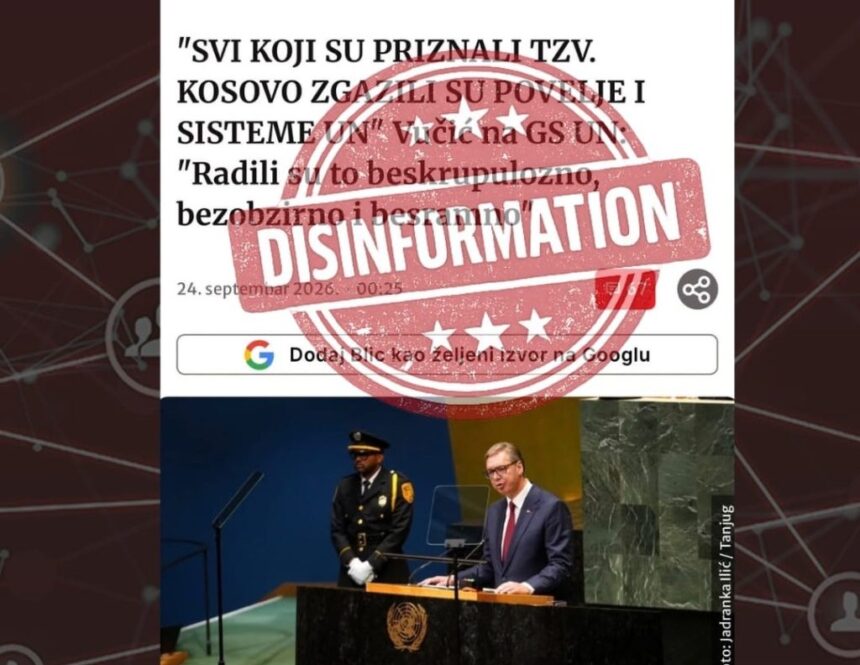
Serbian President Aleksandar Vučić used his address to the 81st session of the UN General Assembly to reiterate Belgrade’s position on Kosovo, NATO’s 1999 intervention and the implementation of the Brussels Agreement.
Vučić said that countries that recognized Kosovo had participated in violating the UN Charter and argued that Serbia had fulfilled all of its obligations under the Brussels Agreement, while the establishment of the Community of Serb Municipalities (CSM) remained the sole unfulfilled obligation on the Kosovo Albanian side.
Several of these claims, however, differ from findings and assessments contained in international legal and EU documents.
Kosovo’s declaration of independence
Vučić has argued that states recognizing Kosovo violated the UN Charter. The International Court of Justice (ICJ), however, did not make such a finding in its 2010 Advisory Opinion.
The ICJ was asked specifically whether Kosovo’s declaration of independence of February 17, 2008, was in accordance with international law. In its July 22, 2010 opinion, the Court concluded that the declaration did not violate international law, Security Council Resolution 1244 or the applicable Constitutional Framework.
The Court also stated that general international law contains no applicable prohibition on declarations of independence.
The ruling did not, however, determine the broader question of whether states were legally required to recognize Kosovo. Nor did it declare that all subsequent acts by recognizing states were lawful.
Claims about the international legal order
During his UN address, Vučić said that the international order based on the UN Charter and international law had been undermined by states that recognized Kosovo.
That is a political assessment rather than a finding of an international court. The ICJ’s 2010 opinion established that Kosovo’s declaration itself did not violate international law; it did not conclude that recognition of Kosovo by individual states constituted a violation of the UN Charter.
At the same time, the ICJ emphasized the binding character of Security Council Resolution 1244, which was adopted under Chapter VII of the UN Charter and established the international legal framework applicable to Kosovo at the time.
The 1999 NATO intervention and the humanitarian crisis
Vučić also argued that the stated humanitarian justification for NATO’s 1999 intervention did not correspond to events on the ground, saying that the humanitarian catastrophe referred to at the time had not occurred.
NATO publicly cited several objectives for its campaign, including stopping violence and repression in Kosovo, securing the withdrawal of Yugoslav and Serbian forces, facilitating the return of refugees and displaced persons, and creating conditions for a political settlement.
International organizations documented a serious humanitarian crisis in Kosovo during the conflict. The OSCE’s Kosovo Verification Mission documented widespread human-rights violations, including killings, forced displacement and other abuses, particularly against Kosovo Albanians.
The existence and scale of those violations are therefore documented independently of the political debate over the legality and legitimacy of NATO’s intervention.
Did Serbia fulfill all of its obligations under the Brussels Agreement?
Vučić repeated at the UN that Serbia had fulfilled all of its obligations under the Brussels Agreement and that the establishment of the CSM was the only outstanding obligation on the Kosovo side.
The implementation record is more complex.
The 2013 Brussels Agreement established commitments for both sides, including the integration of Serbian police and judicial personnel into Kosovo’s institutional framework, the organization of local elections in accordance with Kosovo law, and the establishment of an Association/Community of Serb-majority municipalities.
The European Commission has subsequently assessed implementation of the EU-facilitated dialogue and identified shortcomings involving both parties. In its assessment of Serbia, the Commission has also linked developments including the withdrawal of Kosovo Serbs from Kosovo institutions in November 2022 and the boycott of local elections in northern Kosovo in 2023 to a regression in the implementation of commitments stemming from the dialogue and the 2013 First Agreement.
The EU has also repeatedly called for the establishment of the CSM, which remains an unresolved issue in the normalization process.
Consequently, the record does not support reducing the entire implementation dispute to a single unfulfilled obligation by one side. The EU-facilitated dialogue contains obligations and commitments involving both Belgrade and Prishtina, with implementation assessed as incomplete.
A continuing dispute over the normalization process
Vučić’s UN speech reflects Belgrade’s longstanding position that Serbia has met its commitments while Kosovo has failed to establish the CSM.
The EU, which facilitates the dialogue, has instead continued to describe implementation as incomplete and has called on both parties to fulfill their respective commitments.
The disagreement over implementation remains one of the central obstacles in the normalization process between Kosovo and Serbia.