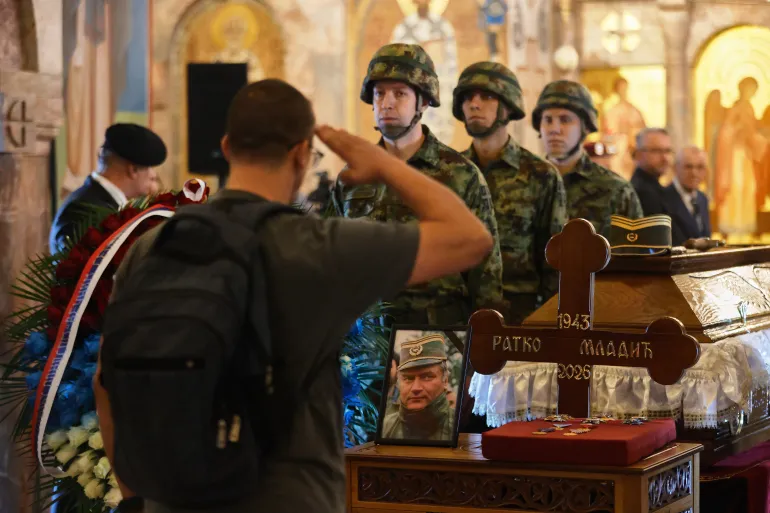
Senior Serbian officials, political figures from Republika Srpska, members of the Serbian Orthodox Church, the son of Serbian President Aleksandar Vučić and representatives of far-right and pro-Russian organizations gathered in Belgrade on September 7 for the funeral of former Bosnian Serb military commander Ratko Mladić, who was convicted of genocide and other war crimes committed during the Bosnian war.
The funeral brought together figures from Serbia’s political establishment, Republika Srpska and the Serbian Orthodox Church, alongside veterans’ organizations, far-right activists and the Russian motorcycle group Night Wolves.
The Russian ambassador to Serbia, Aleksandr Botsan-Kharchenko, also attended the funeral.
An analysis of publicly available photographs and video footage showed the presence of numerous veterans’ and right-wing organizations, including individuals convicted of war crimes and incitement to religious or national hatred.
The funeral, which included Serbian state and military honors, triggered condemnation from Bosnia and Herzegovina, the European Union, the United States and other governments and organizations. Critics said the ceremony insulted victims and undermined reconciliation and Serbia’s European path.
Serbian government officials attend funeral
Serbian President Aleksandar Vučić had previously said he would not attend the funeral because of a previously scheduled meeting with the president of Uzbekistan.
His son, Danilo Vučić, attended the ceremony accompanied by security personnel. Some of those present were photographed wearing T-shirts bearing Mladić’s image.
Six members of Serbia’s government were also identified at the funeral, including Justice Minister Nenad Vujić, Defense Minister Bratislav Gašić, Labor Minister Milica Đurđević Stamenkovski, Culture Minister Nikola Selaković and Minister without Portfolio Nenad Popović, as well as Public Investment Minister Darko Glišić.
Popović, a pro-Russian Serbian politician, is under U.S. sanctions over his political and business ties to Moscow.
Aleksandar Vulin, a former Serbian minister and member of the Senate of Republika Srpska, was also present. Vulin is under U.S. sanctions over alleged support for Russian influence in Serbia and other activities cited by Washington.
Marko Kričak, head of Serbia’s Criminal Police Directorate, also attended.
Opposition politician Miloš Jovanović, leader of the New Democratic Party of Serbia (New DSS), was among the political figures present.
The presence of senior government officials prompted criticism from human rights organizations.
Jasmina Lazović, director of the Humanitarian Law Center, argued that the participation of senior officials indicated state involvement despite pro-government media portraying the funeral as a spontaneous popular gathering.
“President Vučić needs this so that, in the eyes of Western officials, he is not someone who organized a state funeral for a man convicted of the most horrific crimes in the former Yugoslavia,” Lazović told Radio Free Europe.
Republika Srpska leadership joins the ceremony
The political leadership of Republika Srpska also traveled to Belgrade for Mladić’s funeral.
Among those attending were Bosnia and Herzegovina Presidency member Željka Cvijanović, SNSD leader Milorad Dodik, Republika Srpska President Siniša Karan, RS Prime Minister Savo Minić and Banja Luka Mayor Draško Stanivuković.
Representatives of pro-Serbian political parties from Montenegro also traveled to Belgrade, including figures from Milan Knežević’s Democratic People’s Party and Vladislav Dajković’s Free Montenegro.
Their participation underscored the broader regional significance of the funeral and the continued political support for Mladić among sections of the Serbian and Serb political establishment.
Serbian Orthodox Church leadership presides over funeral
The Serbian Orthodox Church played a central role in the ceremony.
Patriarch Porfirije led the funeral service, with other bishops participating in the ceremony. Mladić’s coffin was covered with the flags of Serbia and Republika Srpska.
During the service, Porfirije said Mladić’s name would remain deeply embedded in the memory and prayers of a large part of the Serbian and Orthodox population.
The role of the church drew criticism from human rights activists.
Lazović said the Serbian Orthodox Church had maintained close ties with figures associated with the Bosnian war and argued that its role in the funeral represented a continuation of that political tradition.
The Humanitarian Law Center has also linked Svetozar Andrić, who was reportedly involved in the funeral’s organizing committee, to allegations concerning wartime crimes in Bosnia and Herzegovina.
Among the attendees was Veselin Šljivančanin, a former Yugoslav army officer convicted by the Hague tribunal over the killings at Ovčara in Croatia.
From Red Berets to the Night Wolves
Veterans’ groups from Republika Srpska and Serbia were prominent at the funeral, with representatives standing near Mladić’s coffin.
Photographs showed members of the Red Berets veterans’ association, an organization bringing together former members of the Serbian State Security special unit whose members were involved in war crimes and later convicted in cases involving political assassinations and other crimes.
Other Serbian veterans’ organizations were also represented.
According to previous reporting cited by Radio Free Europe, some of these organizations have received financial support from local or republican authorities.
Social media posts also indicated the presence of members of the far-right Serbian Action and People’s Patrols, as well as the International Sovereignist League – Paladins, an international far-right network founded in Russia in 2025 with links to actors close to the Kremlin.
Members of the Russian motorcycle organization Night Wolves were also seen outside the church. The group has been sanctioned by the European Union and United States because of its close ties to Russian President Vladimir Putin and its support for Russia’s invasion of Ukraine.
Far-right Serbian activist Miša Vacić and Goran Davidović, leader of the banned neo-Nazi National Movement, were also filmed at the funeral.
Davidović was previously sentenced to one year in prison for inciting national, racial and religious hatred and intolerance following an attack on an anti-fascist gathering in Novi Sad in 2005.
What was Ratko Mladić convicted of?
Ratko Mladić, the former commander of the Army of Republika Srpska, was convicted by the Hague tribunal and sentenced to life imprisonment for genocide, crimes against humanity and war crimes committed during the 1992–1995 war in Bosnia and Herzegovina.
His final conviction, upheld on appeal in 2021, covered 10 of 11 counts.
Mladić was found guilty of genocide in Srebrenica, where Bosnian Serb forces killed around 8,000 Bosniak men and boys in July 1995.
He was also convicted of persecution, extermination, murder, forcible transfer and deportation as part of a broader criminal enterprise aimed at permanently removing Bosniaks and Croats from areas claimed by Bosnian Serb forces.
The tribunal also found him responsible for crimes committed during the siege of Sarajevo, including the terrorization of civilians through sniper attacks and shelling.
Mladić was additionally convicted for the hostage-taking of UN peacekeepers, who were detained at strategic military locations in an effort to prevent further NATO air strikes against Bosnian Serb military targets.
He was acquitted of genocide charges relating to six municipalities in Bosnia and Herzegovina in 1992: Prijedor, Sanski Most, Ključ, Kotor Varoš, Foča and Vlasenica.
His funeral has since become a major political and diplomatic controversy, highlighting the continuing divisions over the legacy of the Bosnian war and the unresolved question of how Serbia confronts the crimes for which Mladić was convicted.