The funeral of convicted war criminal Ratko Mladić in Belgrade was a carefully organized and coordinated event in which, according to the assessment of the Helsinki Committee for Human Rights in Serbia, the state, military and church acted in synchronization. According to the organization, the event conveyed a clear message about the rehabilitation of the politics of the 1990s and the strengthening of ties with Republika Srpska.
The Helsinki Committee says that the scenes witnessed in Belgrade over the past several days demonstrated that attitudes toward Mladić have not fundamentally changed, despite his final conviction for some of the most serious war crimes.
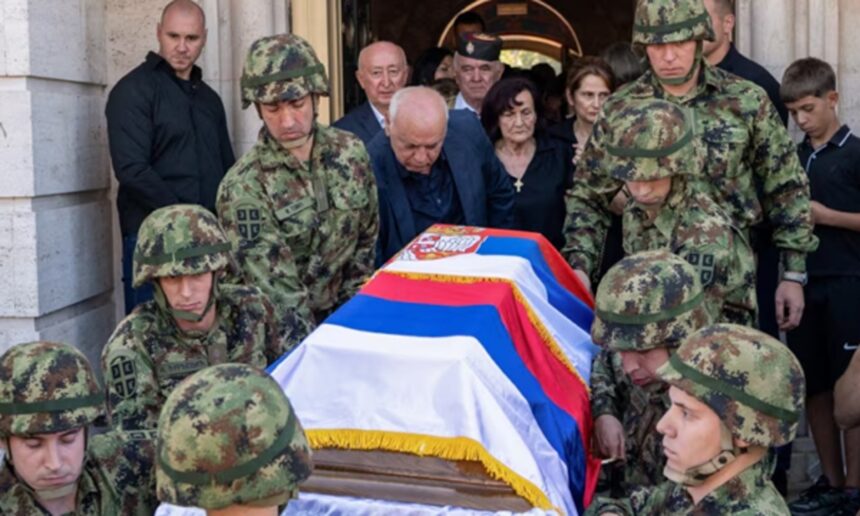
“Tens of thousands of people at his funeral, state honors and the participation of Army of Republika Srpska veterans show that attitudes toward Mladić have not fundamentally changed. On the contrary, what has long existed on the margins of society has now taken on a massive and public manifestation,” the Helsinki Committee said in its statement.
The organization stresses that the issue should not be viewed solely through the figure of Mladić, but also in the context of the long-standing tolerance of nationalist narratives in Serbia and the region.
The committee is particularly critical of Western countries, which, according to the organization, have for years spoken about Serbia’s European path and regional stability while tolerating the glorification of individuals convicted of war crimes.
According to the organization’s assessment, such a policy has also contributed to strengthening the concept of the “Serbian world,” which was initially treated as political rhetoric for domestic consumption. The Helsinki Committee believes that ideas about a special connection between Serbia, Republika Srpska and Serbs in the region have become increasingly present in the public and political sphere.
For this reason, according to the organization, the events surrounding Mladić’s death and funeral cannot simply be portrayed as a spontaneous expression of emotion.
“This is a carefully prepared and synchronized spectacle in which the state, military and church acted on the same common task — the glorification of a war criminal,” the statement said.
The Helsinki Committee adds that the state and religious honors, as well as the presence of representatives from Serbia and Republika Srpska, served to convey a political message about the ties between them.
At the same time, the organization accuses the international community of continued opportunism and a policy of appeasement, the consequences of which, it says, are becoming increasingly visible.
Ratko Mladić was sentenced to life imprisonment in June 2021, with a final verdict for the genocide in Srebrenica, the persecution of Bosniaks and Croats, the terrorizing of Sarajevo civilians, and the taking hostage of UNPROFOR personnel.
He died on August 27 at the United Nations Detention Unit of the International Criminal Tribunal for the former Yugoslavia in The Hague.
Mladić was buried yesterday at Topčider Cemetery in Belgrade, where thousands of citizens, veterans, police officers and members of various right-wing organizations gathered. Officials from Serbia and Republika Srpska also attended the memorial ceremony and funeral.