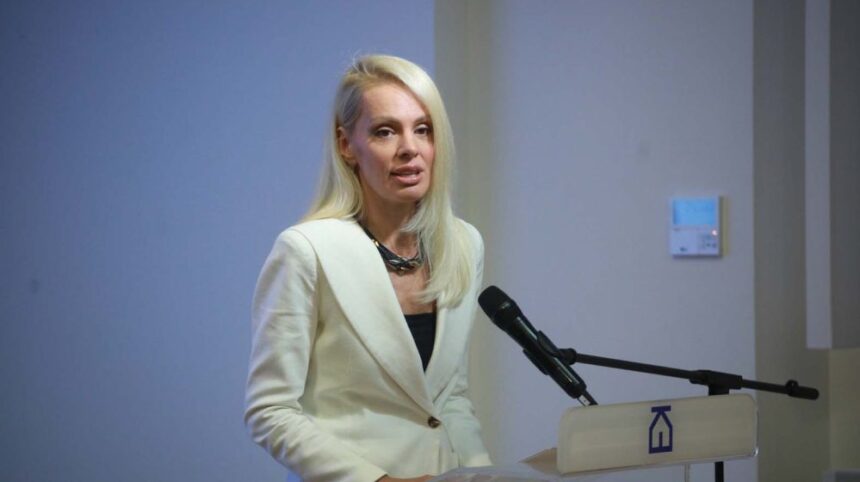
The funeral of convicted Bosnian Serb war criminal Ratko Mladić and the Serbian authorities’ response to the ceremony could mark a turning point in the European Union’s political approach toward the government in Belgrade, according to Dragana Đurica, secretary general of the European Movement in Serbia.
“I think this event could represent a serious turning point in the EU’s political relationship with the current authorities in Belgrade, because a serious line has been crossed,” Đurica said, commenting on European reactions to Mladić’s funeral and the Serbian government’s position.
She pointed to the European Commission’s unequivocal condemnation of the glorification of war criminals, genocide denial and historical revisionism, saying such practices are incompatible with fundamental European values and have no place either in the EU or in candidate countries.
Đurica said the presence of government ministers, representatives of the Serbian Armed Forces and other elements of official participation made it increasingly difficult to portray the funeral as an entirely private event unrelated to the state.
The Serbian authorities have sought to distinguish the participation of individual officials from an officially organized state funeral. However, the presence of senior government figures and military personnel has fueled criticism from Brussels and other international actors.
Growing pressure from Brussels
Đurica noted that EU Enlargement Commissioner Marta Kos had already canceled her planned visit to Belgrade, while European Commission President Ursula von der Leyen issued a strongly worded criticism of the glorification of Mladić.
She cautioned that it remains unclear whether the funeral controversy will affect von der Leyen’s planned visit to Serbia as part of her Balkan tour.
At the same time, she argued that the political consequences for Serbia’s EU integration could be significant even without any immediate formal change to the accession process.
“It will be even harder to find political will among member states to give the authorities in Belgrade any positive signal,” Đurica said.
She stressed that EU accession is not merely a matter of technical alignment with European legislation, but also involves respect for European values, good-neighborly relations, confronting the past and pursuing reconciliation.
The limits of the “stability” argument
Đurica also questioned the long-standing argument that Serbia’s government should be treated as a valuable EU partner because of its role in maintaining regional stability.
For years, she said, the government in Belgrade has been portrayed as a constructive partner on regional stability even as democratic standards in Serbia have deteriorated.
But, she argued, stability and European values cannot remain separate categories indefinitely.
“You cannot claim to contribute to regional stability while simultaneously participating in the glorification of a person finally convicted of genocide, war crimes and crimes against humanity,” Đurica said.
“Reconciliation and good-neighborly relations are not an addition to regional stability; they are its prerequisite.”
Is the EU changing its approach?
Đurica suggested that the Mladić funeral may not represent a formal breaking point in Serbia’s accession negotiations, but could instead mark the end of what she described as a long period of EU political tolerance toward the Serbian authorities.
She argued that a lack of reforms, democratic backsliding and serious departures from European values had been tolerated for too long because of Serbia’s perceived geopolitical usefulness and its role in regional stability.
“Any consequences should not be presented as a conflict between the EU and Serbia or as a punishment of Serbian citizens,” she said. “The problem is the decisions and policies of the current authorities.”
She stressed that EU integration remains in the interest of Serbian citizens and argued that the policies of the current government are increasingly distancing the country from the European Union.
A noticeably sharper message from Brussels
Đurica also highlighted what she described as a notable sequence in the EU’s response to the funeral.
“Marta Kos first canceled her visit to Belgrade. Then, yesterday, the European Commission issued a rather awkward explanation that it was not a state funeral, even though the level of participation by state officials raised precisely the question of the authorities’ relationship with the event,” she said.
“Today, Ursula von der Leyen delivered a much clearer and politically stronger message.”
Đurica said she would not conclude that von der Leyen was correcting the Commission’s previous communication, but argued that the tone from Brussels had clearly become sharper and more unequivocal within a very short period.
She said this could prove more significant than the diplomatic form of individual statements.
The key question, according to Đurica, is therefore not simply whether European officials condemn the glorification of Mladić, but whether the European Commission will translate that condemnation into a change in its practical political approach toward Belgrade.
“Experience has taught us that there is often a considerable gap between the EU’s strong rhetoric and its practical behavior toward the authorities in Belgrade,” she said.
“We have yet to see whether this condemnation will also mean a change in the political approach toward Serbia’s current authorities.”