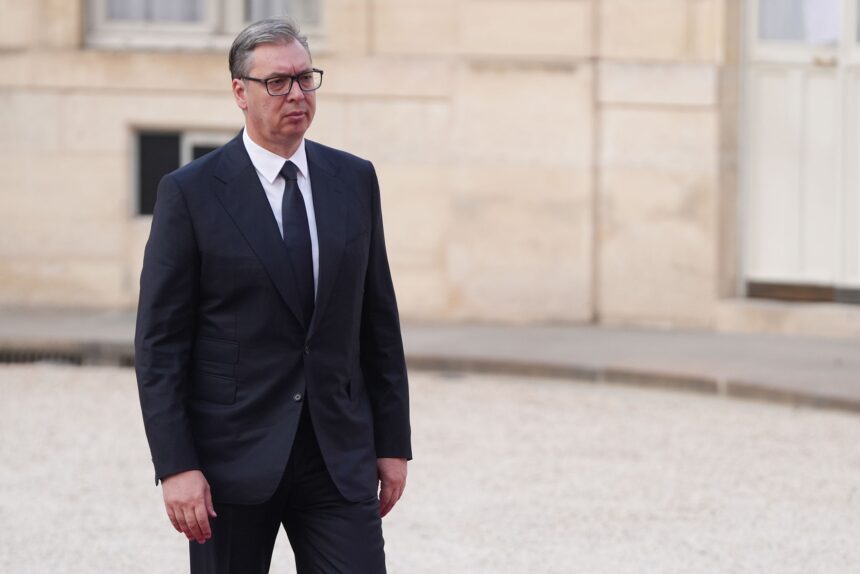
Aleksandar Vučić has lost power. The question now is whether he will also be held accountable for the way he exercised it.
Following the Student List’s victory in the October 25 elections, Serbia faces a challenge that goes beyond a change of government: investigating corruption, freeing institutions from political influence and establishing accountability for alleged abuses during the rule of the Serbian Progressive Party (SNS).
Two analysts in Belgrade believe investigations could reach the former president, but warn that political responsibility does not necessarily translate into criminal liability.
“I believe the investigation should reach Vučić as well, just as it did in Croatia with Sanader,” says Dušan Spasojević, a professor at the Faculty of Political Sciences in Belgrade, referring to former Croatian Prime Minister Ivo Sanader, who was convicted of corruption.
Dragan Popović, director of the Centre for Practical Politics, also considers it difficult to imagine that a new prosecutor’s office would not investigate Vučić’s role.
However, he warns that the charges that can ultimately be proven in court may be more limited than citizens expect.
In a discussion on Most, a programme produced by Radio Free Europe’s Balkan Service, the two analysts examine the possibility of criminal proceedings against Serbia’s former president and the challenges facing the new government as it confronts the legacy of the previous regime.
From the Novi Sad tragedy to the change of power
The political change in Serbia came after a wave of protests triggered by the collapse of a concrete canopy at Novi Sad Railway Station on November 1, 2024, which claimed 16 lives.
The tragedy, at a renovated facility, raised suspicions of corruption, negligence and a lack of oversight in public projects.
Students, who took the lead in the protests, demanded the publication of renovation documents and accountability for the victims.
Over time, their demands expanded, transforming the movement into a direct challenge to the government.
The Student List’s victory in the early parliamentary elections marked the SNS’s loss of power after years of dominance in Serbian politics. It also brought an unusual development: a movement without a single leader managed to defeat a party with a powerful organisational structure and extensive institutional influence.
According to Spasojević, the students ran a well-organised campaign, fielding qualified candidates and maintaining a constant presence on the ground, achieving a better result than even the most optimistic forecasts had anticipated.
However, he expects their victory to be followed by a profound reorganisation of the political landscape.
“We are certainly heading towards a reconstruction of the political scene, and as early as the next elections, we will have two million voters looking for new political actors,” Spasojević says.
Popović believes the students’ success creates an opportunity to renew political parties that have been weakened both by “autocratic rule” and by their own internal problems.
He recalls that most opposition parties supported the Student List, while those that ran separately failed to secure significant support.
For Popović, the victory also demonstrates the rejection of a model of governance in which power is concentrated in the hands of a single leader.
“At this moment, the majority of Serbia has said no to the authoritarian system,” he says.
Is there grounds for prosecuting Vučić?
The former Serbian president’s potential criminal liability is among the most sensitive issues in the political transition.
Spasojević recalls that Vučić publicly positioned himself as the country’s principal decision-maker, even though his decisions were formally implemented by ministers and other officials.
“Vučić positioned himself publicly as the main actor. He issued orders, while his decisions were carried out by ministers, aides and other individuals who had the formal authority to implement them,” Spasojević says.
For this reason, he expects investigations to begin with officials who had direct responsibility for implementing those decisions.
Nevertheless, he believes there are grounds to examine Vučić’s own role, particularly in the case of the collapse of the canopy at Novi Sad Railway Station.
Spasojević argues that evidence exists that could help establish the former president’s role in accelerating the construction work, which, according to him, Vučić had an interest in completing as quickly as possible for political publicity.
Popović also expects Vučić’s role to become the subject of an investigation, given the concentration of power in his hands.
“I find it difficult to imagine that the new prosecutor’s office would not specifically investigate Vučić, as the person who held all the power in the authoritarian, pyramid-shaped system he created,” Popović says.
However, he distinguishes between suspicions of responsibility and the evidence required to bring an indictment.
“The next question is what they will be able to find sufficient evidence for and what they will be able to charge him with. That will probably be less than citizens expect,” he says.
According to Popović, investigations may require documents, testimony and the cooperation of individuals who were part of the previous system.
He stresses that public expectations must not undermine respect for legal procedures.
Will Serbia repeat its experience after Milošević?
Serbia has faced the challenge of establishing accountability following a change of power before.
The overthrow of former President Slobodan Milošević on October 5, 2000, opened the way for democratic reforms and promises to break with the practices of the previous regime. However, some of those promises were never fulfilled.
One example was the attempt to purge institutions of officials responsible for abuses while exercising public office – a process known as lustration.
Popović recalls that Serbia adopted a law for this purpose, which remained in force for ten years but was never implemented.
According to him, the commission responsible for enforcing the law was never established because parties from the ousted regime, by then in opposition, refused to appoint their representative.
The Student List has promised to implement this process, alongside the confiscation of illegally acquired assets.
However, Spasojević doubts that institutional cleansing wil