The German government has officially halved its economic growth forecast for 2026, citing the severe fallout from the ongoing war in Iran. The revision signals a period of prolonged stagnation for Europe’s largest economy as it grapples with skyrocketing energy costs and disrupted global supply chains.
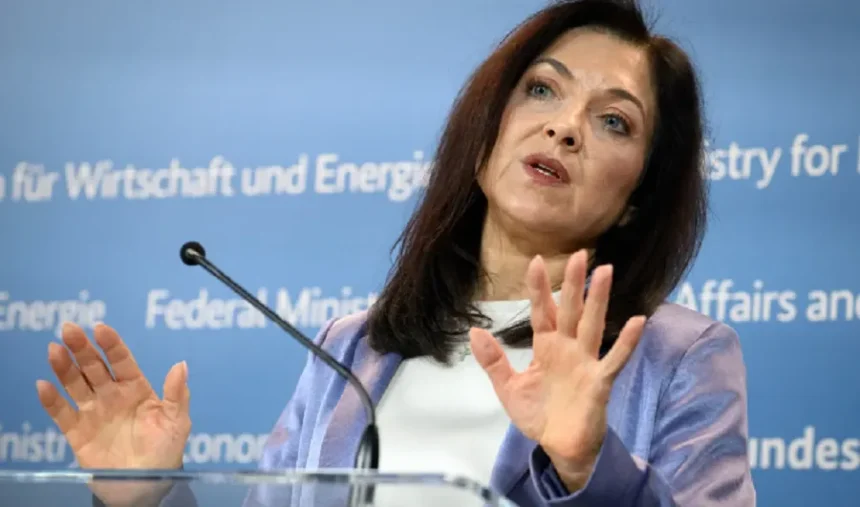
The announcement was made Wednesday by the Minister for Economic Affairs and Energy, Katherina Reiche, who characterized the current situation as a “state of emergency” for the German industrial model.
The Revised Economic Outlook
The German government has significantly lowered its GDP targets, reflecting the reality of a cooling economy under geopolitical pressure:
- 2026 Forecast: Cut to 0.5%, down from the 1.0% projected in January.
- 2027 Forecast: Lowered to 0.9%, down from a previous estimate of 1.3%.
Catalysts for the Economic Contraction
According to official government reports, the conflict in Iran has acted as a “massive energy shock” to the continent, hitting Germany’s heavy industry particularly hard.
- Energy Price Spikes: As a major industrial hub, Germany is uniquely sensitive to the price of oil and natural gas, both of which have surged since the outbreak of hostilities.
- Supply Chain Disruption: The “consequences of the war in Iran” have severed vital trade routes and increased the cost of raw materials, undermining the competitiveness of German exporters.
- Investment Paralysis: Private investors have adopted a “wait and see” approach. Fear of a broader regional escalation in the Middle East has led many firms to freeze major expansion projects.
- Domestic Consumption Slump: Higher household energy bills are significantly reducing disposable income, leading to a sharp drop in domestic demand.
Regional Impact: Italy Follows Suit
Germany is not alone in its fiscal recalibration. On the same day, the Italian government also lowered its economic outlook due to the conflict.
- Italy’s 2026 GDP Forecast: Lowered to 0.6% (from 0.7%).
- Government Response: Italian Economy Minister Giancarlo Giorgetti described the circumstances as “completely extraordinary,” warning that further downward revisions may be necessary in the coming weeks.
A Struggle for Competitiveness
Minister Reiche noted that the downward revision was “inevitable.” The core concern for Berlin is the long-term sustainability of the “German Engine” if energy prices remain decoupled from global averages. With both Germany and Italy—the Eurozone’s first and third largest economies—stalling, the wider European Union faces a challenging path toward fiscal stability and energy independence.