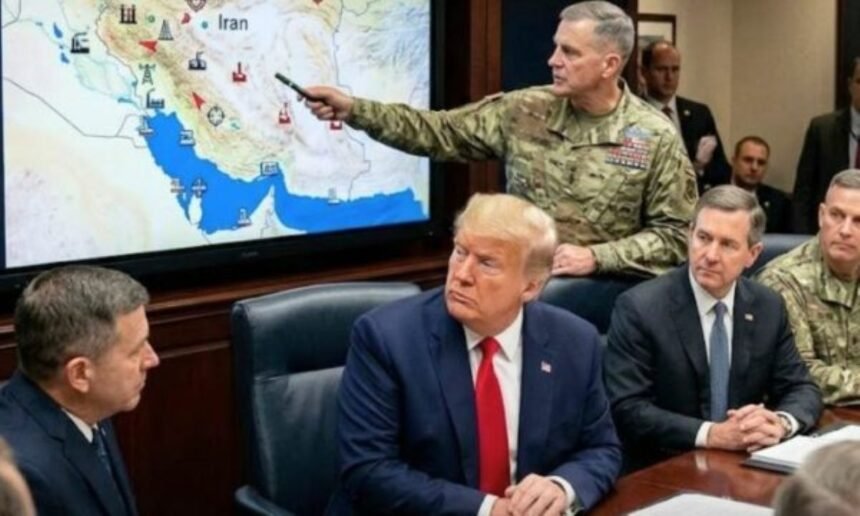
According to reports from Axios and confirmed by senior U.S. officials, a high-stakes military briefing was held late Thursday evening, April 30, 2026, between President Donald Trump and the nation’s top military commanders.
The 45-minute meeting, held as a fragile ceasefire in the region remains under pressure, featured Admiral Brad Cooper, Commander of U.S. Central Command (CENTCOM), and General Dan Caine, Chairman of the Joint Chiefs of Staff. The leaders presented the President with a series of new military contingencies designed to break the current diplomatic stalemate or deliver a “final blow” to Iranian military infrastructure.
The Three-Pronged Strategy
Military planners reportedly presented three primary operational “tracks” for the President’s consideration:
- “Short and Powerful” Strikes: A high-intensity wave of air and missile strikes targeting critical Iranian security and civilian infrastructure. The goal is to apply maximum pressure to force Tehran back to the negotiating table on more favorable terms.
- Strait of Hormuz Control: A naval and potentially ground-based operation to seize portions of the Strait of Hormuz to ensure the permanent reopening of commercial shipping routes, which have been plagued by blockades and harassment.
- Nuclear Material Security: A specialized mission involving elite Special Operations forces to secure or neutralize Iran’s remaining stockpiles of highly enriched uranium.
Trump’s Tactical Preference: Blockade vs. Bombing
President Trump has reportedly signaled a preference for the ongoing naval blockade over immediate large-scale bombing. In recent comments, he described the current blockade as “somewhat more effective than bombing,” noting that it exerts extreme economic pressure while maintaining U.S. leverage.
“The blockade is genius. It shows how good our Navy is… they are choking like a stuffed pig,” Trump told reporters earlier this week, though he remains open to the newly presented kinetic options if negotiations fail.
The Congressional Deadline: May 1, 2026
The briefing comes exactly as the United States reaches a major legal milestone. Under the War Powers Resolution of 1973, Congress must formally authorize the use of force within 60 days of military action—a deadline that falls today, May 1, 2026.
- Administration Stance: The White House argues that because a ceasefire was established in early April, the war has “effectively ended,” rendering the 60-day Congressional authorization deadline moot.
- Legislative Status: Despite unease among some Republicans and fierce opposition from Democrats, Senate Majority Leader John Thune indicated that GOP leadership will continue to defer to the President’s wartime leadership, allowing the deadline to pass without a formal vote.
Current Regional Status
The briefing follows reports from NBC that Iran has been accelerating efforts to recover missiles and munitions buried during earlier U.S. and Israeli strikes. With Israel also signaling that it is “bracing for fighting to resume soon,” the presentation of these new U.S. military plans highlights a critical pivot point in the 2026 conflict.