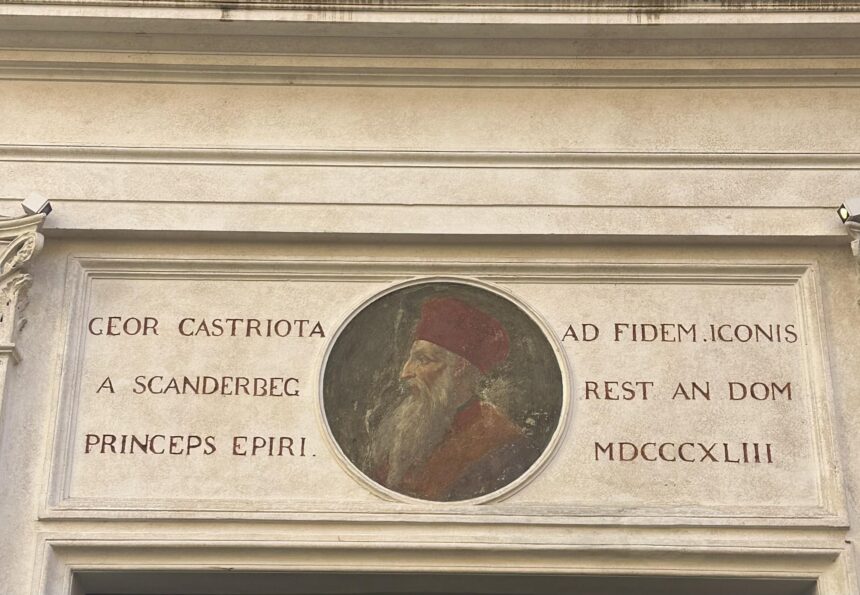
The spiritual and political architecture of the Albanian nation is tied to the name of Gjergj Kastrioti more than to any other figure or historical event. Therefore, there is a need to re-actualize the narrative about him in order to illuminate what the author describes as “the great darkness” in Albanian history, and to better understand the causes of present-day hardships.
According to the author, Albanian history does not record another period after Skanderbeg’s era in which Albanians created major historical impact or actively participated in European or global events.
He argues that this is why Skanderbeg’s deeds were celebrated by European writers, musicians, philosophers, and painters long before he became the central national figure during the Albanian National Awakening, when Albanians after centuries of foreign rule sought their lost freedom and return to Europe, finding inspiration in his legacy.
After his death in 1468, Skanderbeg’s figure, the author notes, was repeatedly attacked and even his memory and grave were desecrated, yet he survived in the collective memory of Albanians in exile and in European cultural tradition, despite Ottoman efforts to erase his legacy.
The text also references literary interpretations, including Ismail Kadare’s works, where Skanderbeg is portrayed with symbolic, almost Christ-like attributes as a foundational figure of the Albanian nation.
The author contrasts Skanderbeg with figures seen as traitorous collaborators, presenting a symbolic “battle of two graves” one empty and one full as a metaphor for opposing historical legacies shaping Albanian identity.
He further argues that Albanians who have fought for freedom are historically linked with Skanderbeg’s legacy rather than that of his enemies.
The article concludes by emphasizing that Skanderbeg is not a myth or ideological construct, but a real historical figure with deep influence in Western cultural history, and that he represents a foundational pillar rather than a symbolic luxury.
It also calls for a clearer understanding of Albanian history, particularly in relation to the Ottoman Empire, which is portrayed as a period of cultural and institutional stagnation, followed by the 1912 independence period marked by poverty, illiteracy, and lack of cultural infrastructure.
Finally, the author cites Albanian intellectuals such as Faik Konica, Mithat Frashëri, Ismail Kadare, and Ibrahim Rugova as figures who critically engaged with this historical narrative, concluding that honoring Skanderbeg today means embracing the ideas, philosophy, and struggle he represented.