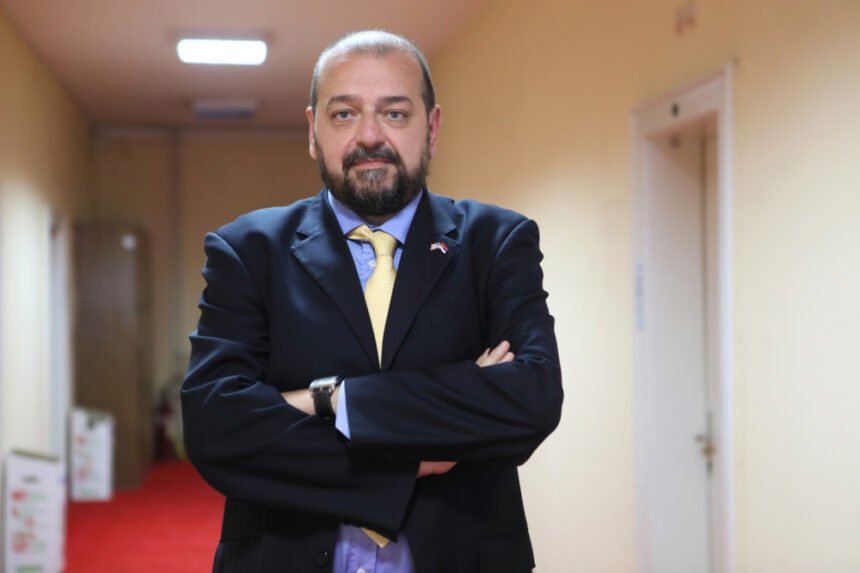
A highly critical op-ed by Dragan Šormaz, published on May 14, 2026, has ignited a fierce political debate in Serbia. Analyzing President Aleksandar Vučić’s recent 5-point plan for “Serbia 2035” published in the tabloid Kurir, Šormaz argues that the document is not a roadmap for progress, but rather an implicit admission that the Serbian Progressive Party (SNS) regime has failed after 14 years in power.
The “Serbia 2035” Manifesto
President Vučić’s plan outlines a hyper-modernized future for Serbia, focusing on five “courageous decisions”:
- Administrative Overhaul: Drastic reduction in the number of ministries and the abolition of “redundant” state agencies.
- Productivity Surge: Rejection of shorter work weeks; a call for Serbians to work more to compete with global powers.
- Educational Reform: A complete shift toward dual education and international university franchises.
- Energy Sovereignty: Building large and small nuclear power facilities to ensure stability.
- AI & Robotics: An “aggressive” adoption of artificial intelligence and the construction of humanoid robot factories.
The Critique: “The Arrogance of Power”
Šormaz, a former SNS member turned vocal critic, claims the President is acting like an opposition leader criticizing a system he himself built.
“Vučić speaks of the ‘arrogance and conceit of power’ as if it were a phenomenon that happened to him by chance, and not a deformed system that he built and maintained for years,” Šormaz writes.
Key Arguments from the Critique:
- Centralization of Failure: For 14 years, the SNS has appointed every minister, director, and advisor. Šormaz asks: If the administration is bloated and inefficient now, who made it that way?
- Meritocracy vs. Loyalty: The critique highlights that the current system prioritizes party loyalty over competence, leading to a “brain drain” of young professionals while the state apparatus remains a “party machine.”
- Economic Strategy: While Vučić now talks about AI, Šormaz notes that for a decade, Serbia’s economy was built on cheap labor and subsidized factories—strategies that are now “exhausted.”
- Geopolitical Omissions: The “Serbia 2035” plan notably omits concrete steps for EU integration, the conclusion of the Kosovo dialogue, or alignment with sanctions against Russia, which critics say are the only real paths to the security needed for technological growth.
A Regime Under Pressure
The timing of this “reset” is significant. Serbia is currently navigating:
- Persistent Protests: Grassroots movements, sparked by the Novi Sad canopy collapse in late 2024, continue to demand accountability and transparency in 2026.
- Election Fallout: Despite a narrow SNS victory in local elections earlier this spring, observers noted a 20% drop in support in several municipalities, signaling a weakening grip on power.
- International Isolation: With the war in Ukraine continuing and the EU demanding foreign policy alignment, the “balancing act” between East and West is becoming increasingly untenable.
Conclusion
Is the “Serbia 2035” plan a genuine shift toward modernization or a marketing “reset” designed to distract from domestic crises? For Dragan Šormaz and many opposition figures, the answer is clear: Aleksandar Vučić is the cause of the problems he now promises to solve. As Serbia looks toward 2035, the fundamental question remains whether a regime built on radicalism and central control can truly implement the liberal, meritocratic reforms required for a high-tech future.