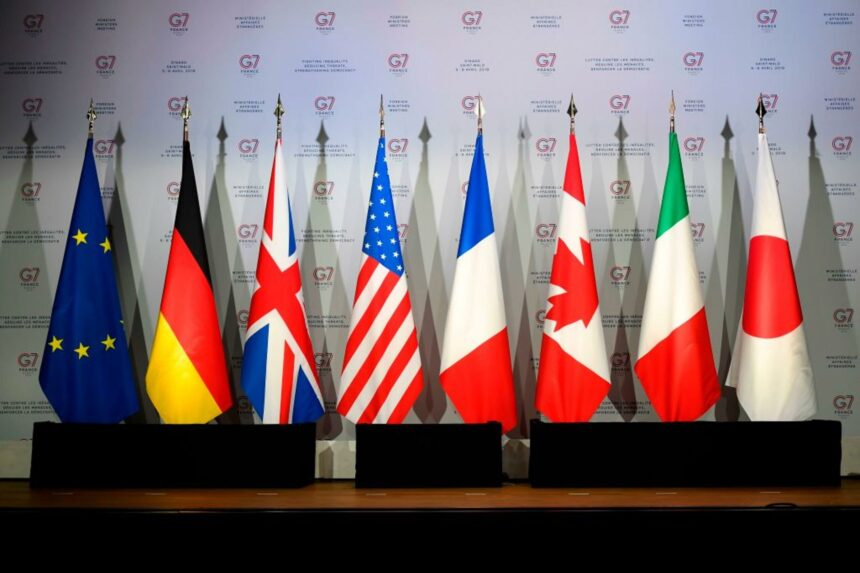
Finance ministers and central bank governors from the Group of Seven (G7) industrialized nations have kicked off a crucial two-day summit in Paris, with discussions heavily centered on mitigating the global economic shocks triggered by the ongoing conflicts in Ukraine and Iran.
The high-stakes agenda was confirmed by European Commissioner for Economy Valdis Dombrovskis, who noted that global security vulnerabilities and the direct macroeconomic fallout of these geopolitical crises remain the top priorities for international policymakers.
A critical point of contention at the summit is the immediate and unconditional reopening of the Strait of Hormuz. The strategic maritime chokepoint—through which roughly 20 percent of global oil supply passes—was closed by Tehran following its military conflict with the United States and Israel. G7 officials warned that the continued naval blockade is severely distorting international energy markets, restricting refinery access, and threatening broader global economic stability.
Taking a hardline stance at the summit, U.S. Treasury Secretary Scott Bessent announced that he would explicitly urge G7 partner nations to strictly enforce a unified, aggressive sanctions regime. The objective, according to Bessent, is to systematically cut off all remaining foreign funding channels feeding what he described as Iran’s “war machine.”
The Paris meeting takes place against a highly complex backdrop. While G7 nations are attempting to project a united front, delegates are also grappling with underlying trade tensions sparked by U.S. President Donald Trump’s aggressive tariff policies, alongside a collective push to aggressively decouple from China’s near-monopoly on critical raw minerals.
The G7 is comprised of Canada, France, Germany, Italy, Japan, the United Kingdom, and the United States, with senior representatives from the European Union participating alongside the member states. The summit is scheduled to conclude tomorrow following a joint ministerial press conference.