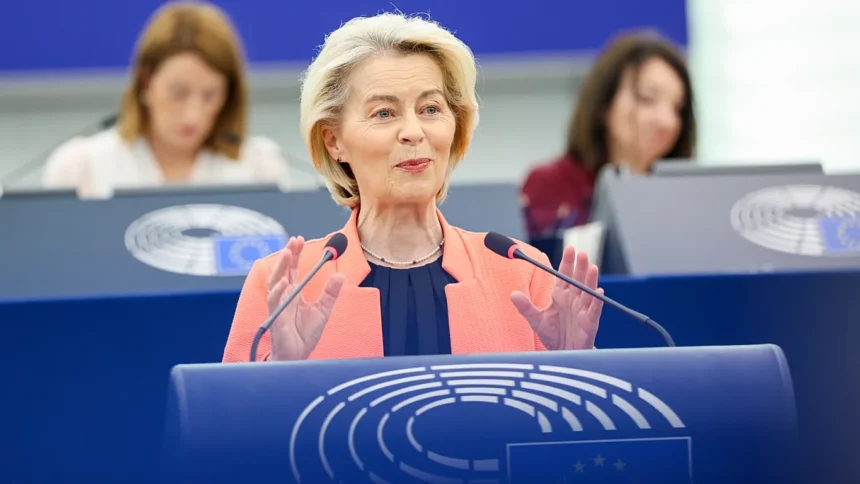
European Commission President Ursula von der Leyen issued an urgent directive to EU lawmakers on Wednesday, declaring that the bloc must aggressively dismantle its remaining internal market barriers if it hopes to survive and compete in an increasingly hostile global geopolitical climate.
Addressing a plenary session of the European Parliament, von der Leyen emphasized that the crown jewel of European integration—the Single Market—remains unfinished, bogged down by regulatory fragmentation, administrative friction, and protectionist domestic policies.
“We must finish what we started. We must remove the barriers that still persist in our internal market,” von der Leyen told MEPs. “We must make it much easier to scale up across Europe. This is the basic promise of the single market and it must be fulfilled.”
Declaring War on “Gold-Plating”
A central pillar of the Commission President’s address was a direct attack on “gold-plating”—the widely criticized practice where individual EU member states intentionally inject unnecessary bureaucratic complexity, additional administrative layers, and stricter requirements when transposing harmonized EU directives into their local national laws.
According to von der Leyen, gold-plating acts as a toxic drag on economic expansion. It paralyzes mid-sized European companies, making it functionally impossible for them to seamlessly scale their operations across borders without navigating 27 distinct variations of the exact same European regulation.
   [THE ECONOMIC DRAG OF GOLD-PLATING]
   EU Core Directive Approved -> Handed to Member States -> National Bureaucracy Added ("Gold-Plating") -> Market Fragmentation
A “Digital by Design” Economic Bloc
Looking toward the next phase of European industrial policy, von der Leyen pledged to transform the single market into an economy that is “digital by design.” She highlighted that the executive branch will heavily lean into existing and upcoming EU legislation targeting three strategic, sovereign technological sectors:
- Semiconductors: Accelerating domestic microchip manufacturing under the European Chips Act frameworks.
- Cloud Infrastructure: Building integrated, continent-wide data hosting networks to ensure European data sovereignty.
- Artificial Intelligence (AI): Streamlining the rollout of trustworthy AI models while safeguarding consumer rights under the EU AI Act.
Clean Innovation and Shifting Supply Chains
Turning to the climate crisis and the bloc’s circular economy targets, von der Leyen argued that environmental sustainability cannot be achieved through subsidies alone. Instead, Europe requires a unified market that actively rewards green, low-carbon innovation while swiftly eliminating lingering trade barriers for recycled goods and eco-friendly services.
She also addressed supply chain security, a vital concern as global trade tensions mount. Von der Leyen confirmed that Brussels is aggressively pursuing new bilateral trade agreements to diversify its raw material sources, revealing that a highly anticipated, modernized EU-Mexico Free Trade Agreement is officially expected to be signed into law later this week.
Concluding her address, the Commission chief stressed that the economic benefits of a friction-free market must be felt equitably across every region and citizen, warning lawmakers against historical complacency. “The single market is one of Europe’s great success stories,” von der Leyen stated. “But success is not something we inherit from previous generations. It requires constant work, vision, and political will.”