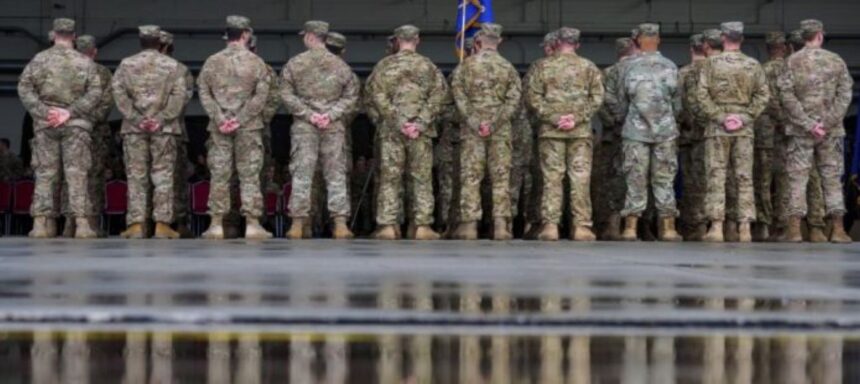
NATO Secretary General Mark Rutte has sought to calm anxieties across European capitals, announcing on Wednesday that the newly initiated reduction of United States military forces on the continent will be executed in a “structured manner” that guarantees zero disruption to the alliance’s foundational defense blueprints.
Speaking to journalists in Brussels, Rutte framed the troop movements as part of a long-planned, logical realignment, noting that formal transatlantic discussions began last year to establish exactly how the U.S. would contribute to NATO during high-intensity regional crises. He emphasized that the shift is a direct, expected response to the significantly expanded defense budgets recently unveiled by European allies and Canada.
   [THE UNRAVELING U.S. EUROPEAN FOOTPRINT]
   • Total Troop Drawdown:  Targeting approx. 5,000 active personnel, primarily from Germany.
   • Delayed Rotations:     4,000 troops bound for Poland (2nd Armored Brigade) placed on hold.
   • Canceled Deployments:  Long-range rocket artillery battalion deployment to Germany scrapped.
   • European Reality:      NATO forces revert to baseline 2021 continental deployment levels.
The Hegseth Memo: Halting Rotations to Poland and Germany
Rutte’s remarks serve as the first official alliance-wide reaction following an explosive CNN report published on May 15, 2026. According to senior defense sources speaking on the condition of anonymity, U.S. Secretary of War Pete Hegseth abruptly signed a classified directive freezing the deployment of two major American military missions originally bound for Europe.
The high-stakes memo abruptly halted the scheduled rotation of the 2nd Armored Brigade Combat Team, 1st Cavalry Division. The heavy armored unit was in the final stages of deploying to serve as a frontline deterrent across Poland, Romania, and the Baltic states. Due to the sudden stand-down order, American personnel who had already arrived in Europe as an advance guard are currently being retroactively reassigned back to bases in the United States.
   [THE GEOPOLITICAL SPARK]
   U.S. Operations in Iran -> Transatlantic Political Rift -> Hegseth Restructuring Memo -> Phased European Drawdown
Beyond the armored brigade, Hegseth’s directive completely canceled the deployment of an elite long-range rocket and missile artillery battalion to Germany. Crucially, the order also instructed the immediate withdrawal of the specialized European command infrastructure tasked with overseeing those specific long-range strike capabilities.
Navigating a Transatlantic Rift Over the Middle East
The sudden drawdown highlights a deepening political and operational rift between Washington and its European allies. Tensions exploded earlier this month following a public spat between U.S. President Donald Trump and German Chancellor Friedrich Merz over the ongoing war in Iran and Europe’s refusal to deploy naval assets to the blocked Strait of Hormuz.
While European leaders look for clarity at an upcoming ministerial summit in Sweden, Rutte is urging the continent to view the U.S. withdrawal not as a crisis, but as a mandatory wake-up call for strategic autonomy.
“We know that adjustments will take place. The U.S. has to pivot more towards other global threats, for example, Asia,” Rutte stated defensively. “This will take place over time in a highly structured way. It underscores the absolute necessity for European nations to take on a greater share of the responsibility for our shared continental security.”
The sudden shifting of American focus arrives at a complex time for NATO’s peripheral states. In the Western Balkans, nations are already aggressively overhauling their domestic security architectures to compensate for shifting international focus—including Kosovo’s rapid legal push to stand up a border-shielding Gendarmerie force to combat regional hybrid threats and voter coercion networks in hubs like Graçanica.