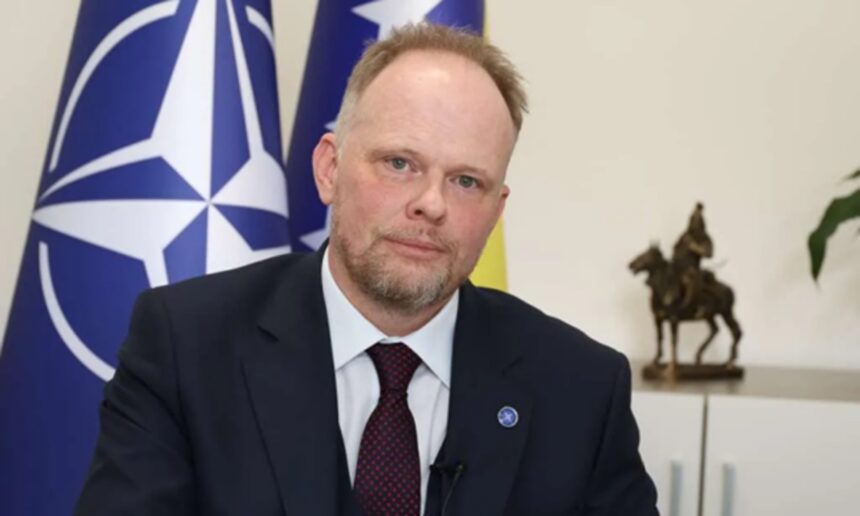
NATO Deputy Assistant Secretary General for Partnerships, Ambassador Kevin Hamilton, said during his visit to Belgrade that the alliance is committed to a partnership with Serbia and described the first joint military exercise with the Serbian Armed Forces as the beginning of a new chapter in relations between the two sides.
Hamilton told the Beta news agency that NATO wants a relationship with Serbia “that goes as far as Serbia wants” and that the alliance “asks nothing” from Belgrade.
“We feel that we are entering a new chapter in our relationship. NATO has approached Serbia in an effort to deepen our relationship, and I think the response so far has been warm and reciprocal. This is the tone and direction of the relationship that we would like to continue,” he said.
“I think we are in a good position. We constantly speak with Serbia about our hopes and expectations that Serbia will be a force for stability and send positive messages throughout the Western Balkans. Serbia is the largest and perhaps most influential country in this region of Europe, and that is why we rely on Serbia as a partner striving for security and stability together with NATO,” Hamilton added.
Asked about the anti-NATO narrative that exists among the Serbian public, Hamilton said the alliance cannot control what individuals in politics or the media say about NATO, but it can act in a way that demonstrates commitment to partnership with Serbia.
“We are certainly committed to a partnership and certainly hope for a reduction in anti-NATO rhetoric in Serbia and in this region, but ultimately we cannot control that, except by showing that we truly want a relationship with Serbia based on transparency, mutual respect, and trust,” Hamilton said after meeting Serbian officials in Belgrade.
Hamilton also stressed the importance of Serbia being “very transparent” with its neighbors regarding arms purchases and the modernization of its armed forces.
When asked about reports that Serbia is purchasing most of its weapons from China, Hamilton said NATO is “fully aware” that Serbia pursues a policy of military neutrality and a multi-vector foreign policy.
“I cannot comment on specific arms purchases except to say that it is important for Serbia to be very transparent with its neighbors, whether they are NATO members or not, regarding its intentions with arms acquisitions and how it is modernizing its armed forces and for what purpose,” he said.
“Today, this week and last week, we have the NATO–Serbia exercise at the Borovac training ground near Bujanovac, where NATO and Serbian forces are learning from one another in peace support operations. It is an opportunity for the Serbian Armed Forces to improve their capabilities for participation in peace support operations abroad under a UN or EU mandate,” he added.
Regarding Kosovo, Hamilton said NATO’s concern is to ensure that the KFOR mission, in line with its UN mandate, “is there to guarantee the security and well-being of all peoples and all communities in Kosovo.”