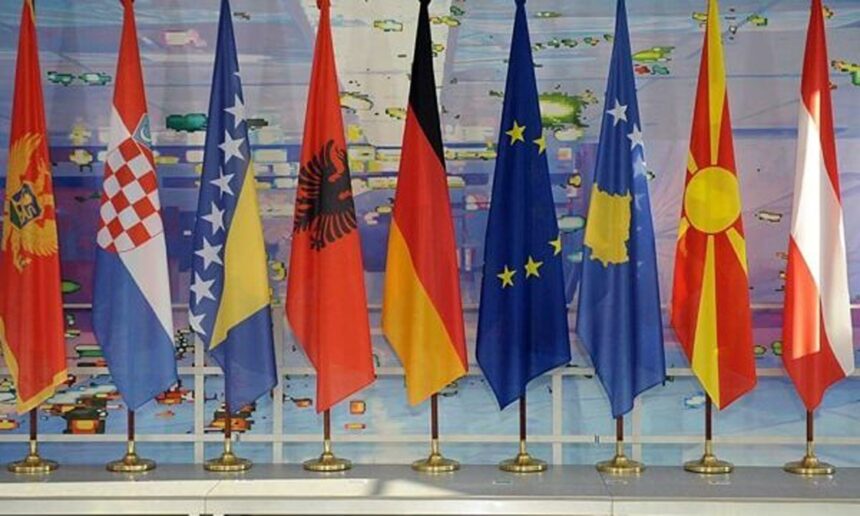
Five EU member states have called on the European Commission to reconsider how it integrates Western Balkan countries into the EU single market, framing the move as a way to keep interested countries away from Russian influence.
“To maintain enlargement momentum and advance European integration, strong and attractive incentives are needed,” Austria, the Czech Republic, Italy, Slovakia, and Slovenia wrote in a confidential document circulated among the EU’s 27 member states in Brussels last Friday, first reported by Rapporteur.
“A merit-based access if necessary, step by step to the European single market represents such an incentive,” the countries wrote. They are part of an informal group that politically supports the Western Balkans’ EU aspirations, according to Euractiv.
The countries described the proposed model as “systematic sectoral integration.” It would involve expanding participation in EU programs for countries such as Montenegro, Albania, North Macedonia, and Serbia, while gradually aligning them, chapter by chapter, with EU regulations.
“Gradual integration should be actively and systematically pursued as soon as a candidate demonstrates a high level of alignment with the EU acquis in the relevant sector,” the document states. It also adds that safeguards should be included in case a country granted partial market access backslides.
The proposal suggests expanding into new sectors such as transport, energy and electricity markets, the digital single market, competition policy, and critical raw materials. It also references the EU–UK youth mobility scheme as a model that could be adapted for Western Balkan countries.
However, the proposal falls short of ideas previously suggested by Albania’s Foreign Minister Igli Hasani in an interview with Euractiv, where he proposed that candidate countries should gain observer status in EU institutions while closing negotiation chapters.
Senior researcher Milan Nič of the German Council on Foreign Relations said the document does not represent a major shift, describing it as “a slightly more sophisticated version of earlier incremental integration ideas.”
The authors of the document urged EU Enlargement Commissioner Marta Kos to develop new ideas along these lines.
“This approach would expand and strengthen the single market, contributing to the EU’s geo-economic relevance and strategic autonomy, while bringing candidates closer and helping counter the influence of third countries,” the document concludes.